What Is an AI Appointment Setter? 2026 Guide + How It Works
Key Takeaways: An AI appointment setter is software that automatically responds to leads, answers common questions, and books appointments directly onto a business's calendar, without a human needing to pick up the phone or reply to a text. It works around the clock, follows up instantly, and turns missed opportunities into booked jobs. This is the umbrella term for a category of tools, and this guide is the starting point for understanding every specific piece of it, including cost, setup, and how it compares to other tools.
Picture this. It is 7:45pm on a Tuesday. A homeowner just searched "plumber near me" because their kitchen sink is leaking. They call the first result. Nobody picks up. So they call the second result. Same thing. By the time they reach the third plumber on the list, they book with whoever answers first.
That moment, the one where a business either answers or loses the job, is exactly why AI appointment setters exist.
I have spent three years helping local service businesses set up systems like this, and the pattern never changes. The businesses that lose the most bookings are rarely the ones with the worst service. They are the ones nobody was available to answer at 7:45pm on a Tuesday.
What Is an AI Appointment Setter and How Does It Work?
An AI appointment setter is a piece of software that talks to your leads and customers the way a human scheduler would, except it never sleeps, never gets busy, and never forgets to follow up.
When someone calls, texts, or fills out a form, the AI appointment setter engages them right away. It asks a few natural questions to understand what they need, checks your calendar for open slots, and books the appointment directly, no human involved unless something unusual comes up.
Most AI appointment setters work across multiple channels. That means the same system can handle a phone call, a text message, a web chat, and even WhatsApp, all while keeping the conversation feeling natural rather than robotic. Behind the scenes, it relies on natural language processing to understand what the person is actually asking, not just matching keywords.
How the Process Works, Step by Step
Step 1: A Lead Reaches Out
Someone calls, texts, fills out a web form, or messages your business through social media. They do not need to know an AI system exists on the other end.
Step 2: The AI Asks Qualifying Questions
The system responds within seconds and asks a few clarifying questions, such as what service they need or their preferred time. This is not a fixed script. It reads the lead's actual answer and adjusts the next question based on what they say.
Step 3: It Checks Calendar Availability in Real Time
The AI checks your calendar before offering a single time slot, avoiding double bookings and factoring in any buffer time your business needs between appointments.
Step 4: It Confirms the Appointment
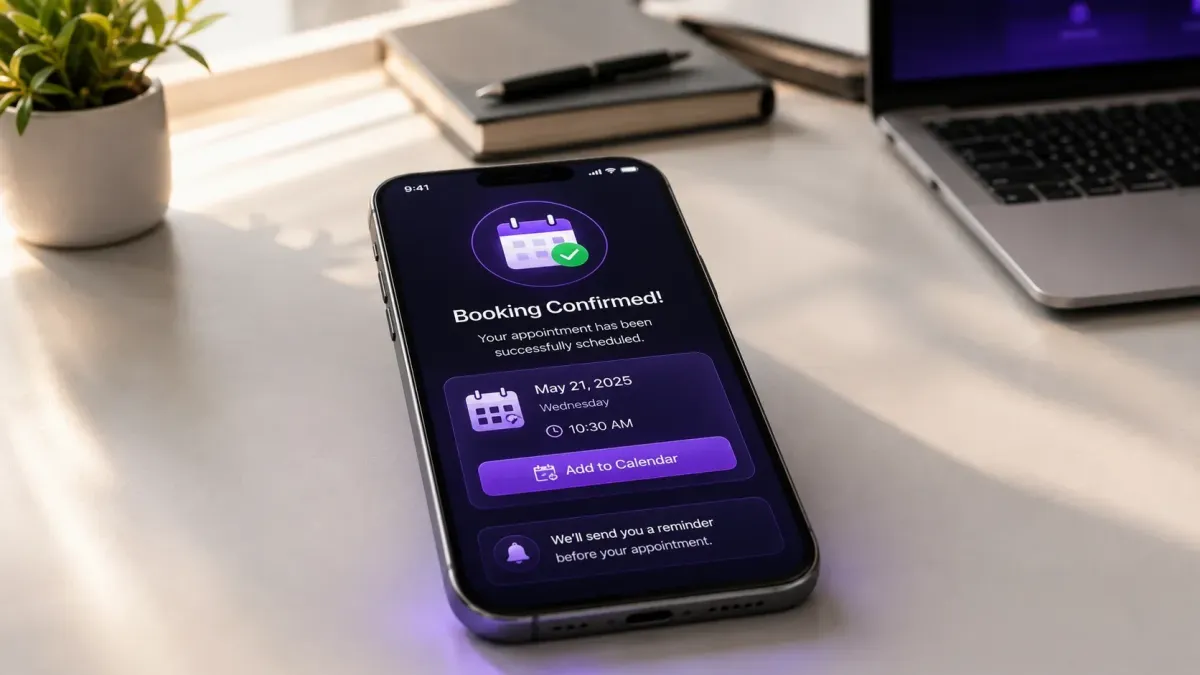
Once a time is agreed on, it confirms the appointment on the spot and sends a summary to the customer, then follows up with a reminder closer to the date.
If the conversation gets complicated or the person asks something the AI cannot confidently handle, it hands the conversation off to a real person with full context, so nothing gets lost.
AI Appointment Setter, Booking Agent, Lead Qualifier, or Chatbot? Here Is How the Terms Fit Together.
If you have been researching this topic, you have probably run into several overlapping phrases: AI appointment setter, AI booking agent, AI lead qualifier, AI appointment setting chatbot, automated appointment setting. These are not competing products. They describe different pieces of the same system, and understanding how they relate makes it much easier to know what you are actually evaluating.
AI appointment setter is the broadest, most common term for the category, and the one this article covers. It is also Viking Marketing's product name.
Automated appointment setting describes the underlying process, the sequence of steps from first message to confirmed booking, that every AI appointment setter runs on.
An AI booking agent is the specific tool that actively executes that process end to end, engaging a lead the moment they reach out rather than waiting for them to fill out a form.
An AI lead qualifier is the piece focused specifically on sorting and prioritizing incoming leads using the BANT framework, budget, authority, need, and timeline, before a booking conversation even starts.
An AI appointment setting chatbot refers to the conversational interface most customers actually interact with, typically through text or web chat.
AI appointment scheduling software is the broader software category all of these tools belong to.
A well-built AI appointment setter, like Viking Marketing's, combines all of these into one integrated system rather than five separate products. The rest of this guide covers the category as a whole. The linked articles above go deeper on each specific piece.
AI Appointment Setters vs Hiring a Human: Which Is Better?
This is the question almost every business owner asks once they hear about AI appointment setters, and the honest answer is that it depends on what problem you are trying to solve.
A human scheduler brings judgment, empathy, and the ability to handle truly unusual situations. But a human also needs to sleep, take breaks, and can only handle one conversation at a time. If a lead calls at 9pm or three people reach out at once, a human scheduler simply cannot be everywhere.
An AI appointment setter never has that limitation. The original InsideSales.com and MIT Lead Response Management study found that businesses responding within five minutes of a lead inquiry are 100 times more likely to make contact, and 21 times more likely to qualify that lead, than those who wait 30 minutes (reported by LeadResponse, since the original study is no longer hosted at a stable public URL). A person juggling multiple conversations at once cannot consistently hit that window. An AI appointment setter can hold hundreds of conversations simultaneously, respond within seconds regardless of the hour, and never forgets to follow up on a lead that went quiet. What it gives up in nuanced judgment, it makes up for in speed, consistency, and availability.
Most businesses that adopt AI appointment setters are not replacing their human team. They are covering the gaps, the after-hours calls, the moments when the front desk is swamped, the leads that would otherwise slip through completely unanswered. The AI handles the repetitive scheduling work. The humans stay focused on the conversations that actually need a human touch.
What Types of Businesses Benefit Most From AI Appointment Setters?
AI appointment setters tend to deliver the biggest impact for businesses where speed to respond directly affects whether a lead becomes a customer.
Home service businesses like HVAC, plumbing, electrical, and roofing companies benefit enormously, since these leads are often urgent and price shop across multiple providers within minutes.
Healthcare and dental practices use AI appointment setters to reduce no-shows and handle high call volumes without overwhelming front desk staff. Viking Marketing's dental configuration handles new patient intake automatically.
Insurance agencies use them to respond to quote requests before a competing agent calls back. See Viking Marketing's insurance-specific setup.
Real estate agents use them to instantly respond to property inquiries at any hour, when a prospect's interest is highest.
Salons, med spas, and fitness studios use them to fill last-minute cancellations and keep booking calendars full.
The common thread across every one of these industries is the same. Whoever responds first usually wins the business.
Can an AI Appointment Setter Reduce No-Shows?
Yes, and this is one of the most immediate benefits businesses notice. An AI appointment setter can automatically send confirmation messages right after booking, then follow up with a reminder text a day or two before the appointment. Many systems also allow the customer to confirm, cancel, or reschedule directly through the reminder text, which removes the friction that normally causes people to simply not show up.
Research from the National Institutes of Health on appointment reminder systems found that reminder calls alone reduced no-show rates from 23.1% down to 13.6% in a general health setting, a reduction of nearly half. Automated text reminders sent consistently, without relying on a staff member to remember, tend to produce similar or stronger results.
How Much Does an AI Appointment Setter Cost?
Across the market, AI appointment setters and AI receptionists typically run $29 to $500 per month for flat-subscription plans, with entry-level, voice-only tools like My AI Front Desk starting around $65 per month (reported by Call Setter AI, March 2026). Fully integrated systems built for local service businesses, like Viking Marketing's, typically sit at the upper end of that range, running $297 to $997 per month depending on channel coverage and configuration depth.
Compare that to a full-time front desk employee, whose median base wage is $37,230 per year nationally, or about $17.90 an hour, before payroll taxes or benefits (U.S. Bureau of Labor Statistics, Occupational Outlook Handbook: Receptionists, 2024 data). That figure covers business hours only, one conversation at a time. The AI covers every hour of every day simultaneously, for a fraction of the fully loaded staffing cost.
Want to see what your business is actually losing to slow response and missed after-hours leads right now? Viking Marketing's free missed call ROI calculator runs the numbers on your specific volume in under two minutes.
Compare Viking Marketing's plan options and pricing here.
Is an AI Appointment Setter TCPA Compliant?
Because AI appointment setters send automated text confirmations and reminders, this question deserves a direct answer.
The Telephone Consumer Protection Act governs how businesses can send automated text messages. TCPA litigation surged 95% in 2025, and the FCC's expanded one-to-one consent rules, originally scheduled to take effect in January 2025, have faced ongoing legal challenges over their exact status. Regardless of how that litigation settles, the direction is the same: legal exposure for outbound automated texting is rising, not falling.
The safest configuration is inbound-only: the AI responds and follows up exclusively within conversations the customer initiated. A confirmation or reminder sent to a customer who already messaged your business is fundamentally different, legally, from an automated text sent to a purchased lead list that never contacted you first.
Before choosing any AI appointment setter, ask the vendor directly whether the system is inbound-only or capable of outbound texting to lists. Always consult a qualified legal professional for guidance specific to your state. Viking Marketing's system operates inbound-only across every channel.
Key Benefits of Using an AI Appointment Setter
Around-the-clock availability. Leads get a response at 2am just as fast as at 2pm, closing the exact gap where most missed bookings happen.
Instant follow-up. Businesses responding within five minutes are 100 times more likely to make contact than those waiting 30 minutes. Response speed is one of the single biggest factors in whether a lead converts.
Fewer no-shows. NIH research found automated reminders reduce no-show rates from 23.1% to 13.6%, thanks to consistent confirmations and easy rescheduling.
Lower overhead. One system handles the volume that would otherwise require multiple front desk staff members, at a fraction of the annual cost.
Consistent lead qualification. Every conversation follows the same qualifying process, so your team only spends time on appointments that are actually a good fit.
Multichannel coverage. Phone, text, chat, and social messages all get handled through one system, so no channel becomes the one your team forgets to check.
How Viking Marketing's AI Appointment Setter Works
Viking Marketing's AI appointment setter was built specifically for local service businesses that cannot afford to lose a single lead to a missed call or a slow reply.
When a call comes in and goes unanswered, Viking's missed call text back feature automatically sends a text within seconds, keeping the conversation alive instead of letting the lead move on to a competitor. From there, the system qualifies the lead using AI lead qualifier logic, answers common questions, and books the appointment directly onto your calendar through a fully automated AI booking agent.
Every conversation, whether it started as a call, a text, or a web chat message, lands in Viking's all-in-one inbox, so your team always has full visibility without juggling multiple apps.
Viking Marketing holds a 5.0-star Google rating across 21 reviews, based in Chandler, AZ, with most clients live and booking within the first week of setup.
The result is a system that behaves like a full front desk team, minus the overhead, working the same way at midnight as it does at noon.
Want to see how this would work for your business specifically? Book a free 15-minute call and we will walk through it together.
Key Facts: AI Appointment Setter Statistics
Businesses responding within five minutes of a lead inquiry are 100 times more likely to make contact and 21 times more likely to qualify that lead than those waiting 30 minutes, based on InsideSales.com and MIT research.
Companies responding within one hour are seven times more likely to have a meaningful conversation with a decision-maker than those that respond later, according to Harvard Business Review research on online sales leads.
NIH research on appointment reminder systems found reminder calls reduced no-show rates from 23.1% to 13.6% in a general health setting, a reduction of nearly half.
TCPA litigation surged 95% in 2025. AI appointment setters that operate inbound-only carry significantly lower legal exposure than outbound automated texting tools.
AI appointment setters typically work across phone, SMS, web chat, and messaging platforms like WhatsApp through a single system.
Most AI appointment setters are designed to hand off to a human when a conversation requires judgment the AI is not built to handle.
Home service, healthcare, insurance, real estate, and beauty or wellness businesses see some of the strongest results from AI appointment setters, since speed to respond directly impacts booking rates in these industries.
Viking Marketing holds a 5.0-star Google rating across 21 reviews as of July 2026.
Frequently Asked Questions: AI Appointment Setters
What is an AI appointment setter and how does it work?
An AI appointment setter is software that automatically responds to leads, asks qualifying questions, checks calendar availability, and books appointments without a human needing to manage the conversation. It works across phone calls, text messages, and web chat, using natural language processing to understand what the person needs and confirm a booking in real time.
Is an AI appointment setter worth it for small businesses?
Yes, for most small businesses that rely on fast response times to win new customers. Since AI appointment setters can respond to leads instantly at any hour, small businesses gain the ability to compete with larger companies that have full front desk teams, without the added payroll cost of hiring additional staff.
Can an AI appointment setter work 24/7?
Yes. One of the core advantages of an AI appointment setter is that it never needs to sleep, take a break, or clock out. It can respond to a lead at 3am with the exact same speed and consistency as during regular business hours.
Can an AI appointment setter work with SMS and WhatsApp?
Most modern AI appointment setters, including Viking Marketing's system, are built to handle multiple channels including SMS, WhatsApp, phone calls, and web chat, all through a single unified system so no conversation gets missed regardless of how the customer chooses to reach out.
What happens when an AI appointment setter makes a mistake?
A well-built AI appointment setter is designed with fallback logic. If it encounters a question or situation it cannot confidently handle, it hands the conversation off to a human team member along with the full context of what was already discussed, so the customer never has to repeat themselves.
How much does an AI appointment setter cost?
Across the market, AI appointment setters and receptionists typically run $29 to $500 per month, with entry-level tools starting around $65 per month (Call Setter AI, March 2026). Fully integrated systems built for local service businesses, like Viking Marketing's, typically run $297 to $997 per month depending on configuration. That compares to a national median of $37,230 per year in base wages for a full-time front desk employee covering business hours only (U.S. Bureau of Labor Statistics, 2024 data), before payroll taxes or benefits are added in.
Is an AI appointment setter TCPA compliant?
It depends on how it is configured. Inbound-only systems, which respond and follow up exclusively within conversations the customer initiated, carry significantly lower TCPA risk than tools capable of outbound texting to purchased lists. Always confirm a vendor's configuration and consult a qualified legal professional for state-specific guidance.
What is the difference between an AI appointment setter and an AI booking agent?
An AI appointment setter is the broad category. An AI booking agent is the specific tool within that category that actively executes the booking conversation end to end. In practice, most AI appointment setters, including Viking Marketing's, include a booking agent as one of their core components.
How long does it take to set up an AI appointment setter?
With Viking Marketing, most local service businesses are live and booking appointments within the first week. If a vendor quotes six to eight weeks, you are buying a software implementation project, not a ready-to-use tool.
Stop Losing Jobs to Whoever Answers First
Every lead that reaches voicemail tonight is a booking on a competitor's calendar by tomorrow morning.
An AI appointment setter closes that gap without adding payroll. Viking Marketing's system responds in seconds across every channel, qualifies the lead, checks your calendar, and confirms the appointment, whether it is Tuesday at noon or 7:45pm on a Tuesday when the sink is leaking.
Book a free 15-minute call and be live within the week →
Not ready for a call yet? Run the numbers on your own missed calls first →
Sources and Citations
InsideSales.com and MIT, Lead Response Management Study, cited by LeadResponse: https://leadresponse.co/blog/speed-to-lead-statistics
Harvard Business Review, "The Short Life of Online Sales Leads": https://hbr.org/2011/03/the-short-life-of-online-sales-leads
National Institutes of Health, "Reducing Appointment No-Shows: Going from Theory to Practice": https://pmc.ncbi.nlm.nih.gov/articles/PMC3962267
ActiveProspect, "TCPA Text Messages: Rules and Regulations Guide for 2026": https://activeprospect.com/blog/tcpa-text-messages/
U.S. Bureau of Labor Statistics, Occupational Outlook Handbook, "Receptionists" (2024 data): https://www.bls.gov/ooh/office-and-administrative-support/receptionists.htm
Call Setter AI, "AI Appointment Setting Cost: $29 to $500/Mo (2026)": https://callsetter.ai/blog/ai-appointment-setting-cost
Viking Marketing: https://vikingmarketing.ai