AI handles the volume. A human handles the complexity. Here is an honest, specific breakdown of where each one actually wins, on speed, cost, and close rate.
Author: Charlie DeFelice, Founder of Viking Marketing
About the author: Charlie founded Viking Marketing in Chandler, AZ, and has spent years helping local service businesses figure out where AI qualification should end and a human closer should take over.
TL;DR: AI appointment setters and human appointment setters solve different parts of the same problem. AI wins on speed, volume, and cost per booked call, responding to every lead instantly regardless of the hour. A human wins on rapport, objection handling, and closing high stakes, high ticket conversations. Most businesses that get the best results use AI to qualify and book the volume, while a skilled human handles the sales ready calls that genuinely need a personal touch.
The debate over AI appointment setters versus human appointment setters shows up constantly in sales and agency communities. It usually gets framed as a competition, one replacing the other entirely. That framing misses what is actually happening on the ground. Businesses running both side by side are finding a specific division of labor that plays to what each one does best, not a full replacement of one by the other.
This comparison matters most for a specific kind of business: agencies, coaches, consultants, solar and home improvement sales teams, and any business where converting a raw lead into a booked appointment is a distinct, high value job in itself, separate from simply answering the phone.
Can an AI Appointment Setter Replace Your Current Staff?
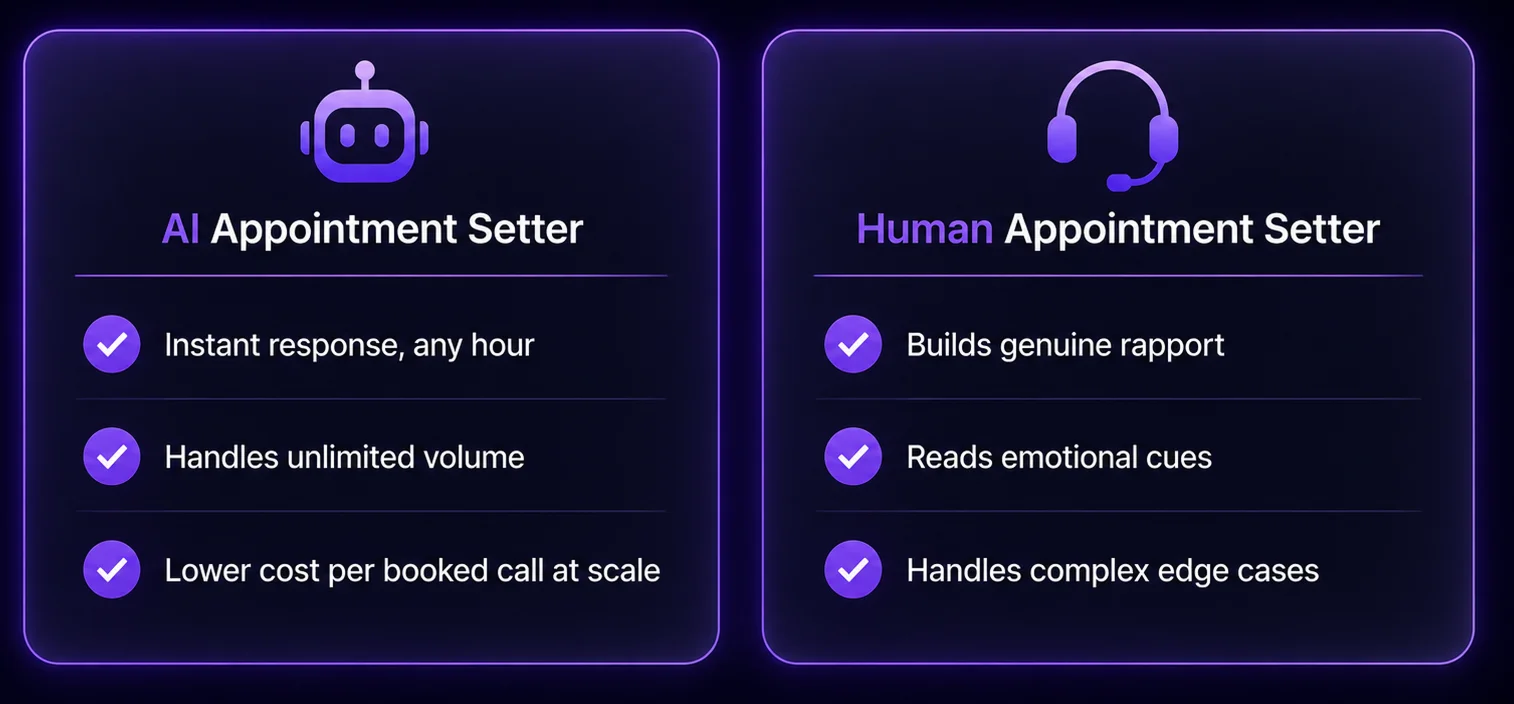
Not entirely, and for most businesses, not the way people initially picture it. An AI appointment setter can fully take over the repetitive front end of the process: first contact, lead qualification, calendar checking, and confirming routine bookings. What it does not replace is the judgment a skilled human setter or SDR brings to a genuinely complex or high stakes conversation, reading hesitation in someone's voice, adapting an offer on the fly, or building the kind of trust that moves a hesitant, high ticket prospect toward showing up.
The businesses seeing the strongest results are not choosing one over the other. They are restructuring the role. AI takes over the volume work that used to consume a human setter's entire day, cold outreach follow up, initial qualification, basic scheduling, and the human setter's time gets reallocated entirely to the conversations that actually determine whether a deal closes.
What's the Real Cost of Hiring Human Appointment Setters vs Using AI?
The honest cost comparison depends heavily on volume. But the underlying pattern holds fairly consistently across industries.
A human appointment setter, whether hired directly or contracted through an agency, represents a fixed cost. As of August 2026, U.S. appointment setters average roughly $24 an hour, or about $50,000 a year loaded with payroll taxes and benefits, according to ZipRecruiter's live salary data. That cost holds regardless of how many leads actually convert into booked, sales ready appointments in a given week. It does not flex down during a slow week, and it does not scale up cleanly during a sudden spike in lead volume without hiring additional staff.
AI appointment setters price differently. Most run on usage-based pricing or a flat monthly rate. Because AI does not require breaks, overtime, or benefits, the cost per booked call tends to drop as volume increases. That is the opposite pattern from human staffing, where cost per booked call often rises once a single setter's daily capacity is maxed out.
The clearest way to think about it: a human setter's cost is tied to their time. An AI setter's cost is tied to usage. For businesses with unpredictable or rapidly scaling lead volume, that difference compounds quickly.
Do AI Appointment Setters Actually Book More Meetings?
For raw volume, yes, often significantly more than a human setter working the same lead pool, simply because AI never has a slow day, never gets pulled into an unrelated task, and never lets a lead sit in a queue while waiting to get to the next call.
Harvard Business Review research on online sales leads found that the odds of successfully qualifying a lead drop sharply the longer a business takes to respond. AI's instant response time directly targets that exact gap. A cold lead that comes in at 9pm on a Friday, historically the kind of lead a human setter would not touch until Monday, gets engaged immediately by AI, while the intent that drove them to reach out in the first place is still fresh.
Whether those additional booked meetings convert into closed deals at the same rate a human qualified pipeline would is a separate question, and the honest answer is that it depends on how the AI is qualifying leads and what happens once a meeting is booked. More booked meetings is not automatically the same as more revenue if the qualification bar is too loose.
Is an AI Appointment Setter Better Than a Human Phone Caller?
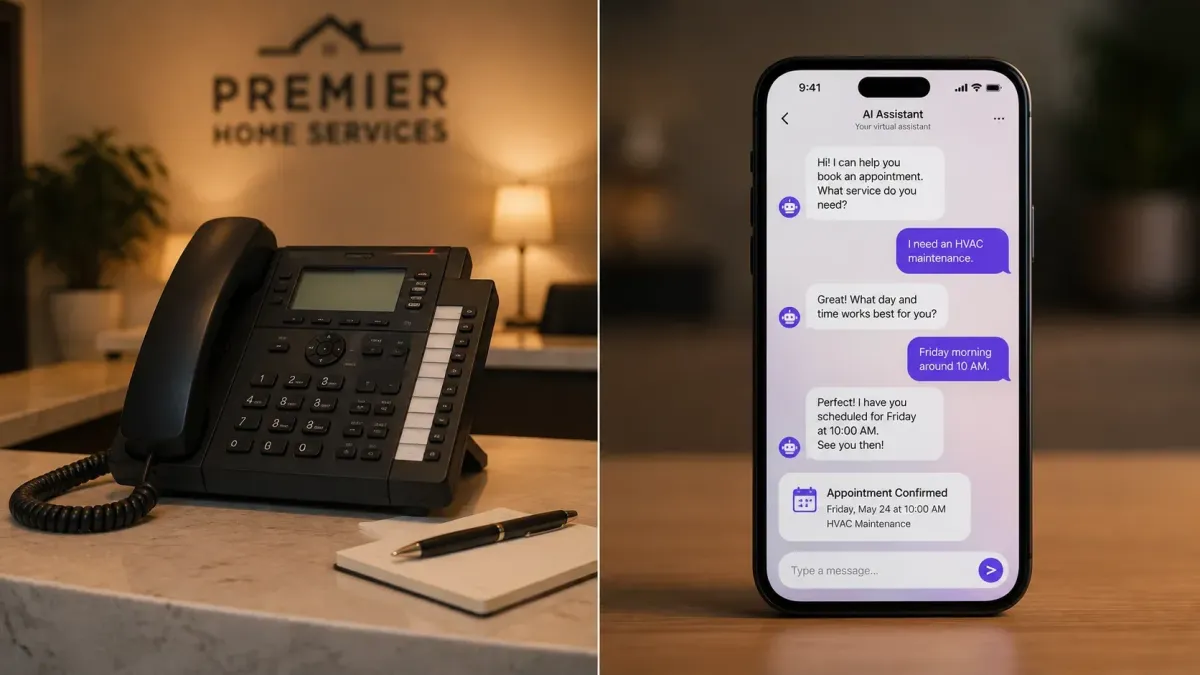
It depends on what "better" is measuring, and on which channel each one is actually working. Most AI appointment setters, Viking's included, qualify and book leads through text, web chat, and other messaging channels rather than live voice calls. For sheer speed, scale, and cost efficiency, that text-based approach still outperforms a human phone caller on the front lines of lead response. It engages every single inbound lead within seconds, day or night, instead of working through a call queue one conversation at a time.
For a genuinely complex, high stakes cold call, where the entire job is building rapport with a skeptical stranger in real time on the phone, an experienced human caller still holds the edge. Reading tone, adapting an offer mid-call, and handling an unscripted objection are voice skills a text-based AI system is not built to replicate.
The businesses getting the most value from AI appointment setters use them for structured, repeatable conversations that do not require a live voice: initial qualification over text, appointment confirmations, and reminder messages. They keep a human on the phone for the calls that need real-time, spoken persuasion.
Should You Use an AI Appointment Setter or Hire More Sales Staff?
This is often the real decision businesses are weighing, not AI versus a single existing setter, but AI versus the cost of hiring additional human capacity to handle growing lead volume.
Hiring another human setter adds fixed payroll cost and takes time to onboard and ramp up to full productivity. Adding an AI appointment setter typically deploys faster and scales instantly with lead volume, without the ramp up period a new hire requires. For businesses where lead volume is growing quickly or fluctuates seasonally, AI often provides more flexible capacity than hiring ahead of demand.
That said, if the actual bottleneck in your business is closing skill, not lead volume or response speed, adding AI capacity will not solve the underlying problem. In that case, investing in a stronger human closer matters more than adding faster qualification at the top of the funnel.

Can an AI Appointment Setter Help You Sell More Effectively?
Indirectly, yes, mainly by freeing up your best human sellers to spend their time exclusively on the conversations most likely to close. When AI handles first touch, qualification, and routine booking on effectively every lead, your strongest closers stop spending hours on repetitive outreach and scheduling logistics, and instead spend that time exclusively on sales ready, warm conversations.
The businesses that see the biggest lift are the ones that treat AI as a filter that protects their best salespeople's time, not as a replacement for the sales conversation itself.
The Hybrid Model Most Businesses Actually Use
Rather than choosing one over the other, most agencies, coaches, and sales driven businesses using both together have converged on a similar pattern. AI handles first touch and qualification on effectively every lead that comes in. It responds instantly, asks the standard qualifying questions, and confirms initial bookings or reminders. Humans step in for the calls that matter most: the sales ready conversations, the hesitant high value prospects, and any edge case that needs real judgment or relationship building.
This division plays to what each side does best. AI captures every lead and qualifies at volume, something no team of human setters could realistically match around the clock. Humans then focus their time exclusively on the conversations most likely to convert.
AI vs Human Appointment Setter at a Glance
| Factor |
AI Appointment Setter |
Human Appointment Setter |
| Primary channel |
Text, web chat, SMS, DM |
Phone, in person, text |
| Response time |
Instant, 24/7 |
Limited to working hours |
| Cost structure |
Usage-based, scales with volume |
Fixed salary or hourly rate |
| Best fit |
High-volume qualification, routine booking |
Complex, high-stakes, high-ticket conversations |
| Deployment time |
Days |
Weeks, including hiring and ramp-up |
Key Benefits of Combining AI and Human Appointment Setters
Every lead gets an instant response, regardless of when they reach out
Human setters spend their time exclusively on sales ready, high value conversations
Consistent qualification applied to 100 percent of incoming leads
Lower cost per booked call compared to a human only process at scale
Reduced risk of losing a cold lead simply because nobody was available to respond in time
How Viking Marketing Approaches This
Viking Marketing's AI appointment setter is built to handle exactly the first touch and qualification role described above. It responds to every lead instantly over text, web chat, and messaging channels, and books straightforward appointments directly, so your team's time goes toward the conversations that actually need a human on the phone.
When a call goes unanswered, Viking's missed call text back feature responds within seconds, and every conversation, qualified and ready or flagged for a human follow up, lands in Viking's all-in-one inbox so nothing slips through. For a broader look at how AI compares to a human front desk role specifically, rather than the sales focused setting role covered here, see our guide on AI receptionist vs human receptionist.
The goal is not choosing AI or a human. It is making sure every lead gets a fast, consistent first response, and every conversation that matters most gets a real person's full attention.
Want to see how this balance would work for your specific sales process? Book a free 15 minute call and we will walk through it honestly.
Key Facts
Harvard Business Review research on online sales leads found that the odds of successfully qualifying a lead drop sharply the longer a business takes to respond.
AI appointment setters can hold effectively unlimited simultaneous conversations, while a human setter handles one conversation at a time.
Most agencies and sales driven businesses using both AI and human setters together use AI for first touch and qualification, reserving human setters for high value or complex conversations.
Cost per booked call for a human setter is tied to their time and tends to rise once daily capacity is maxed out, while AI cost is tied to usage and tends to scale more predictably.
Human appointment setters tend to retain an advantage in close rate on high ticket, emotionally significant purchases where rapport and objection handling matter most.
More booked meetings from AI does not automatically mean more closed revenue, since the qualification standard applied still determines lead quality.
Frequently Asked Questions
Can an AI appointment setter replace your current staff?
Not entirely. AI can fully take over the repetitive front end of the process, first contact, qualification, and routine booking, but it does not replace the judgment a skilled human setter brings to a genuinely complex or high stakes conversation. Most businesses restructure the role rather than eliminate it, letting AI handle volume while humans focus on sales ready conversations.
What is the real cost of hiring human appointment setters versus using AI?
A human setter's cost is tied to their time, typically a fixed salary or hourly rate regardless of conversion outcomes. An AI setter's cost is typically tied to usage, which tends to scale more predictably and often results in a lower cost per booked call as volume increases.
Do AI appointment setters actually book more meetings?
For raw volume, yes, often significantly more than a human setter working the same lead pool, since AI responds instantly at any hour without the delays a human schedule naturally introduces. Whether those additional meetings convert into closed deals at the same rate depends on how tightly the AI qualifies leads before booking.
Is an AI appointment setter better than a human phone caller?
It depends on the channel. Most AI appointment setters qualify and book leads over text and chat rather than live voice calls, and for speed, scale, and cost efficiency, that text-based approach outperforms a human phone caller on the front lines of lead response. For a genuinely complex, unscripted cold call that depends on building rapport with a skeptical stranger in real time, an experienced human caller still holds the edge.
Should you use an AI appointment setter or hire more sales staff?
It depends on where your actual bottleneck is. If lead volume and response speed are the constraint, AI typically provides more flexible, faster deployed capacity than hiring ahead of demand. If the real bottleneck is closing skill rather than volume, investing in a stronger human closer matters more than adding AI capacity at the top of the funnel.
Sources and Citations
Keep Reading
See how the Viking AI appointment setter answers and books your leads, compare pricing, or book a free strategy call.


 AI Appointment Setter