What Is an AI Appointment Setting Chatbot and How Does It Work?
The plain-language answer for local service businesses who are tired of losing leads while the phone goes unanswered.
A prospect finds your salon on Instagram at 9:47 on a Thursday night. They send a DM asking about availability next week. Your team is asleep. The lead sits there until someone checks the account Friday morning, by which point the prospect booked with the salon two blocks away that responded within a minute.
That is not a marketing problem. That is a response speed problem. And it is exactly the gap an AI appointment setting chatbot fills.
If you have been trying to figure out what an AI appointment setting chatbot actually is, how it differs from the basic chatbots you have seen on healthcare websites and bank support pages, and whether one could work for your business, this guide covers all of it.
TL;DR
An AI appointment setting chatbot is not a FAQ widget. It is software that picks up an incoming message on any channel, holds a real qualifying conversation, collects the information your team would normally ask for, and books a confirmed appointment directly onto your calendar without anyone on your team lifting a finger. If the chatbot cannot do that end to end, it is not a booking tool.
What Is an AI Appointment Setting Chatbot? The Direct Definition
An AI appointment setting chatbot is software that handles the entire process from first contact to confirmed booking automatically, in real time, across every channel where your leads reach out.
It reads what a prospect writes, understands what they are asking even when the phrasing is casual or incomplete, asks your business-specific qualifying questions, and books the appointment directly onto your calendar. The whole sequence happens without a human stepping in between the first message and the calendar confirmation.
That definition matters because a lot of tools describe themselves as AI appointment setting chatbots while doing something far more limited.
How It Differs From a Basic FAQ Chatbot
A basic FAQ chatbot is a decision tree. Someone types "what are your hours?" and it returns a canned response. Someone asks anything outside its scripted paths and it either gets confused or says "let me transfer you to a human." You have probably seen this on a cable company's support page or a hospital's website. It answers questions. It does not schedule anything or qualify anyone.
The simplest way to understand the difference: a FAQ bot is a vending machine. You push a button, it gives you what is already in the slot. An AI appointment setting chatbot is a front desk assistant. It listens, asks the right follow-up questions, and takes action.
If the tool you are looking at cannot book an appointment without a human stepping in, it is a FAQ bot with a more expensive label.
What Makes It "AI"? The Technology Behind the Conversation
This is the part most vendors skip over, and it matters more than you might think, because the word AI gets put on tools that do not actually use it.
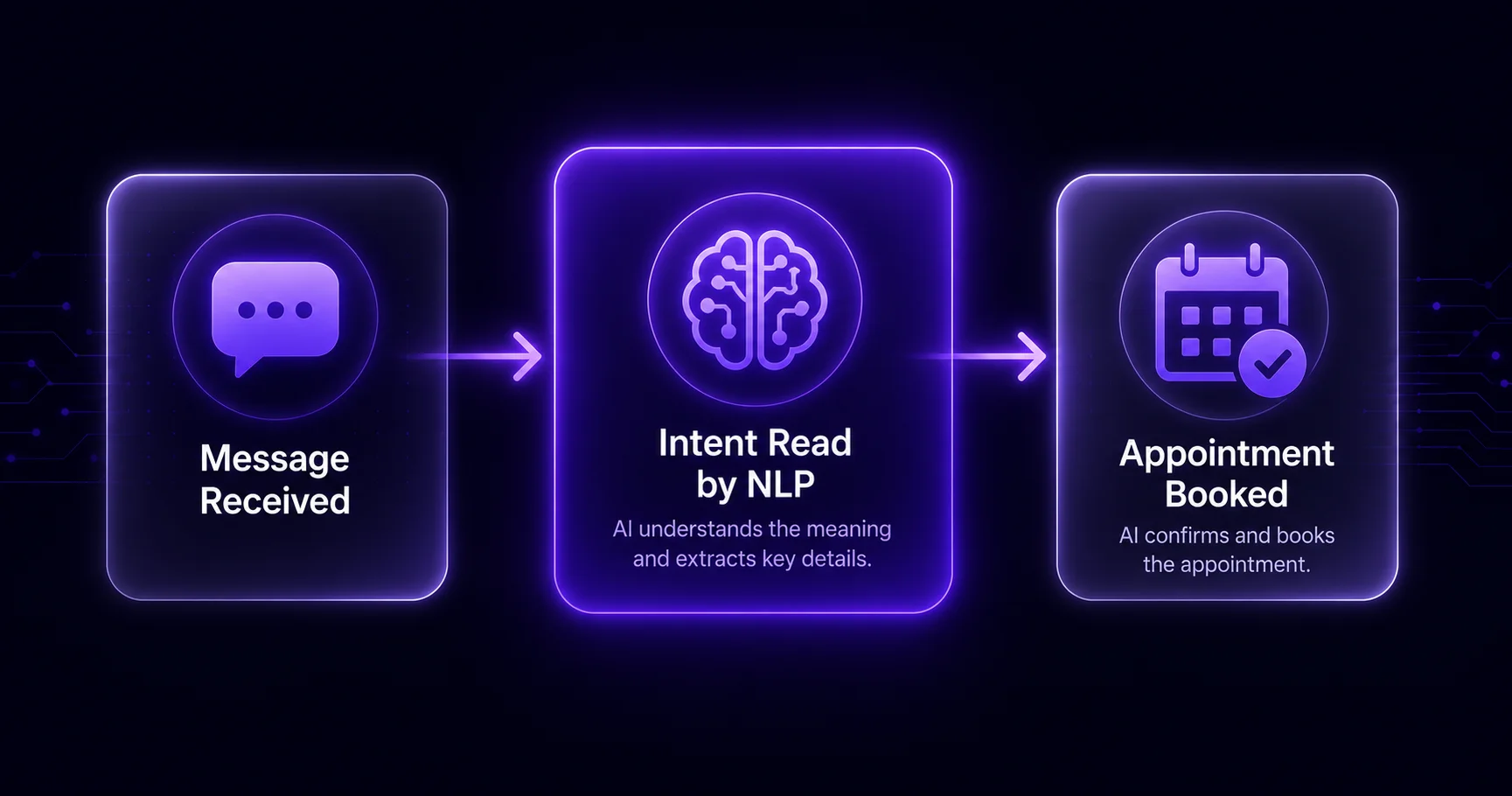
A genuine AI appointment setting chatbot uses natural language processing, or NLP, to understand the intent behind what someone types. Instead of scanning a message for a keyword like "book" and triggering a pre-written reply, it reads the full message and interprets meaning the way a person would.
When a homeowner messages your HVAC company and says "our AC has been struggling all week," an NLP-powered chatbot understands that as a service request, even though the message contains no scheduling language. It responds with a qualifying question, keeps the conversation moving toward a booked slot, and adjusts its next question based on whatever the prospect says next.
That adaptive behavior is what separates a conversational AI chatbot from a scripted bot. A scripted bot follows a fixed path regardless of what the prospect says. The AI reads intent, adjusts, and responds to what is actually in front of it.
The AI is also trained on your business specifically. It learns your service areas, your availability, your pricing ranges, and the qualifying questions your team would normally ask. That training is what makes the conversation feel specific to your business rather than generic. A dental practice gets different qualifying questions than an insurance agency or a home services contractor, because those businesses need different information before a confirmed appointment has any real value.
What Channels Does an AI Appointment Setting Chatbot Cover?
This is where local service businesses often get surprised. The leads you are missing are not all coming through your website. They arrive through every channel where someone happens to find you.
An AI appointment setting chatbot that earns its price should respond across all five of the following:
Website chat for visitors who find you through search or a paid ad
SMS text for people who text a number from your Google Business profile or a click-to-text ad
Facebook Messenger for leads who reach out through your Facebook page
Instagram DM for prospects who find you through posts, reels, or your profile link
Google Business messages for the message button that appears directly on your Maps listing
Every one of those channels feeds into a single place. Viking Marketing's all-in-one inbox shows every inbound conversation from every channel so your team never has to toggle between five different apps to see what came in overnight.
If the chatbot only covers one or two of these, it is leaving real money on the table. Your prospects do not choose which channel to contact you on based on what is convenient for your software. They contact you wherever they found you, often after hours on a weeknight.
How Does an AI Appointment Setting Chatbot Work? Step by Step
Here is the process from the moment a lead reaches out to the moment the appointment appears on your calendar.
Step 1: The Prospect Sends an Inbound Message
A lead reaches out through any connected channel, whether that is your website chat, an Instagram DM, an SMS text, a Facebook Messenger message, or a Google Business message. The chatbot picks it up within seconds, day or night.
Step 2: The Chatbot Reads Intent and Qualifies the Lead
The AI reads what the prospect wrote, identifies what they need, and starts the qualifying conversation. It asks the questions your team would normally ask, service type, location, timeline, and whatever details are specific to your industry. Each question is shaped by what the prospect just said, not a fixed script.
Step 3: The Appointment Is Booked Directly to Your Calendar
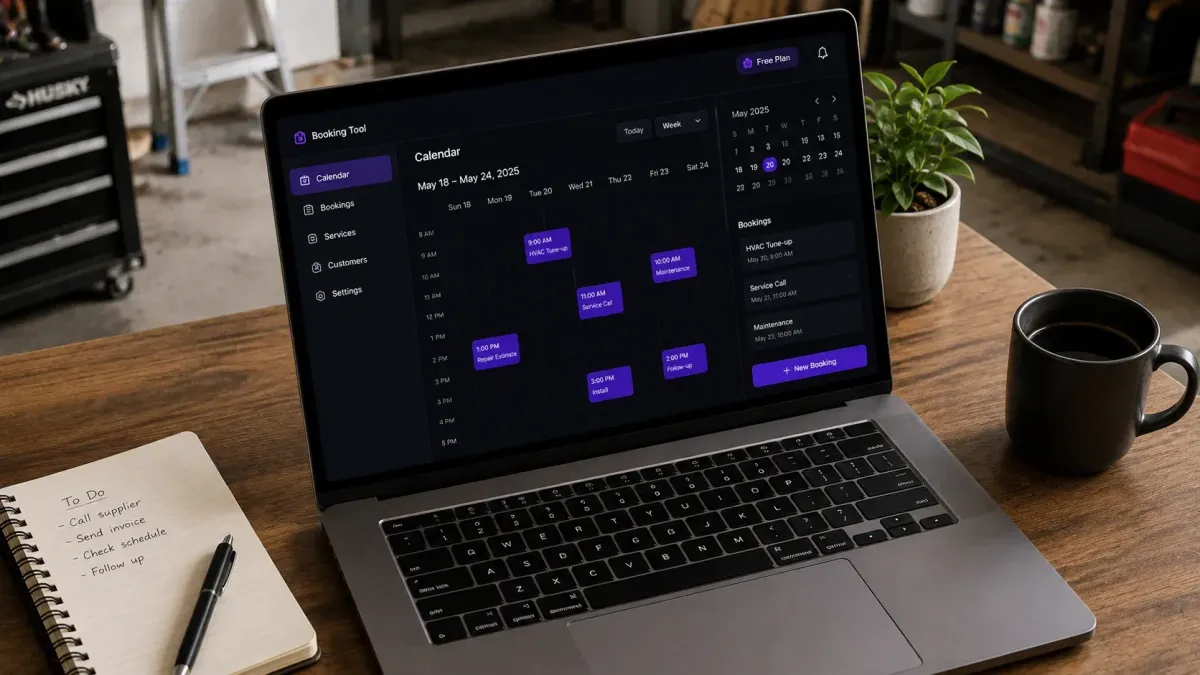
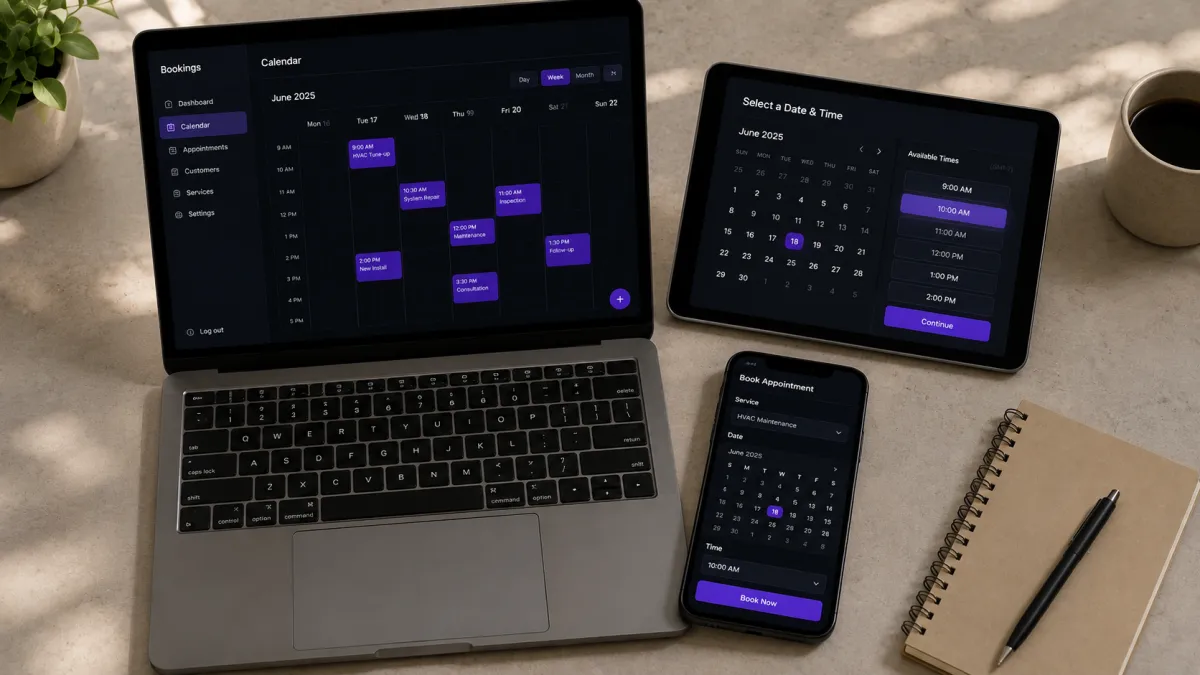
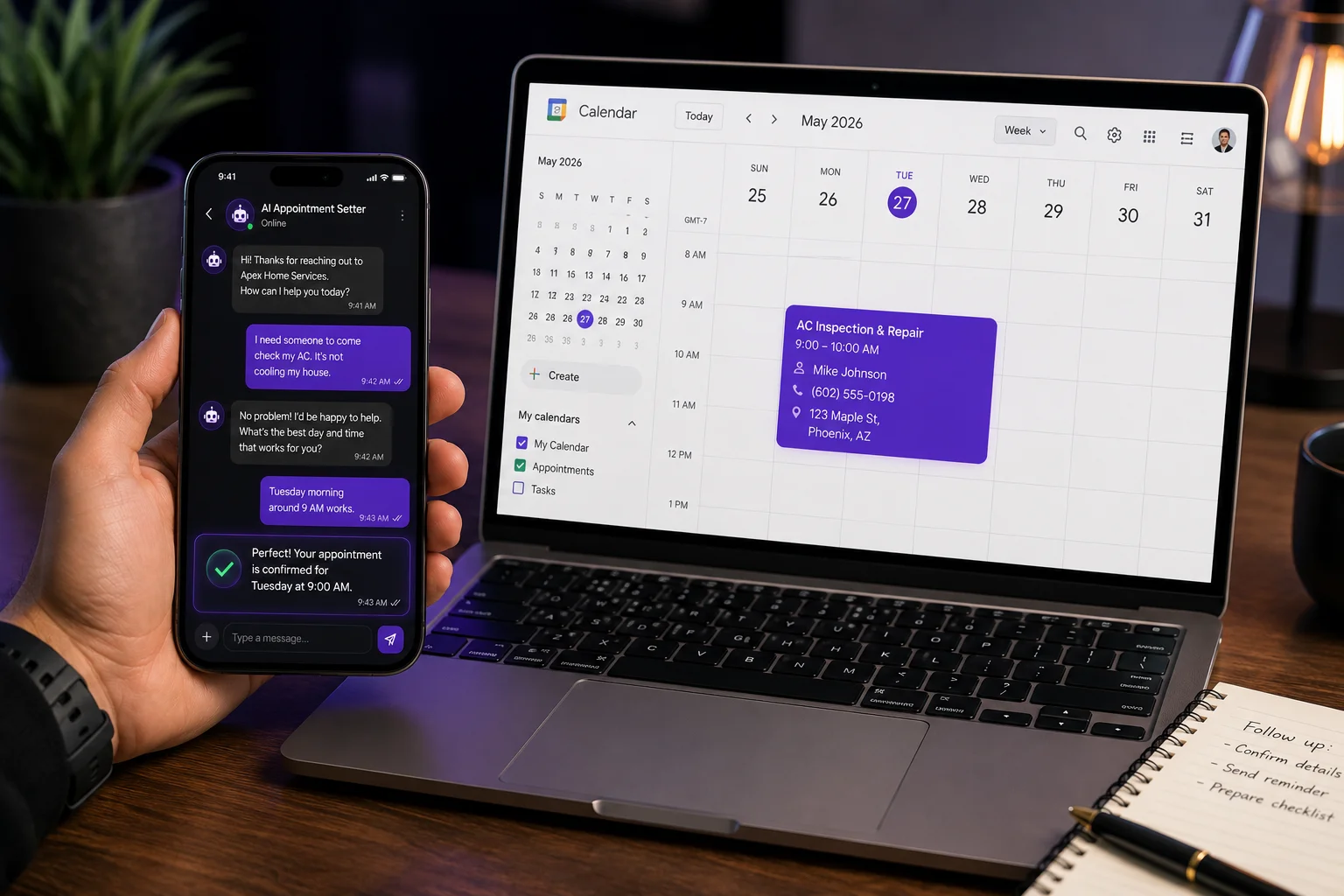
Once the lead is qualified, the chatbot offers available times based on your real schedule. The prospect picks one and receives a booking confirmation automatically. The appointment appears on your calendar with the lead's contact information and qualifying answers already attached. Your team gets a notification. No manual entry. No callback required.
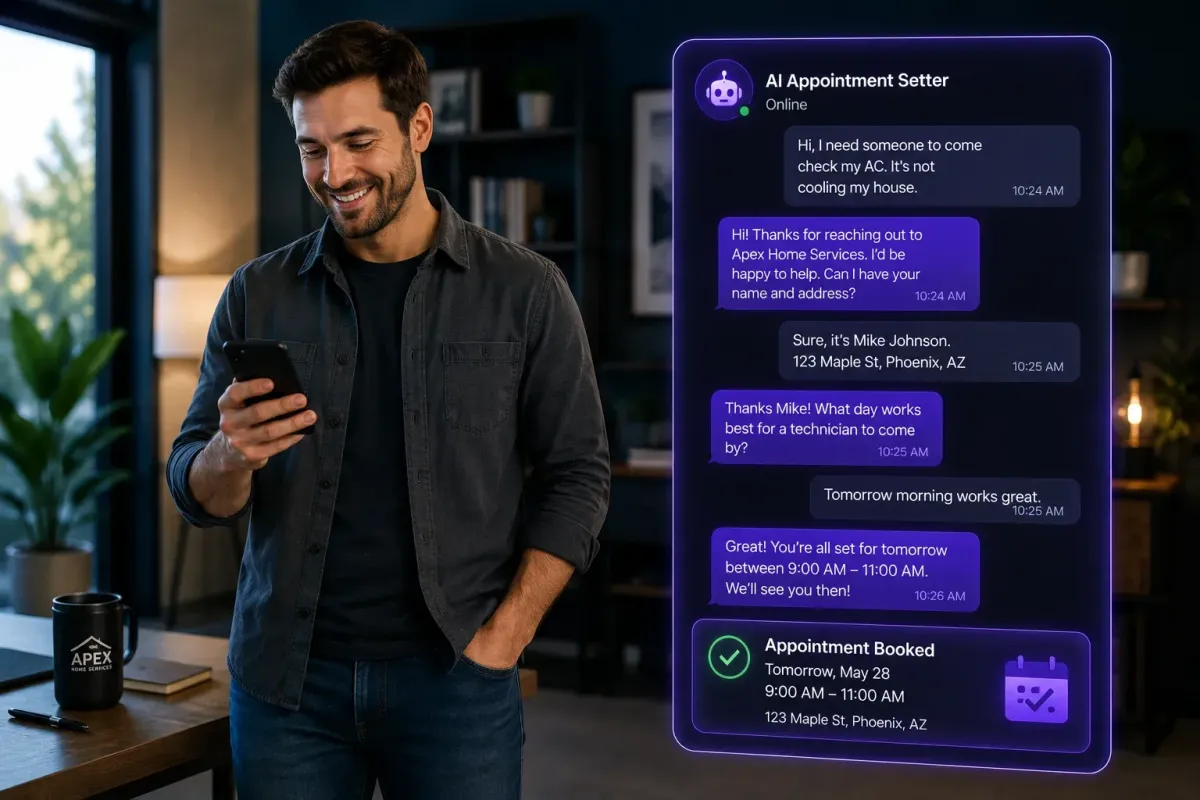
Here is what that looks like in a real HVAC conversation, at 9:52 PM on a Tuesday via Facebook Messenger:
Prospect: "Hi, are you guys available next week? Our AC stopped working."
AI: "Sorry to hear that. We would love to get that fixed. Is this a home or commercial system, and roughly what year was it installed?"
Prospect: "Home. I think it's about 8 years old."
AI: "Got it. And is this a repair call or has there been a full system failure?"
Prospect: "It just stopped cooling. The fan runs but no cold air."
AI: "That's helpful. We have availability Tuesday and Wednesday next week. Would morning or afternoon work better for you?"
Prospect: "Morning Tuesday."
AI: "Perfect. I've got you down for Tuesday between 8 AM and 11 AM. You'll receive a confirmation text with the technician's name shortly. Is 555-0172 the best number to reach you?"
That conversation ran under two minutes. The lead is qualified. The slot is on the calendar. The on-call technician gets a notification. No one from your team was awake.
The key distinction between this and a scripted FAQ widget is that the chatbot is adapting to what the prospect says at each step. It is not following a rigid script. It reads the intent, adjusts the question, and keeps the conversation moving toward a booked appointment.
[Want to see how Viking Marketing sets this up for your business type? Book a 15-minute call and we will walk you through the exact conversation flow for your industry. →]
How Does Calendar Integration Actually Work?
This is the question most business owners ask right after "does it actually work?" and it is the part vendors explain least.
When the qualifying conversation is complete, the AI appointment setting chatbot checks your calendar in real time. It offers the prospect available slots based on your actual schedule, not a generic open window. When the prospect confirms a time, the booking is created automatically. It appears on your calendar the same way a manually entered appointment would, with the lead's name, phone number, email, and the qualifying details collected during the conversation.
Your team receives a notification. The prospect receives a confirmation text. That is the complete handoff.
There is no separate dashboard your team needs to monitor. There is no copy-paste step where someone transfers information from a chatbot log into your scheduling software. The appointment exists on your calendar from the moment the prospect confirms it.
What an AI Appointment Setting Chatbot Does NOT Do
This is the section most product pages skip because honest answers about limitations are rarer than hype. Here is what a well-built AI appointment setting chatbot genuinely cannot and should not do.
It does not replace your licensed agent, your front desk person, or the human conversation that closes a client. It handles first contact and qualification only. Once the appointment is booked, a real person from your team takes over completely. The chatbot's job ends at the calendar confirmation.
It does not handle complex objections, negotiate pricing, explain detailed medical or legal information, or de-escalate an upset customer. These are human conversations. Any chatbot that tries to fake its way through them creates more liability than value.
A well-built AI appointment setting chatbot knows its limits. When a question falls outside its training, it says so plainly and either takes a message for your team or offers a callback rather than guessing. The worst chatbots in this space try to handle everything. The best ones know exactly where to stop.
What Separates a Real Booking Chatbot From a FAQ Widget
| Feature |
FAQ Widget |
AI Appointment Setting Chatbot |
| Answers predefined questions |
✓ Yes
|
✓ Yes, and more
|
| Holds a two-way qualifying conversation |
✕ No
|
✓ Yes
|
| Asks business-specific qualifying questions |
✕ No
|
✓ Yes
|
| Books directly to your calendar |
✕ No
|
✓ Yes
|
| Works across SMS, DM, chat, and Google Messages |
− Rarely
|
✓ Yes
|
| Adapts to what the lead says |
✕ No
|
✓ Yes
|
| Flags complex conversations for human follow-up |
✕ No
|
✓ Yes
|
| Operates 24 hours a day without a human |
Canned replies only
|
✓ Yes
|
If the tool you are evaluating cannot do the bottom four rows of that table, you are looking at a FAQ widget with a more expensive name.
How to Choose an AI Appointment Setting Chatbot for Your Business
Local service businesses in 2026 have more chatbot options than ever. Most are not built for appointment setting. Here is what actually separates the right tool from the wrong one.
1. Response Time
An AI appointment setting chatbot that takes minutes to reply defeats the purpose. Research from InsideSales.com and MIT found that businesses responding within five minutes are 21 times more likely to qualify a lead than those that wait 30 minutes. Your prospect is messaging your competitors at the same time. The chatbot needs to reply in seconds, not when someone on your team opens a dashboard.
2. Channel Coverage
Confirm the tool covers SMS, website chat, Facebook Messenger, Instagram DM, and Google Business messages as a minimum. Ask vendors specifically which channels are live on day one and which require additional setup or extra fees. If a channel is still in beta, it is not covered for your business.
3. Business-Specific Qualifying Logic
A dental chatbot should ask different questions than a gym chatbot. An insurance chatbot needs to understand lines of business. If the tool comes with a generic script and no way to customize it around your service type, your leads will notice the conversation feels off, and your team will receive bookings without the information they actually need.
4. Direct Calendar Integration
The appointment needs to land on your calendar automatically, confirmed, with the lead's information attached. Not in an email your team manually enters. Not in a spreadsheet you check at end of day. On the calendar, immediately, without a manual handoff step between the chatbot and your scheduling system.
5. TCPA Compliance Posture
TCPA litigation surged 95% in 2025, according to ActiveProspect's 2026 TCPA compliance guide. Any chatbot using automated text messaging carries legal exposure if it operates incorrectly. The safest AI appointment setting chatbots operate inbound-only, meaning they respond only after a prospect contacts you first. Ask any vendor directly whether their system sends the first text or only responds to inbound contacts. The answer tells you more about your TCPA exposure than any compliance badge on their website. Always consult a qualified legal professional for guidance specific to your state.
6. Setup Timeline
If a vendor quotes six to eight weeks, you are buying a software implementation project, not a business tool. A properly built AI appointment setting chatbot should be live and booking appointments within days of signing up. Every week of delay is a week of after-hours leads going unanswered.
What Changes When Local Service Businesses Add an AI Appointment Setting Chatbot
Across Viking Marketing's client base in HVAC, dental, insurance, and home services, the same three shifts show up consistently within the first 30 days.
After-hours lead capture increases sharply. Before adding an AI appointment setting chatbot, most local service businesses lose a significant portion of their after-hours inquiries to voicemail or unanswered DMs. HubSpot lead response research cited by Greetnow found that 52% of all service inquiries arrive outside standard business hours. If you want to see exactly how many leads and how much revenue that represents for your business specifically, Viking Marketing's free missed call ROI calculator runs the numbers for you in under a minute. Once the chatbot is live, those after-hours contacts receive a response within seconds and the appointment lands on the calendar before the team starts the next morning.
Front desk time shifts from callbacks to booked clients. In service businesses with a front desk team, the first hour of every workday typically involves returning messages from the night before. After going live with an AI appointment setting chatbot, that backlog largely disappears because after-hours contacts were handled in real time. The team uses that hour on confirmed appointments instead.
Conversion rate improves without changing lead volume. The lead volume stays the same. What changes is how many of those leads turn into booked appointments. According to Tidio chatbot research, 62% of consumers prefer a chatbot response when they need a quick answer rather than waiting for a human to be available. The preference is not for automation over people. It is for speed, and an AI appointment setting chatbot delivers that consistently.
[For a closer look at the specific results local service businesses see after adding one, read: AI Appointment Setter Benefits Most Home Service Owners Learn Too Late →]
Why Viking Marketing Stands Out for Local Service Businesses
Viking Marketing built its AI appointment setting chatbot specifically for local service businesses competing on response speed. The system operates across all five inbound channels from a single dashboard: SMS, website chat, Instagram DM, Facebook Messenger, and Google Business messages. Every conversation is inbound-triggered, meaning the chatbot only responds after a prospect contacts you first. That architecture keeps you on the safest side of TCPA compliance because the prospect initiated contact before the AI sent a single word.
The qualifying logic is built around your business type, not a generic sales script. A gym owner configures different questions than an HVAC contractor. An insurance agency configures line-of-business qualifying for auto, home, and commercial lines. The chatbot adapts to what your leads actually ask rather than following a script written for a different industry.
Setup runs in days. Most clients are live and booking appointments within the first week. The system connects directly to your calendar so confirmed bookings appear without a manual step between the chatbot and your team.
Viking Marketing holds a 5.0-star Google rating across 21 reviews and is based in Chandler, AZ. The platform was built for the local service market, not adapted from an enterprise tool looking for a small-business version.
Pricing starts at $297 per month for the Starter plan, $497 per month for Growth, and $997 per month for Pro, which covers full multi-source lead integration and dedicated onboarding. Compare that to a full-time receptionist at $37,000 or more per year who still cannot answer an Instagram DM at 11 PM on a Saturday.
[See which plan matches your business size and lead volume: View Viking Marketing pricing →]
If you run an insurance agency, we built the qualifying logic specifically around your lines of business. See how it works: AI Appointment Setter for Insurance Agencies →
[The leads are already coming in. The question is whether your business answers first. Get started with Viking Marketing →]
Ready to Stop Losing Leads After Hours?
Here is the honest version of what happens when a local service business does not have an AI appointment setting chatbot running: leads arrive at 9 PM, see a voicemail, and call the next business on the list. By the time your team opens messages in the morning, the appointment is already on a competitor's calendar.
The first step is knowing how much that is actually costing you. Viking Marketing built a free missed call ROI calculator that shows you exactly how much revenue your business is leaving behind each month based on your call volume, your average job value, and your current response time. Most business owners find the number uncomfortable. That discomfort is where the decision gets easy.
If you want to see how the chatbot would be configured for your specific business type, your channels, and your qualifying questions, a 15-minute call with the Viking Marketing team covers all of it. Most clients are live and booking within the first week.
Three ways to take the next step:
Calculate your missed call revenue loss →
See Viking Marketing's plans and pricing →
Book a 15-minute call with the team →
Key Facts
62% of consumers prefer a chatbot response for quick service interactions over waiting for a human agent, according to Tidio chatbot research.
An AI appointment setting chatbot is fundamentally different from a FAQ widget: it qualifies leads, adapts to the conversation, and books confirmed appointments without human involvement.
TCPA litigation surged 95% in 2025. Inbound-only AI chatbots carry significantly lower compliance risk than outbound automated texting systems.
52% of service inquiries arrive outside standard business hours. Businesses without an AI appointment setting chatbot lose roughly half their pipeline before the workday starts.
An AI appointment setting chatbot should cover at minimum five channels: SMS, website chat, Instagram DM, Facebook Messenger, and Google Business messages.
Leads not contacted within five minutes are 21 times less likely to be qualified than those reached immediately, based on InsideSales.com and MIT research.
Viking Marketing holds a 5.0 Google rating and operates its chatbot as inbound-only, covering all five channels, with setup measured in days.
The core technology behind an AI appointment setting chatbot is natural language processing, which allows it to read intent rather than match keywords, enabling adaptive conversations that scripted bots cannot hold.
Setup time is a real differentiator. Systems that take weeks to deploy cost you leads during the gap. A properly built AI appointment setting chatbot should be live within the first week.
Frequently Asked Questions
What is an AI appointment setting chatbot? It is software that picks up an incoming message from a prospect, holds a real qualifying conversation, collects the information your business needs, and books a confirmed appointment directly onto your calendar without anyone on your staff needing to respond. It differs from a FAQ bot in that it drives toward a booked outcome rather than just answering questions.
How is it different from a regular chatbot? A regular chatbot follows scripted paths and fails when a question falls outside its programmed responses. An AI appointment setting chatbot uses natural language processing to read intent, hold an adaptive two-way conversation, and complete the booking on its own without a human in the loop.
What channels should it cover? At minimum, SMS text, website chat, Facebook Messenger, Instagram DM, and Google Business messages. If a tool covers fewer than those five, you are still leaving after-hours leads unanswered on the channels it misses.
How does an AI appointment setting chatbot work step by step? The prospect sends an inbound message on any connected channel, the chatbot reads their intent and asks business-specific qualifying questions, available times are offered based on your real calendar, the prospect confirms a slot, and the appointment appears on your calendar automatically with their contact details and qualifying answers attached.
What does an AI appointment setting chatbot NOT do? It does not replace licensed professionals, handle complex negotiations, explain detailed legal or medical information, or de-escalate upset customers. It handles first contact and qualification only. Once the appointment is booked, a real person from your team takes over. A well-built chatbot flags conversations that go outside its training rather than guessing through them.
Will my customers know they are talking to AI? Most customers care more about getting a fast, accurate response than about who delivers it. A well-built AI appointment setting chatbot is transparent when asked directly, and the goal of the conversation is a confirmed booking. Most prospects are satisfied when the chatbot answers their question and gets them on the calendar quickly.
Is it TCPA compliant? That depends entirely on how it is configured. A chatbot that only responds to inbound messages from prospects who contacted you first carries the lowest TCPA risk. Systems that send outbound texts to purchased lists carry significantly more exposure. Always confirm with any vendor whether their system is inbound-only, and consult a qualified legal professional for guidance specific to your state.
How long does setup take? With Viking Marketing, most local service businesses are live and booking appointments within the first week. If a vendor quotes you six to eight weeks, you are buying a software implementation project, not a business tool.
How much does an AI appointment setting chatbot cost? Viking Marketing's plans start at $297 per month for the Starter plan, $497 per month for Growth, and $997 per month for Pro with full multi-source integration and dedicated onboarding. Compare that to a full-time receptionist at $37,000 or more annually, who still cannot answer an Instagram DM at 10 PM.
Can I customize the qualifying questions for my specific service type? Yes. The qualifying logic is configured around your business, not a generic sales script. An HVAC company asks different questions than a dental office or an insurance agency. The setup process includes configuring exactly what the chatbot asks based on the specific information your team needs before a job or consultation.
Sources and Citations
Tidio, Chatbot Consumer Research, https://www.tidio.com/blog/chatbot-statistics/
ActiveProspect, "TCPA Text Messages: Rules and Regulations Guide for 2026," https://activeprospect.com/blog/tcpa-text-messages/
Greetnow, "Lead Response Time Statistics 2026," https://greetnow.com/blog/lead-response-time-statistics
InsideSales.com and MIT Lead Response Management Study, cited by LeadResponse, https://leadresponse.co/blog/speed-to-lead-statistics
Infobip, "2026 Guide to TCPA Compliance for SMS in the US," https://www.infobip.com/blog/tcpa-compliance-sms
Chatbase, "AI Chatbot vs AI Agent: Customer Support in 2026," https://www.chatbase.co/blog/ai-chatbot-vs-ai-agent
Slack, "AI Agent vs. Chatbot: Understanding the Differences," https://slack.com/blog/transformation/ai-agent-vs-chatbot-understanding-the-differences-and-business-impact
Viking Marketing, https://vikingmarketing.ai
Still Losing Leads After Hours? That Ends This Week.
Every lead that hits your voicemail tonight is a job on a competitor's calendar tomorrow morning.
Viking Marketing's AI appointment setting chatbot answers every inbound message in seconds, across SMS, web chat, Instagram DM, Facebook Messenger, and Google Business messages. It qualifies the lead, books the appointment directly to your calendar, and does it all without anyone on your team being awake. Most local service businesses are live and booking within the first week.
You have already read what it does and how it works. The only question left is whether your business starts answering first.
Book a 15-minute call with Viking Marketing and be live within the week →
Not ready to call yet? See plans and pricing first →
Keep Reading
See how the Viking AI appointment setter answers and books your leads, compare pricing, or book a free strategy call.

 AI Appointment Setter