What actually works when you let AI answer your leads, and the mistakes that cost local businesses money every week.
Author: Charlie DeFelice, Founder of Viking Marketing Published on: vikingmarketing.ai/post/ai-appointment-setting-best-practices
Most content on AI appointment setting best practices sounds like it was written for a 50-person sales floor with a dedicated CRM admin. It assumes you have reps, dialers, routing logic, and an ops team fine-tuning qualification criteria between quarterly reviews.
That is not your business. You run a dental practice with three people at the front desk. Or you own an HVAC company where the whole team is on job sites by 8 AM. Or you manage an insurance agency where every producer is also writing policies, returning service calls, and trying to answer quote requests before a competitor gets there first.
I have spent the last three years watching what actually separates the local service businesses that get real results from an AI appointment setter from the ones that quietly stop using it after 60 days. The difference comes down to nine things. Not theory. Not AI trends. Just what works.
TL;DR
The 9 AI appointment setting best practices that book jobs:
Respond in under 60 seconds
Cover every channel your leads use
Ask qualifying questions built for your specific service
Book directly to the calendar with no manual handoff
Operate inbound-only for TCPA safety
Configure a clear human escalation path
Automate confirmations and reminders to cut no-shows
Review real conversations weekly and adjust
Track the four metrics that actually tell you if it is working
These nine rules are what separates a working system from an expensive widget.
Why Most AI Appointment Setting Best Practices Miss the Mark for Local Businesses
The top-ranking articles on this topic right now are written by SaaS companies selling to enterprise sales teams. They talk about dialer integrations, sales development rep workflows, and pipeline velocity metrics. That content is accurate for that audience. It just has nothing to do with your Tuesday afternoon when three web form leads and an Instagram DM came in while your team was finishing a job.
The gap is obvious. Local service businesses need AI appointment setting advice built around their reality: small teams, multiple inbound channels, leads that compare you against three or four competitors simultaneously, and compliance rules that carry real financial risk if you get them wrong.
That is what these nine rules cover.
Rule 1: Respond in Under 60 Seconds or Lose the Lead
This is not a suggestion. It is the single most important variable in whether AI appointment setting produces results for your business.
Research from MIT and InsideSales.com found that businesses responding within five minutes are 21 times more likely to qualify a lead than those waiting 30 minutes, and 100 times more likely to make contact than those waiting an hour. A Velocify study drawn from insurance, mortgage, and education platforms showed that a one-minute response lifts conversions by 391% compared to a two-minute delay.
The average business response time to a new lead is 47 hours. For a local service business competing against three or four other companies who received the exact same quote request at the exact same moment, 47 hours might as well be 47 days.
Your AI appointment setter should fire a reply the instant a lead arrives. Not when someone checks a dashboard. Not when a notification finally gets noticed between jobs. Immediately.
If you want to see exactly how much revenue your business is leaving behind from slow response times, Viking Marketing's free missed call ROI calculator runs the numbers in under a minute. Most local service business owners find the result uncomfortable enough to act on.
For the full picture on why response speed matters this much, the benefits of an AI appointment setter breaks down the dollar cost of every minute you wait.
Rule 2: Cover Every Channel Your Leads Actually Contact You On
This is where most AI appointment setting setups fall short immediately. The tool covers your website chat. Maybe it covers SMS. But your leads are also reaching you through Facebook Messenger, Instagram DMs, and Google Business messages. If the AI does not answer on those channels, those leads sit unanswered until someone on your team manually checks each platform.
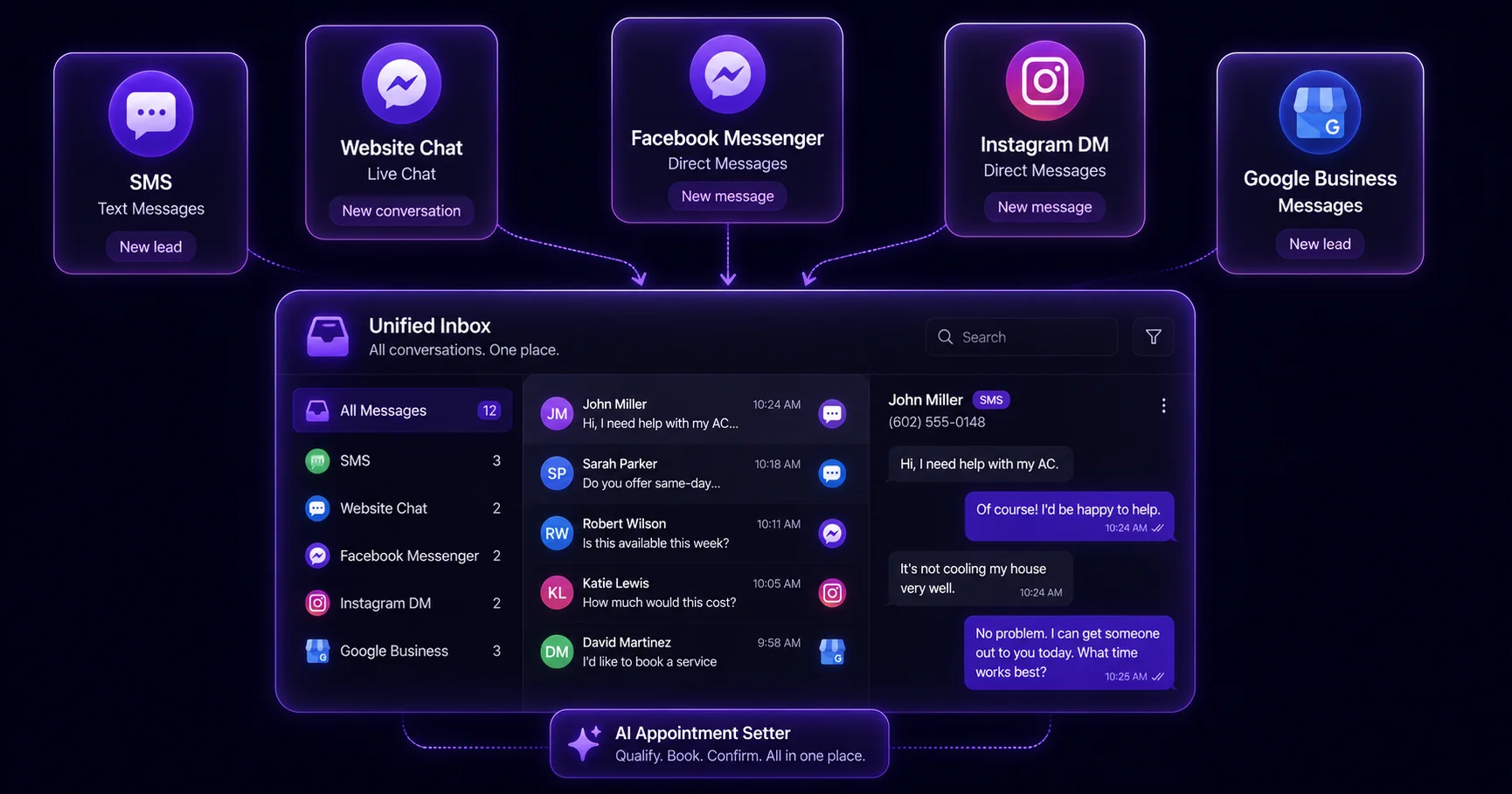
For local service businesses in 2026, five channels need coverage at minimum:
Website chat for visitors who find you through search or a paid ad
SMS text from your Google Business profile or click-to-text ads
Facebook Messenger for leads reaching out from your page
Instagram DM for prospects who find you through posts, reels, or your bio link
Google Business messages from the button on your Maps listing
If your AI only covers one or two of these, you are still losing leads on the channels it misses. Your customers do not choose where to contact you based on what is convenient for your software. They contact you wherever they found you.
Managing five channels does not mean monitoring five separate inboxes. Viking Marketing's all-in-one inbox pulls every inbound conversation from every channel into one place, so your team sees everything without toggling between apps.
Rule 3: Ask Qualifying Questions Built for Your Specific Service
A dental practice and an HVAC company need completely different qualifying questions. An insurance agency writing auto policies needs different intake than one quoting commercial general liability. A gym needs to know about membership goals and schedule preferences. A salon needs to know the service type and preferred stylist.
Generic AI appointment setters ask for a name, phone number, and "how can we help you?" That is not qualification. That is a contact form with extra steps.
Your AI should ask the questions your front desk or intake person would ask if they picked up the phone. These answers do two things. They pre-qualify the lead so your team walks into the conversation prepared. And they signal to the prospect that they are already in capable hands, which reduces the chance they call the next business on their list.
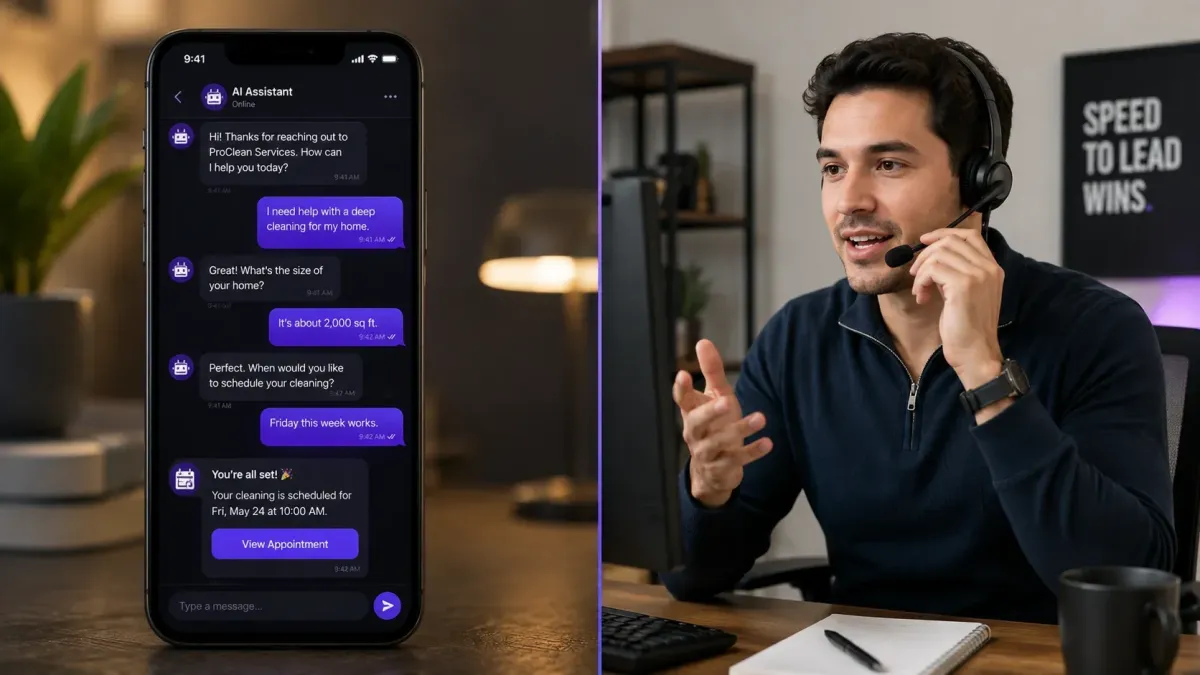
Our breakdown of what an AI appointment setting chatbot actually does walks through a real qualifying conversation step by step if you want to see the difference between a generic script and a service-specific one.
Here is what service-specific qualifying looks like in practice for four of the industries Viking Marketing serves.
HVAC Appointment Qualifying
For HVAC companies, the AI should collect: residential or commercial system, repair or replacement inquiry, system type (central air, mini-split, heat pump), estimated age of the unit, and whether the issue is urgent or can wait for a scheduled slot. A prospect who says "our AC stopped cooling last night" needs different urgency handling than one asking about a routine system checkup before summer.
Visit the HVAC and home services page for a full walkthrough of how the qualifying flow is configured.
Dental Practice Qualifying
For dental practices, the AI should ask: new or returning patient, reason for visit (routine checkup, pain, cosmetic consultation), insurance carrier, and preferred appointment day and time. Capturing insurance information upfront removes a common friction point at the front desk and lets staff prepare the patient's benefit verification before they arrive.
Insurance Agency Qualifying
For insurance agencies, the qualifying logic splits by line of business. Personal lines inquiries need: coverage type (auto, home, renters, life), current carrier, and a general sense of what is changing (new vehicle, new home, rate increase). Commercial lines inquiries need: business type, number of employees, and the specific coverage being sought. A prospect shopping for general liability needs a different opening question than one asking about workers' compensation.
See how Viking Marketing has built qualifying logic specifically for insurance agencies: AI Appointment Setter for Insurance Agencies.
Gym and Fitness Qualifying
For gyms and fitness studios, the AI should ask: membership type being considered (individual, family, student, day pass), primary fitness goal, preferred training times, and current experience level. These answers let your sales team personalize the tour conversation before it starts, which measurably improves conversion from inquiry to signed membership.
Rule 4: Book Directly to the Calendar With No Manual Handoff
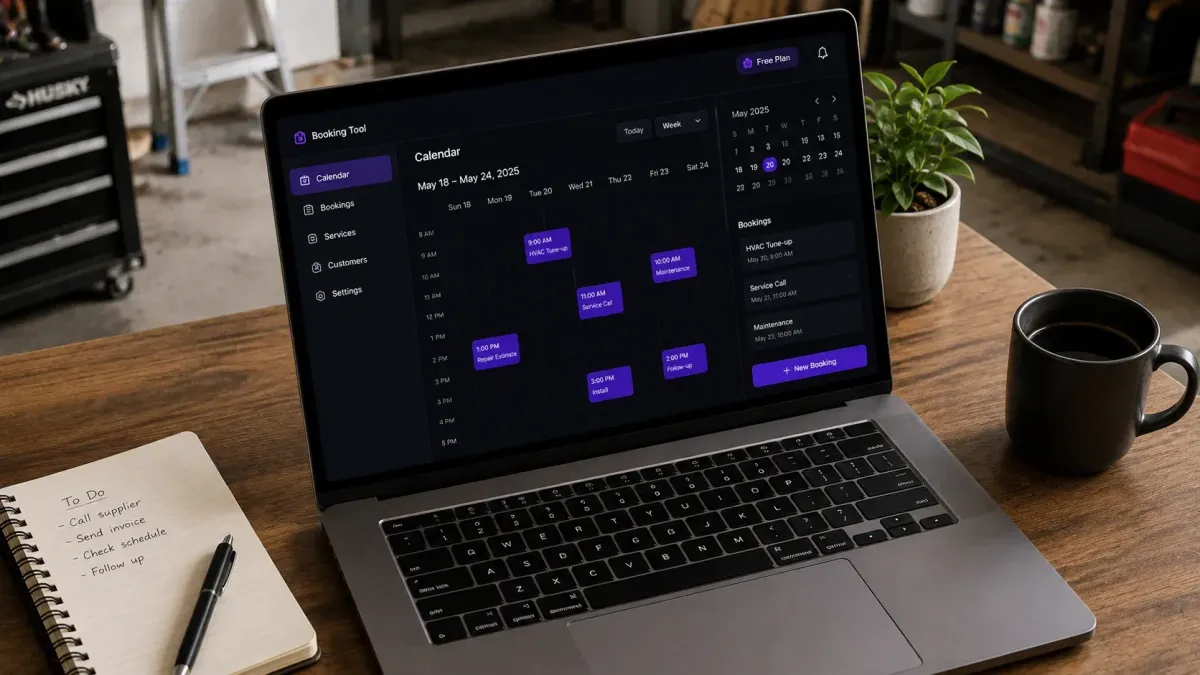
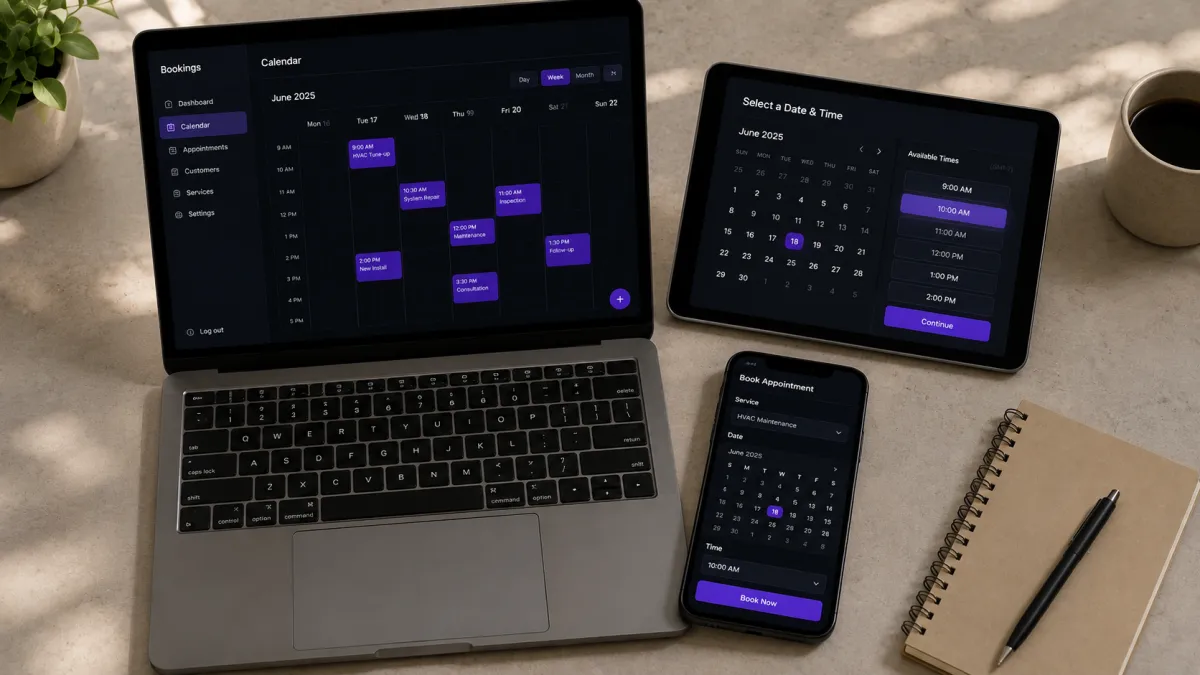
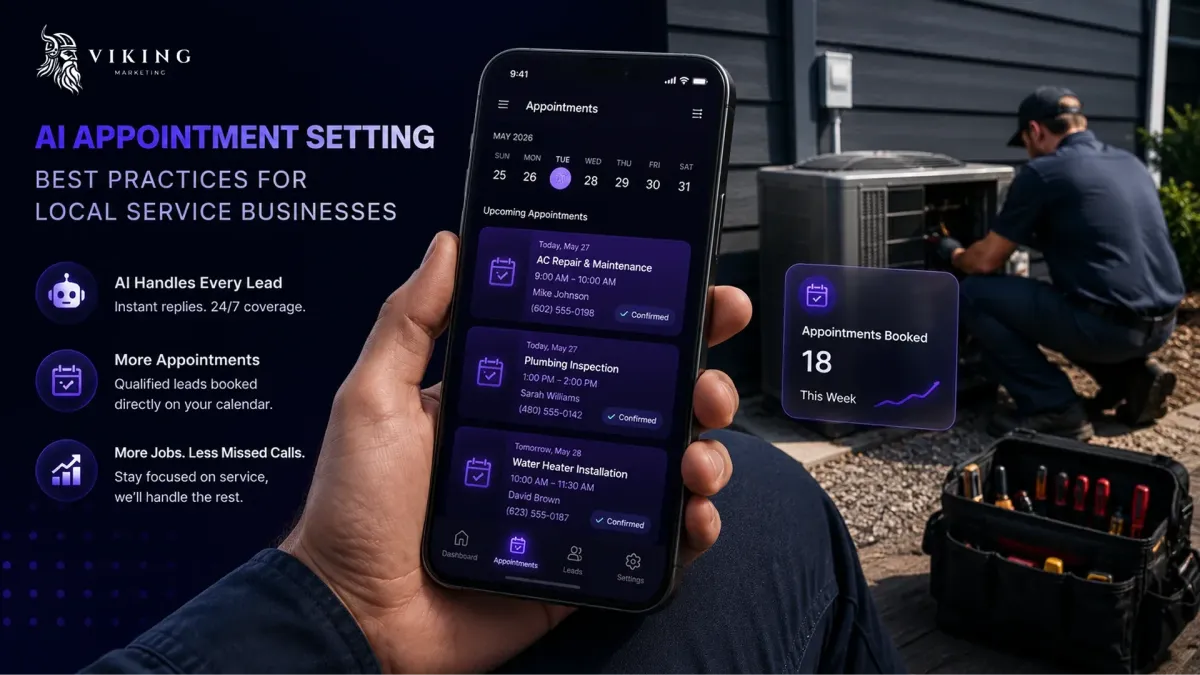
An AI that qualifies a lead and then drops the result into a spreadsheet, an email, or a notification queue is doing half the job. The appointment should land on a specific team member's calendar, confirmed, with the lead's contact information and qualifying answers already attached. No re-entry. No "check the dashboard in the morning." No gap between the AI finishing the conversation and a human reviewing it.
The manual handoff is where most AI appointment setting setups break down in practice. The AI does its job. But the lead sits in a holding pattern because nobody transferred the data to the calendar in time. By the time someone manually creates the appointment, the prospect already booked with the competitor whose system confirmed the appointment on the spot.
Direct calendar integration is not a luxury feature. It is the minimum bar.
Rule 5: Operate Inbound Only for TCPA Safety
This rule matters more in 2026 than it ever has before, and most advice on AI appointment setting skips it entirely.
TCPA stands for the Telephone Consumer Protection Act. It governs how businesses can send automated text messages to consumers. TCPA litigation surged 95% in 2025. Individual violations carry statutory damages of $500 to $1,500 per message. Class action exposure has no cap.
The FCC's expanded opt-out rules took effect in April 2025, requiring businesses to honor consent revocation through any reasonable method, including informal language, email, or even a verbal request during a call.
The safest AI appointment setting configuration is inbound only. That means the AI responds exclusively to messages the prospect sent first. A homeowner who fills out your quote form, sends you a Facebook message, or texts your business number initiated the contact. Responding to that specific conversation is fundamentally different, legally, from sending outbound promotional texts to a list of purchased numbers.
If you are evaluating AI tools and the vendor cannot clearly explain whether their system is inbound-only, that is a red flag.
The AI appointment setter comparison for insurance agencies covers TCPA compliance posture as a ranked evaluation criterion if you want the full picture on what to ask vendors. Always consult a qualified legal professional for guidance specific to your state.
Rule 6: Configure a Clear Human Escalation Path
An AI appointment setter is not a replacement for your team. It handles the first response and qualification step. That is its job. When a conversation goes beyond what the AI is trained on — a question about complex pricing, an upset customer, a regulatory or clinical issue — the AI should know when to stop and flag the conversation for a human.
The worst systems try to fake their way through every scenario. The best ones say something like "I want to make sure you get an accurate answer on that. I will have someone reach out shortly" and then notify your team immediately with the full conversation transcript.
Before you go live with any AI appointment setter, test it deliberately. Ask it questions you know it should not answer. See what happens. If it guesses, fabricates, or keeps looping without escalating, that is a system your customers will learn to distrust.
Rule 7: Automate Confirmations and Reminders to Cut No-Shows
Booking the appointment is only half the battle. Showing up is the other half. No-shows cost local service businesses real revenue, and the fix is straightforward.
Your AI should send an immediate confirmation after the appointment is booked, followed by at least one timed reminder before the scheduled time. The most effective setups send the confirmation via the same channel the prospect originally contacted you on. If they messaged you on Instagram, the confirmation goes to Instagram, not just email. Then follow up with an SMS reminder 24 hours before the appointment.
This is not complicated to configure. But it is one of the first features businesses skip during setup and one of the most expensive mistakes over time. Every no-show is a slot your team held open and a prospect you now have to re-engage.
Rule 8: Review Real Conversations Weekly and Adjust
AI appointment setting is not set-and-forget. The businesses that get the strongest results treat the first 30 days as a calibration period and continue reviewing real conversation logs weekly after that.
Look for patterns. Are prospects dropping off at a specific qualifying question? Is the AI misunderstanding a common phrasing? Are certain service types converting at a lower rate than others? Every one of those patterns is an adjustment you can make in the AI configuration, and every adjustment lifts your conversion rate incrementally.
The businesses I have watched abandon AI appointment setting almost always did the same thing: they set it up, walked away, and judged the results 90 days later without ever looking at a single conversation in between. The ones who review weekly and tweak the qualifying flow are the ones still running it a year later with stronger numbers every quarter.
Rule 9: Measure What Actually Matters
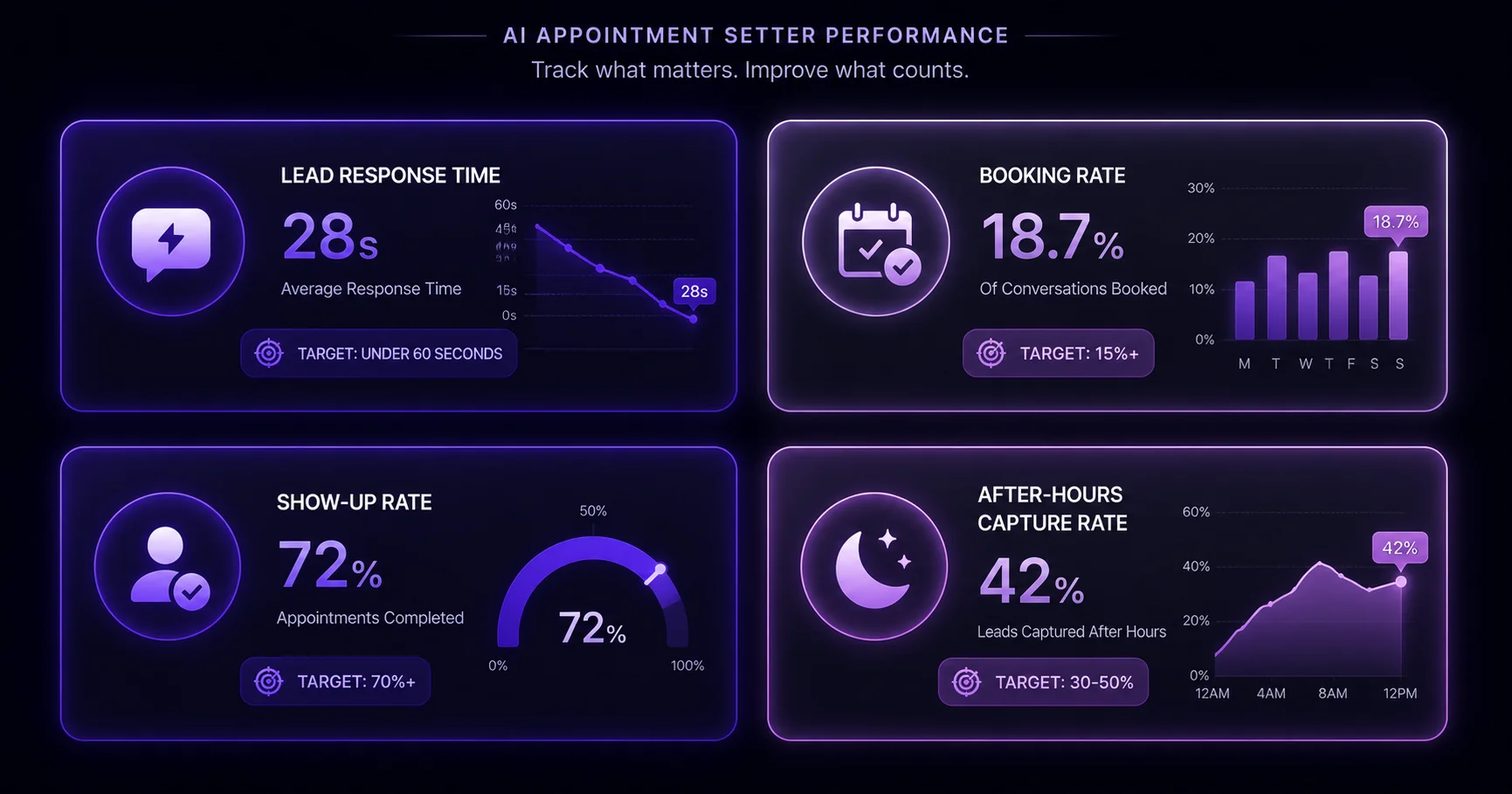
There are really only four numbers you need to track. Everything else is noise.
The following benchmarks are based on patterns observed across Viking Marketing's client base in local service businesses. Use them as directional thresholds for evaluating your own setup, not as fixed industry standards.
Lead Response Time
How many seconds between the lead arriving and the AI sending the first message. This should be under 60 seconds on every channel. If you are seeing response times measured in minutes rather than seconds, something in the channel connection is broken. Fix this before anything else.
Booking Rate
What percentage of AI conversations result in a confirmed calendar appointment. Based on patterns across Viking Marketing clients, a booking rate below 15% signals a problem with the qualifying flow, the available time slots, or the channel coverage. If leads are engaging but not booking, the most common cause is that the AI is asking too many questions before offering an appointment time, or the available slots shown do not match when the prospect actually wants to come in.
Show-up Rate
What percentage of booked appointments actually happen. A show-up rate below 70% across Viking Marketing's client base typically indicates the confirmation and reminder sequence needs work. The single highest-impact fix is sending the reminder via the same channel the prospect used to book, not defaulting to email for every confirmation.
After-Hours Capture Rate
What percentage of your total booked appointments come from leads that arrived outside your normal business hours. For most local service businesses using Viking Marketing, this number runs between 30% and 50% of all bookings. If yours is significantly lower, your AI is not covering enough channels after hours, or the channels it does cover are not triggering responses consistently.
Track these four numbers. If all four are healthy, the system is working. If one is off, these benchmarks tell you exactly where to look.
How Viking Marketing Was Built Around These Rules
Viking Marketing built its AI appointment setter specifically for local service businesses competing on response speed. Everything in these nine rules — the five-channel coverage, the inbound-only TCPA posture, the service-specific qualifying logic, the direct calendar booking — is built into how the system works from day one.
It operates across SMS, website chat, Instagram DM, Facebook Messenger, and Google Business messages from a single system. Every conversation is inbound-triggered. The qualifying logic is configured around your business type, not a generic sales script. Appointments book directly to your team's calendar with qualifying answers attached, confirmed, with no manual step required from your team.
Viking Marketing holds a 5.0-star Google rating across 21 reviews. Based in Chandler, AZ, the platform was built for this exact audience: small teams losing leads to slower response times, not enterprise sales organizations with dedicated ops departments.
See how Viking Marketing's AI appointment setter works for your specific business type →
Pricing starts at $297 per month for the Starter plan, $497 per month for Growth, and $997 per month for Pro. Setup runs in days, not weeks.
View pricing and pick the plan that fits your lead volume →
Book a 15-minute call to see it in action on your actual lead flow →
Key Statistics: AI Appointment Setting for Local Service Businesses 2026
Businesses responding within 5 minutes are 21 times more likely to qualify a lead than those that wait 30 minutes, based on research from MIT and InsideSales.com.
A one-minute response lifts conversion rates by 391% compared to a two-minute delay, according to Velocify data from insurance, mortgage, and education platforms.
TCPA litigation surged 95% in 2025. Inbound-only AI appointment setting is the lowest-risk compliance posture for local service businesses.
The average business lead response time is 47 hours — in a multi-quote environment, that is effectively zero chance of winning the job.
52% of leads arrive outside standard business hours, meaning a 9-to-5 team without AI loses roughly half its pipeline before the workday opens.
78% of consumers buy from whichever business responds first, not necessarily the cheapest or highest-rated.
AI appointment setting should cover at minimum five channels: SMS, website chat, Instagram DM, Facebook Messenger, and Google Business messages.
Viking Marketing holds a 5.0-star Google rating across 21 reviews and operates inbound-only across all five channels, with most clients live and booking within the first week.
Frequently Asked Questions: AI Appointment Setting Best Practices
How does an AI appointment setter work for a local service business? It picks up an incoming message from any channel where a prospect contacts you, holds a real qualifying conversation using questions specific to your service type, and books a confirmed appointment directly onto your team's calendar without anyone on your staff needing to respond. Your team shows up to the appointment with the lead's answers already in hand.
What should I look for when choosing an AI appointment setter? Prioritize response speed under 60 seconds, coverage across all five key channels, qualifying questions built for your specific service type, direct calendar booking, a clear human escalation path, and an inbound-only TCPA compliance posture. Price should be the last thing you compare.
Is AI appointment setting TCPA compliant? Yes, when configured correctly. Inbound-only operation, where the AI responds exclusively to messages the prospect sent first, carries the lowest legal risk. Systems that send outbound texts to purchased lists carry significantly more exposure. TCPA litigation surged 95% in 2025, so compliance structure is a buying criterion, not an afterthought. Always consult a qualified legal professional for state-specific guidance.
What happens when the AI does not know the answer to a prospect's question? A properly configured system flags the conversation for human follow-up rather than guessing. It takes a message, notifies your team immediately with the full conversation transcript, and tells the prospect that someone will reach out shortly. The worst systems fabricate answers. The best ones know their limits.
How long does it take to set up an AI appointment setter? With Viking Marketing, most local service businesses are live and booking appointments within the first week. If a vendor quotes you six to eight weeks, you are buying a software integration project, not a business tool.
Can AI appointment setting reduce no-shows? Yes. Automated confirmations sent immediately after booking, followed by timed reminders via the same channel the prospect originally contacted you on, reduce missed appointments without adding any manual effort from your team. The combination of same-channel confirmation plus a 24-hour SMS reminder is the most effective pattern based on Viking Marketing client data.
What industries benefit most from AI appointment setting? Local service businesses with high inbound lead volume and fast-moving competitive markets see the strongest results. HVAC, dental practices, insurance agencies, home services contractors, gyms, and salons all fit this profile because their prospects are typically comparing multiple providers simultaneously and book with whoever responds first.
What is the difference between an AI appointment setter and a virtual receptionist? A virtual receptionist is a human being answering calls during set hours. An AI appointment setter handles inbound contacts 24 hours a day across all five digital channels simultaneously, with no overtime and no sick days. For businesses that lose the majority of their leads after hours or on weekends, a virtual receptionist cannot close that gap. An AI setter can.
Stop Losing Jobs to Whoever Responds First
Every lead that hits your voicemail tonight is a job on a competitor's calendar tomorrow morning.
These nine rules are not complicated. They are specific. The businesses that follow all nine and measure the four metrics consistently see their after-hours booking rate climb, their no-show rate drop, and their front desk team spending less time on callbacks and more time on confirmed clients.
Viking Marketing built its system around exactly these rules for exactly this audience.
Three ways to take the next step:
Calculate what slow response is costing your business right now →
See Viking Marketing's plans and pricing →
Book a 15-minute call and be live within the week →
Sources and Citations
InsideSales.com and MIT, Lead Response Management Study, cited by LeadResponse at https://leadresponse.co/blog/speed-to-lead-statistics
Velocify, lead response time study (insurance, mortgage, education), cited by Digital Applied at https://www.digitalapplied.com/blog/speed-to-lead-response-time-benchmarks-2026-data-playbook
Greetnow, "Lead Response Time Statistics 2026," https://greetnow.com/blog/lead-response-time-statistics
ActiveProspect, "TCPA Text Messages: Rules and Regulations Guide for 2026," https://activeprospect.com/blog/tcpa-text-messages/
Infobip, "2026 Guide to TCPA Compliance for SMS in the US," https://www.infobip.com/blog/tcpa-compliance-sms
Viking Marketing, https://vikingmarketing.ai
Keep Reading
See how the Viking AI appointment setter answers and books your leads, compare pricing, or book a free strategy call.

 AI Appointment Setter