Neither one wins every category. Here is an honest breakdown of where each actually comes out ahead.
About the author: Charlie DeFelice founded Viking Marketing in Chandler, AZ, and has spent three years helping local service businesses set up AI and human receptionist coverage that actually fits how they operate.
TL;DR: AI receptionists and human receptionists solve different problems. AI wins on cost, availability, and consistency at volume. Humans win on empathy, judgment, and handling genuinely unusual situations. Most local service businesses get the best results using AI to cover the gaps a single human receptionist cannot realistically fill, rather than choosing one over the other entirely.
This comparison gets framed as a battle more often than it should. Search "AI receptionist vs human receptionist" and most articles pick a side, either arguing AI will replace receptionists entirely, or insisting nothing can replace a real person. Neither framing is particularly useful if you are actually trying to decide what your business needs.
I have spent three years helping local service businesses figure out where the line actually sits. One HVAC client called us after her one full-time receptionist quit with two weeks' notice, right before the summer rush. She did not need to replace that person with another full-time hire. She needed her evenings and weekends covered while her office manager handled the phones during the day.
That hybrid setup is what most businesses in this position actually end up needing. Not a full AI takeover, and not a full-time replacement hire. It is why this comparison should not be framed as a fight to the death between the two options.
AI Receptionist vs Human Receptionist at a Glance
Custom HTML/CSS/JavaScript
What a Human Receptionist Actually Does Well
Judgment in Unusual Moments
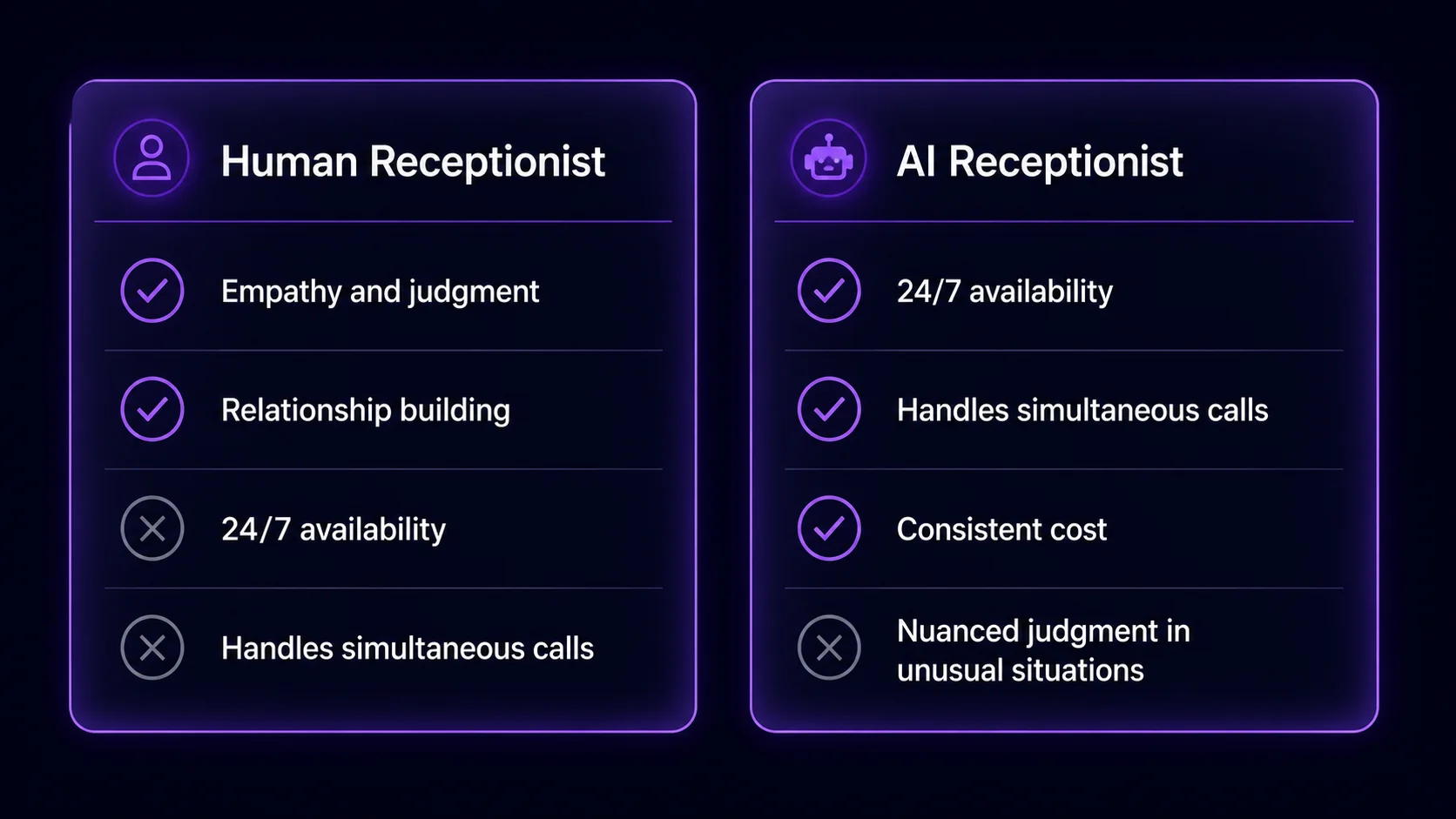
A human receptionist brings something no software fully replicates: genuine judgment in unusual moments. When a caller is upset, confused, or asking something that does not fit a standard script, a person can read the situation, adjust tone, and make a real-time decision about how to handle it.
Relationship Building
Human receptionists also build relationships. A regular customer who calls and hears a familiar, friendly voice experiences something different than one who talks to a system, even a well-designed one. For businesses where personal relationships are a core part of the value they offer, that matters.
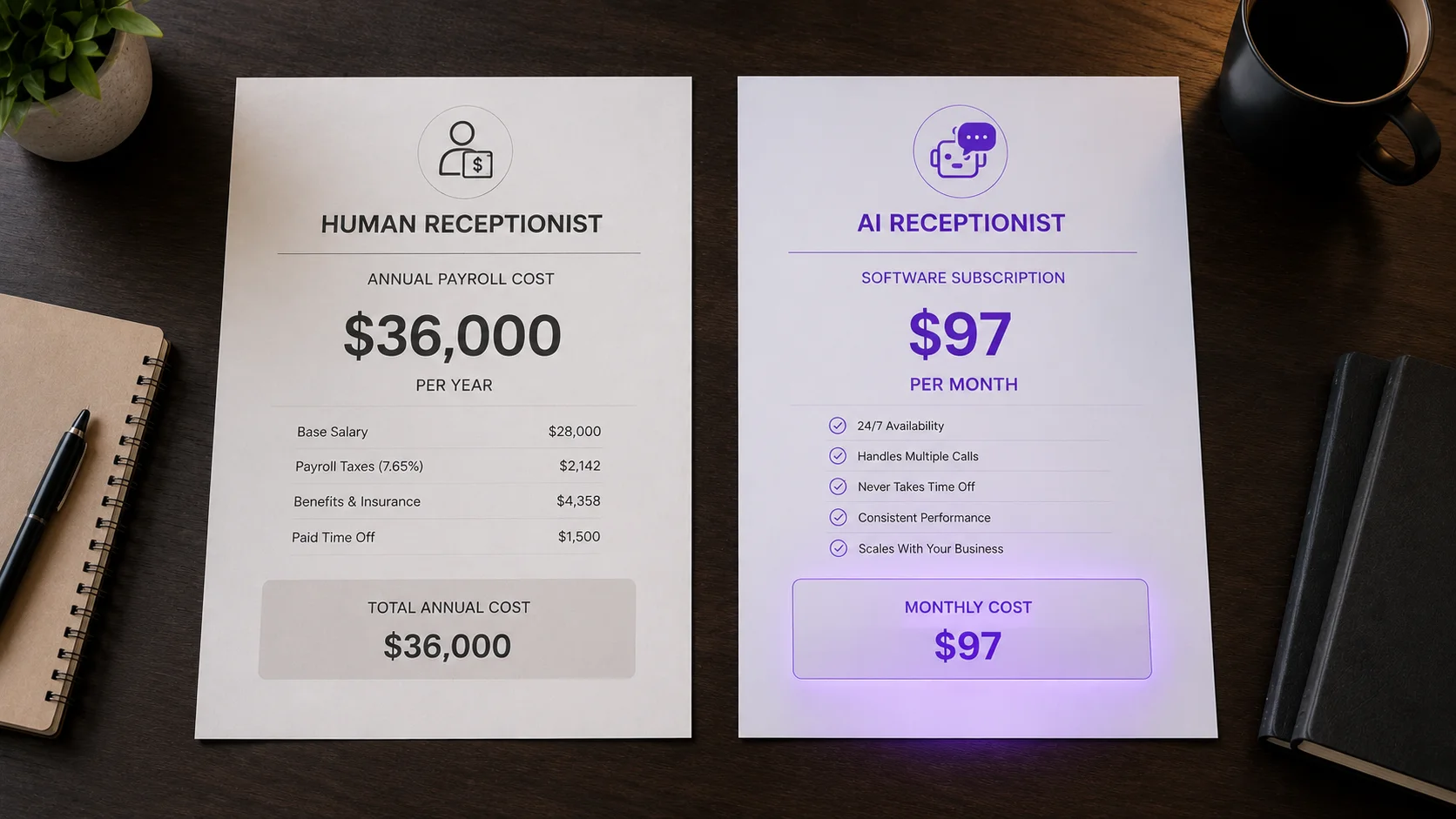
The tradeoff is availability and cost. A human receptionist works fixed hours, typically around 40 hours a week, can only handle one conversation at a time, and costs a full salary regardless of how many or how few calls come in on any given day. A full-time receptionist typically runs $30,000 to $45,000 per year in salary and benefits, covering business hours only.
What an AI Receptionist Actually Does Well
Constant Availability
An AI receptionist does not get tired, does not need a lunch break, and does not have a ceiling on how many conversations it can hold at once. It answers a call at 2am with the same speed and consistency it offers at 2pm on a Tuesday, and it can manage several conversations happening at the exact same moment without any of them waiting.
Companies that respond to a lead within one hour are seven times more likely to have a meaningful conversation with a decision-maker than those that respond later, according to Harvard Business Review research on online sales leads. A single human receptionist, however good, cannot guarantee that response window across every call, every hour, every day. An AI receptionist can.
Lower Cost at Scale
Cost is the other major factor. A GoHighLevel comparison of their own AI voice agent against a human receptionist notes that a human typically works around 40 hours a week, while AI operates continuously, covering nights, weekends, and holidays without overtime pay. For a business trying to cover more hours without adding headcount, that math is hard to ignore.
What AI gives up in exchange is nuanced judgment. A well-designed AI receptionist follows consistent logic and handles routine bookings, common questions, and standard scheduling extremely well. It is not designed to navigate a genuinely unusual, emotionally complex situation the way a person can.
What's the Difference Between an AI Receptionist and a Virtual Answering Service?
A traditional virtual answering service is a team of real people, often working for an outsourced call center, who answer calls on your behalf using a script. You get the human judgment benefits, but you are still paying for human labor, so the cost structure looks more like staffing than software, and availability during a sudden call spike is still limited by how many live agents are on shift.
An AI receptionist replaces the live agents with software that reads intent, asks qualifying questions, and books directly to your calendar, with no live person in the loop unless the conversation is escalated. That is the meaningful difference: a virtual answering service scales its cost with call volume the way human staffing does, while an AI receptionist's cost stays fixed regardless of how many conversations happen.
Is AI Actually Replacing Receptionists?
Not entirely, and not for most businesses. What is actually happening across most local service businesses is narrower and more practical than a full replacement.
AI receptionists are most commonly used to cover the specific gaps a human receptionist cannot realistically fill: after-hours calls, weekend inquiries, and the moments when call volume spikes and a single person simply cannot answer every line at once. Rather than eliminating the human role, AI tends to absorb the overflow and the off-hours coverage, while a person continues handling calls during regular business hours and anything that needs real judgment.
This hybrid approach is becoming increasingly common because it captures the strengths of both. The human handles what humans do best. The AI covers what would otherwise go unanswered. This is exactly the setup the HVAC client mentioned earlier landed on: her office manager kept the daytime calls, and the AI receptionist picked up everything from 5pm to 8am plus weekends.
How Much Does an AI Receptionist Cost Compared to a Human?
This is usually where the comparison becomes concrete for business owners, and it is worth putting real numbers on both sides.
A full-time human receptionist typically costs $30,000 to $45,000 per year in salary and payroll taxes, covering roughly 40 hours a week, one conversation at a time. That cost does not flex with call volume. A slow week and a slammed week cost the same in payroll.
AI receptionist platforms built for local service businesses typically run $297 to $997 per month, covering every hour of every day simultaneously, across multiple channels at once. Viking Marketing's Starter plan starts at $297 per month, roughly $3,564 per year, a fraction of a single receptionist's salary, for coverage that extends well beyond what one person's schedule allows. Setup for a purpose-built AI receptionist is typically measured in days; hiring and training a human receptionist is realistically measured in weeks once you account for posting the role, interviewing, and onboarding.
For many small businesses, the practical outcome is that AI becomes the more affordable way to extend coverage beyond what a single receptionist's schedule allows, without needing to hire a second person just to cover evenings and weekends. If you want to see this math against your own call volume, Viking Marketing's free missed call ROI calculator runs the numbers in under two minutes.
When a Human Receptionist Is Still the Better Choice
Relationship-Driven Businesses
There are real situations where a human receptionist remains the stronger option. High-touch, relationship-driven businesses, where the personal connection with a receptionist is part of what customers value, benefit from keeping a person in that role.
Complex or Sensitive Conversations
Businesses handling frequent, genuinely complex or emotionally sensitive conversations, certain healthcare or legal contexts for example, often need the judgment a person brings more than the availability AI offers. A family law practice fielding a distressed caller, or a specialty medical office navigating a sensitive diagnosis conversation, are both situations where AI should not be making the call alone.
The businesses that benefit least from switching entirely to AI are usually ones with low call volume overall, where the cost savings of automation are smaller, and where every caller genuinely needs individual, nuanced attention.
What to Ask Before Choosing Either Option
Whether you are evaluating an AI receptionist, a human hire, or a hybrid setup, a few direct questions clarify the decision fast.
Ask what happens when the AI does not understand a request. A well-built system flags the conversation for a human rather than guessing or looping. If a vendor cannot explain this clearly, that is a red flag.
Ask whether it integrates with your existing calendar and scheduling tools. A receptionist, human or AI, that cannot see your real calendar creates double-bookings and confusion regardless of how good the conversation itself sounds.
Ask how long setup actually takes for a business your size. Purpose-built AI receptionists are typically live within days. If a platform quotes weeks, you may be looking at a tool built for a larger organization.
Ask whether the system is inbound-only or capable of outbound texting. This determines your TCPA exposure and is worth confirming before signing anything.
Is an AI Receptionist TCPA Compliant?
Because an AI receptionist often follows up by text after a call, this question deserves a direct answer. TCPA litigation surged 95% in 2025, and the safest configuration is inbound-only: the AI responds and follows up exclusively within conversations the customer initiated, rather than sending automated texts to a purchased list. Ask any AI receptionist vendor directly whether their system is inbound-only, and consult a qualified legal professional for guidance specific to your state. Viking Marketing's system operates inbound-only across every channel.
Key Benefits of Combining AI and Human Receptionists
Around-the-clock coverage without needing to staff a second shift
Lower cost for extending availability beyond a single receptionist's working hours, starting at $297 per month versus $30,000+ per year for a full-time hire
Consistent handling of routine bookings and common questions at any volume
Human judgment preserved for genuinely complex or sensitive conversations
Reduced risk of missed calls during peak volume or after hours
How Viking Marketing Approaches This Balance
Viking Marketing's AI appointment setter is built to cover exactly the gaps described above, the after-hours calls, the moments when your team is already on another line, the leads that would otherwise go completely unanswered. For businesses comparing Viking specifically against other purpose-built options like Smith.ai's hybrid human-plus-AI model, our full software comparison breaks down the tradeoffs.
When a call goes unanswered, Viking's missed call text back feature responds within seconds, and every conversation lands in Viking's all-in-one inbox so your team retains full visibility and can step in personally whenever a conversation calls for it. Viking's AI receptionist capability is part of the same AI booking system built for local service businesses, so appointment setting and receptionist coverage run through one platform rather than two.
Viking Marketing holds a 5.0-star Google rating across 21 reviews, based in Chandler, AZ, with most clients live within the first week.
The goal is not to remove people from your business. It is to make sure no customer ever reaches a dead end, regardless of when they call.
Not ready to commit to a paid platform yet? Our guide to free AI appointment setter tools covers what you can genuinely test before paying anything.
Want to see how this would work alongside your current team? Book a free 15-minute call and we will walk through it honestly.
Key Facts: AI Receptionist vs Human Receptionist
Human receptionists typically work fixed hours, commonly around 40 hours a week, costing $30,000 to $45,000 per year, while AI receptionists operate continuously for $297 to $997 per month.
AI receptionists can manage multiple simultaneous conversations, while a human receptionist can only handle one call at a time.
Companies responding to a lead within one hour are seven times more likely to have a meaningful conversation with a decision-maker than those that respond later, according to Harvard Business Review.
TCPA litigation surged 95% in 2025. Inbound-only AI receptionists carry significantly lower legal exposure than outbound automated texting tools.
Purpose-built AI receptionists are typically live within days; hiring and training a human receptionist realistically takes weeks.
Most businesses adopting AI receptionists use them to cover after-hours and peak volume gaps rather than fully replacing human staff.
Human receptionists retain a clear advantage in emotionally complex or highly relationship-driven conversations that require nuanced judgment.
A hybrid approach, using AI to cover overflow and off-hours while humans handle standard business hours, is increasingly common among local service businesses.
Viking Marketing holds a 5.0-star Google rating across 21 reviews as of July 2026.
Frequently Asked Questions
Is AI replacing receptionists?
Not entirely, and not for most businesses. Most local service businesses use AI receptionists to cover gaps a human receptionist cannot realistically fill, such as after-hours calls and peak volume moments, rather than eliminating the human role altogether.
Is an AI receptionist worth it?
For most local service businesses, yes, particularly for extending coverage beyond normal business hours. AI receptionists tend to be more cost-effective than hiring additional staff to cover evenings, weekends, and overflow call volume, while human staff continue handling standard hours and complex conversations.
How much do people charge for an AI receptionist compared to a human one?
AI receptionist platforms built for local service businesses typically run $297 to $997 per month, compared to $30,000 to $45,000 per year for a full-time human receptionist. The AI cost stays fixed regardless of how many additional hours of coverage it provides.
What's the difference between an AI receptionist and a virtual answering service?
A virtual answering service uses real people, often at an outsourced call center, whose cost scales with call volume the way staffing does. An AI receptionist uses software that reads intent and books directly to your calendar, with a fixed monthly cost regardless of how many conversations happen.
Will customers be upset if they talk to an AI receptionist?
Most customers care more about getting a fast, accurate response than about who or what answers. A well-built AI receptionist is transparent if a caller asks directly, and most callers are satisfied when the system resolves their request quickly, whether that is booking an appointment or answering a common question.
How long does it take to get an AI receptionist running?
Purpose-built AI receptionists are typically live within days. Hiring and training a human receptionist realistically takes weeks once you factor in posting the role, interviewing, and onboarding.
How does an AI receptionist handle angry or confused customers?
A well-designed AI receptionist recognizes when a conversation is escalating or falling outside what it can confidently handle, and hands it off to a human team member with full context, rather than continuing to guess. This is one of the clearest situations where human judgment should take over.
Can an AI receptionist transfer calls to my team?
Yes. Most AI receptionists built for local service businesses can escalate a live call or hand off a text conversation to a team member when the situation calls for it, keeping the customer from having to repeat themselves.
What's the best AI receptionist for service businesses?
It depends on what you need most. Viking Marketing is built specifically for local service businesses needing full inbound coverage across phone, text, and web chat at a fixed monthly cost. Smith.ai offers a hybrid model with live human receptionists blended with AI, which suits businesses that want a person involved in every call. The right choice depends on whether you prioritize full automation or human backup.
Do AI receptionists integrate with my scheduling software?
Most AI receptionists built for small businesses integrate directly with your existing calendar, such as Google Calendar or Outlook, so bookings appear automatically without manual entry. Confirm live integration availability with any vendor before signing up.
Is an AI receptionist secure for customer information?
Reputable AI receptionist platforms use encrypted connections and standard data security practices to protect customer information. Ask any vendor directly how customer data is stored and who has access to it before choosing a platform.
Can AI be a receptionist for every type of business?
AI receptionists work well for routine bookings, common questions, and standard scheduling across most local service businesses. Businesses that frequently handle emotionally complex or highly relationship-driven conversations, such as certain healthcare or legal practices, often still benefit from keeping a human in that role for those specific situations.
What is the biggest difference between AI and human receptionists?
The core tradeoff is availability and cost versus nuanced judgment. AI offers constant availability and consistent handling at any volume for a few hundred dollars a month, while a human brings empathy and the ability to navigate genuinely unusual situations that fall outside a standard process, at the cost of a full salary and limited hours.
Is an AI receptionist TCPA compliant?
It depends on how it is configured. Inbound-only systems, which respond only within conversations the customer initiated, carry significantly lower TCPA risk than tools capable of outbound texting to purchased lists. Always confirm a vendor's configuration and consult a qualified legal professional for state-specific guidance.
Can I use an AI receptionist alongside my current human receptionist?
Yes, and this is the most common setup among Viking Marketing's clients. The AI covers after-hours calls, overflow during busy periods, and any channel your front desk cannot monitor in real time, while your human receptionist continues handling standard hours and complex conversations.
Stop Choosing Between Coverage and Cost
You do not have to pick one. Most local service businesses get the best of both by keeping their human receptionist for standard hours and letting AI cover everything else.
Calculate what missed after-hours calls are costing your business
See Viking Marketing's plans and pricing
Book a free 15-minute call and be live within the week
Sources and Citations
Custom HTML/CSS/JavaScript

 AI Appointment Setter