Not every call is worth a callback. Here is how businesses are letting software figure out which ones are, before a human ever gets involved.
Author: Charlie DeFelice, Founder of Viking Marketing
TL;DR: An AI lead qualifier is software that automatically evaluates incoming leads, callers, texts, or web inquiries, to determine how likely they are to convert into a paying customer, before a human ever needs to spend time on the conversation. It applies the same framework sales teams have used for decades, Budget, Authority, Need, and Timeline, consistently and instantly, to every single lead. Then it sorts them so your team calls the best ones first, not the oldest ones.
Not every person who contacts a business is ready to become a customer. Some are comparing five providers before deciding weeks from now. Some are asking a quick question with no real intent to book. And some are exactly the customer a business wants, ready to schedule today, if only someone had time to sort through the noise to find them.
That sorting job used to fall entirely on a person, usually whoever happened to be free when the phone rang. Now it is increasingly handled by an AI lead qualifier, and I have spent three years watching what changes when local service businesses make that switch.
The pattern is the same every time. The businesses losing the most revenue are rarely the ones with the worst leads. They are the ones calling leads back in the order they arrived instead of the order they should be prioritized. An AI lead qualifier fixes exactly that.
What Is an AI Lead Qualifier, and What Framework Does It Actually Use?
This is the question every business owner asks first, and it deserves a real answer, not a vague one.
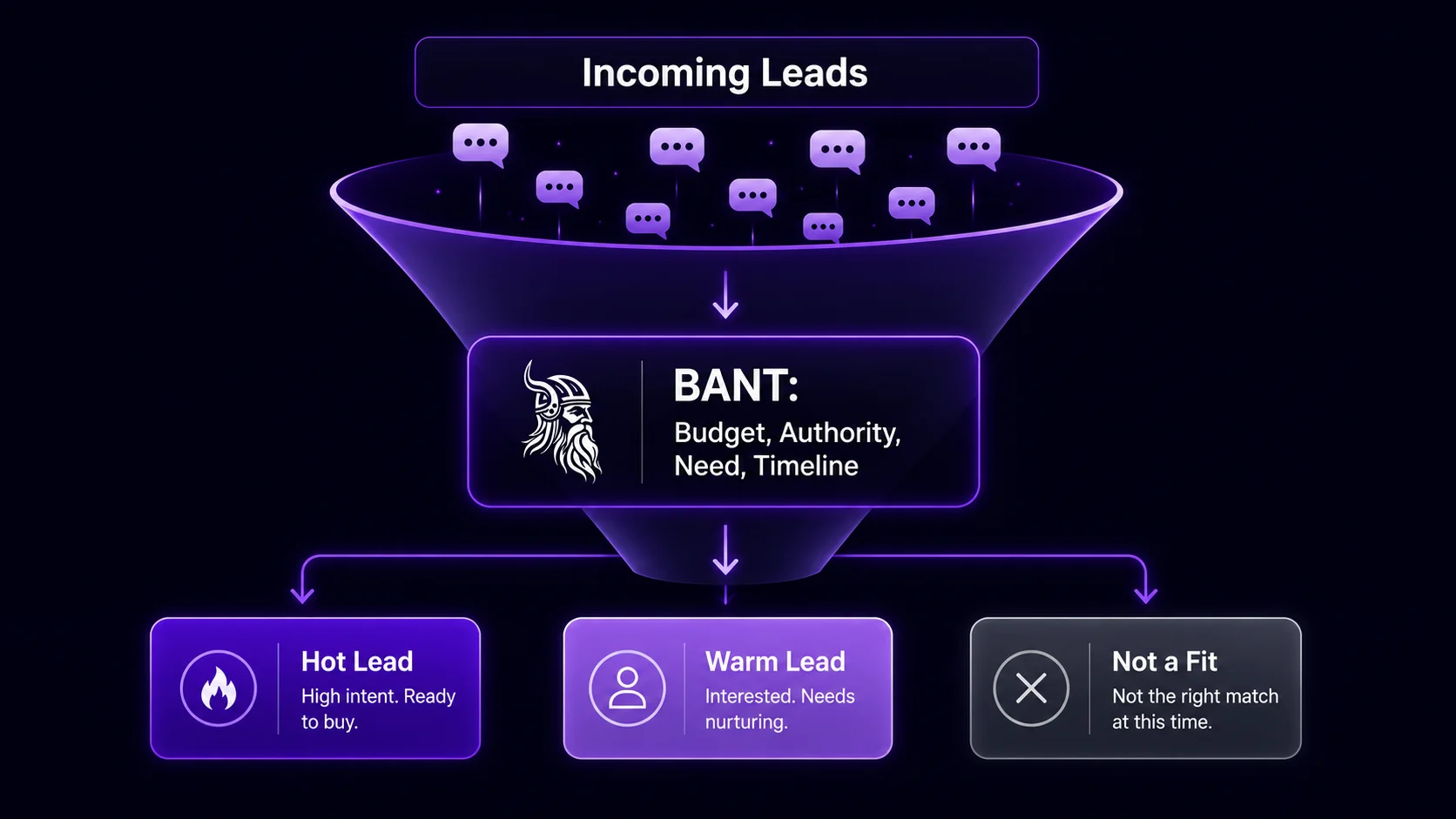
An AI lead qualifier is not guessing. It is applying the same framework sales organizations have relied on for decades: BANT, short for Budget, Authority, Need, and Timeline.
Budget
Can this person actually afford what you offer? A qualifying conversation might ask directly about price range, or infer it from the type of service requested.
Authority
Is this person the one who makes the decision? A homeowner calling about their own roof is different from a tenant asking on behalf of a landlord who is not on the call.
Need
Does this person actually need what you sell? Someone asking a general question with no specific service in mind signals lower intent than someone describing a clear problem that matches your services.
Timeline
When do they need it done? "This week" and "sometime next year, just researching" are two completely different leads, even if every other answer is identical.
An AI lead qualifier asks a small set of direct questions built around these four categories, then scores the response against the criteria your business has set. It also reads language cues. Someone asking urgent questions about pricing or availability signals real intent. Someone asking vague, general questions with no follow-up signals lower intent.
How Leads Get Scored: Hot, Warm, and Not a Fit
Most AI lead qualifiers sort the result into three simple categories.
Hot leads answer all four BANT questions favorably. They have the budget, the authority, a real need, and an immediate timeline. These go straight to the top of your team's call list.
Warm leads meet some but not all criteria. They might have a real need and the authority to decide, but no clear timeline yet. These are not wasted leads. They are leads that need a different kind of follow-up, not an immediate hard sell.
Not a fit leads fall outside your service area, budget range, or actual need. Routing these out of your team's priority queue is what saves the hours that used to go into calling people who were never going to book.
The system is not guessing randomly. It applies the same qualifying logic every single time, consistently, without getting tired, distracted, or influenced by a bad mood. That consistency is what makes it more reliable than it sounds at first, even though it lacks the deeper intuition a seasoned salesperson brings to an unusual situation.
What Questions Should an AI Lead Qualifier Ask?
The specific questions depend entirely on your industry, and this is where most generic explanations of AI lead qualification fall short. Here is what real qualifying logic looks like for three common local service categories.
HVAC and Home Services
What type of service do you need — repair, replacement, or a routine check?
Is this a residential or commercial property?
Are you located in [service area]?
How urgent is this — same day, this week, or flexible?
Dental and Healthcare Practices
Are you a new or returning patient?
What is the reason for your visit — checkup, pain, or a specific concern?
What insurance carrier do you have?
What day and time works best for you?
Insurance Agencies
What type of coverage are you looking for — auto, home, or commercial?
Do you have a current policy, or is this a new purchase?
What is prompting the change — a new vehicle, a rate increase, or something else?
How soon are you looking to have coverage in place?
Four short questions per industry. That is the entire qualifying conversation for most local service businesses, and it takes the AI seconds to complete regardless of how many leads arrive at once.
Is AI Lead Qualification Better Than Manual Research?
Each approach has a different strength, and for most local service businesses, AI wins on the job that matters most: speed and consistency at volume.
Manual lead qualification depends on a person being available, paying close attention, and applying the same judgment to every inquiry. That works reasonably well when lead volume is low. It breaks down quickly once inquiries start arriving from multiple channels at once, phone calls, texts, web forms, and social messages all competing for the same person's attention.
Research from InsideSales.com and MIT found that businesses responding to a lead within five minutes are 100 times more likely to make contact, and 21 times more likely to qualify that lead, than those who wait 30 minutes. A person juggling five open conversations cannot hit that window consistently. An AI lead qualifier hits it every time, on every channel, without exception.
What AI does not replace is the nuanced judgment a person brings to a genuinely unusual conversation, which is exactly why the best systems flag those situations and hand them to a human instead of forcing a decision automatically.
Most local service businesses get the best results by letting AI handle the first pass, sorting through volume quickly and consistently, while a person makes the final call on anything borderline or high value.
What Happens to Leads That Do Not Qualify Right Away?
This is the question most articles on this topic skip entirely, and it matters more than the qualification process itself.
A "warm" or "not ready now" lead is not a lost lead. It is a lead on a different timeline. Research from Gleanster indicates that roughly half of all leads are not immediately ready to buy, which means qualification is not just about identifying who to call today. It is also about identifying who to re-engage in 30, 60, or 90 days.
This is where lead qualification and lead nurturing connect directly. Leads that score "warm" because they lack an immediate timeline should not be discarded. They should move into a structured re-engagement sequence so they are not forgotten the moment the conversation goes quiet.
Viking Marketing's database reactivation system handles exactly this. Leads that qualify as warm or not-ready-now are automatically routed into a re-engagement sequence, so your business has a pipeline of future opportunities instead of a discard pile of leads nobody ever follows up with again.
Is AI Lead Qualification the Same as Lead Scoring?
Not quite, and the distinction matters if you are comparing tools.
Lead qualification is closer to binary. Does this prospect meet the minimum criteria to be worth pursuing at all? Do they need what you sell, can they afford it, are they in your service area? A lead either qualifies or it does not.
Lead scoring is graduated. It assigns a numerical or weighted value to a lead based on behavior and signals, producing a ranked priority order rather than a pass-or-fail result. This is more common in B2B sales environments with longer, multi-touch buying cycles and marketing-generated leads.
Most local service businesses need qualification more than sophisticated scoring. The buying cycle is short, the decision is usually made by one person, and the goal is simple: know within seconds whether this lead is worth a callback today, worth a nurture sequence, or not a fit at all. An AI lead qualifier built for local service businesses focuses on exactly that, rather than the complex, multi-variable scoring models built for enterprise sales pipelines.
Can Small Businesses Actually Use AI for Lead Qualification?
Yes, and this misconception holds back more small business owners than it should. Many assume AI lead qualification is built only for large sales teams running complex CRM systems with dedicated operations staff.
That is true for some enterprise platforms. It is not the only option. Tools built specifically for small and local service businesses are designed to work with a single location, a small team, and a straightforward set of qualifying questions, no data science background or dedicated ops person required. Setup usually takes far less time than people expect, and the qualifying logic can be as simple as the four-question examples above, tailored to what actually matters for that specific business.
The real barrier for most small businesses is not affordability or complexity. It is not knowing this kind of tool exists in a form built for a business their size.
How Much Does an AI Lead Qualifier Cost?
AI lead qualification built into a full appointment setting system typically runs $297 to $997 per month, depending on channel coverage and configuration depth.
Compare that to hiring someone specifically to sort and prioritize inbound leads. A part-time admin handling that role costs $1,500 to $2,500 per month for limited hours, one lead at a time. A dedicated full-time lead qualification hire runs $3,000 to $4,500 per month before benefits, and still cannot apply consistent judgment to the fiftieth lead of the day the same way they did to the first.
The AI applies the same criteria to every single lead regardless of volume, at a fraction of that staffing cost, without ever getting tired or distracted.
If you want to see what leads are currently slipping through the cracks in your response process, Viking Marketing's free missed call ROI calculator runs the numbers on your specific lead volume in under two minutes.
Compare Viking Marketing's plan options and pricing here.
Key Benefits of an AI Lead Qualifier
Consistent criteria applied to every single lead. A human qualifier gets tired, distracted, or inconsistent by the fiftieth call of the day. An AI lead qualifier applies the exact same BANT-based logic to the first lead of the morning and the last lead before midnight, without any drop in accuracy.
Faster response to high-intent leads. Businesses responding within five minutes are 100 times more likely to make contact than those waiting 30 minutes. Because qualification happens the moment someone reaches out, your highest-priority leads surface immediately instead of sitting in a queue behind lower-priority ones.
Less wasted time on leads that were never going to convert. Every hour your team spends calling back someone who was never in your service area or never had the budget is an hour not spent on a lead that was actually ready to book. Qualification removes that wasted effort at the source.
Around-the-clock qualification, including after hours. A lead that reaches out at 11 PM gets sorted the moment it arrives, not the next morning when your team finally checks messages. That means your team starts the day already knowing which after-hours leads deserve the first callback.
Reduced risk of missing a high-value lead buried in volume. During a busy week, a genuinely great lead can get lost in a pile of lower-priority inquiries if everything is handled in the order it arrived. AI qualification surfaces it immediately regardless of how much volume came in around it.
Multichannel consistency. Whether a lead comes from a phone call, a text, a web form, or a social message, the same qualifying criteria apply every time. Your team gets a consistent priority signal no matter which channel the lead used to reach you.
How Viking Marketing's AI Lead Qualifier Works
Viking Marketing's AI appointment setter qualifies every lead the moment it arrives, so local service businesses know quickly which inquiries are worth prioritizing without hiring someone dedicated to sorting through every lead by hand.
When a customer reaches out, whether by phone, text, or web chat, the qualifying process happens immediately. If a call goes unanswered, Viking's missed call text back feature responds within seconds, opening a conversation the system then uses to understand what the customer needs and how ready they are to book.
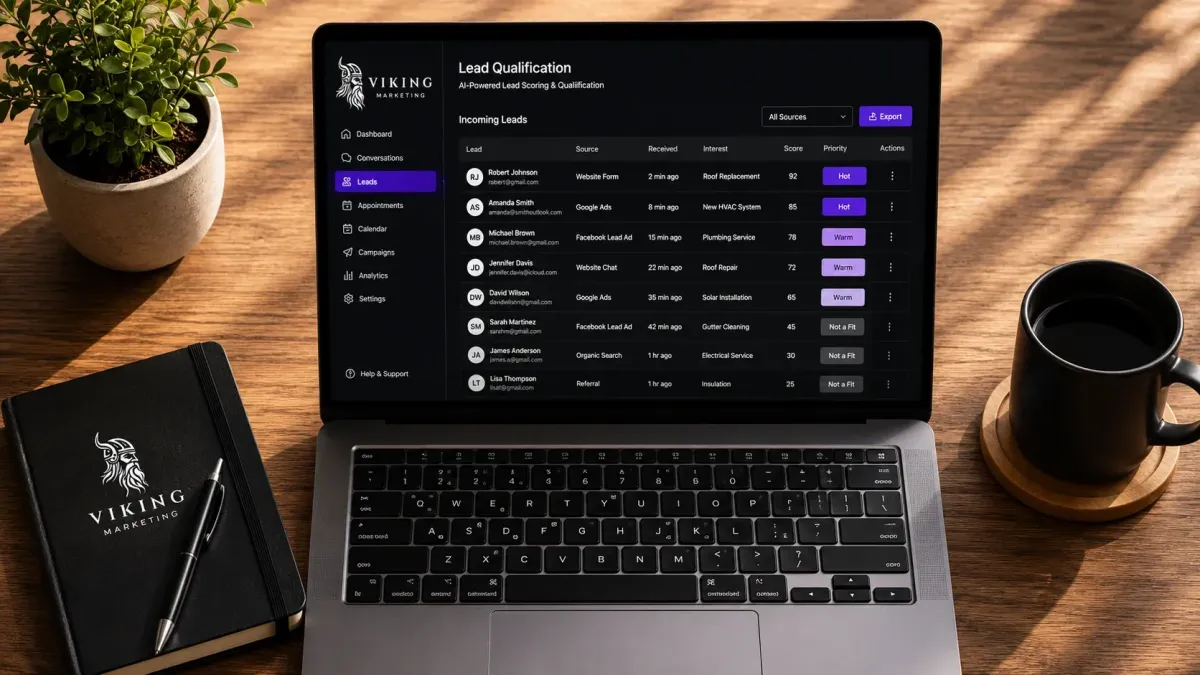
Every qualified conversation lands in Viking's all-in-one inbox, so your team can see exactly which leads are worth a callback first, instead of working through every inquiry in the order it arrived. Qualified leads are then organized inside Viking's lead management software, built specifically for small businesses that need a simple, clear view of who to follow up with next. Once a hot lead is ready to book, Viking's AI booking agent takes over and confirms the appointment directly.
For the leads that score warm or not-ready-now, Viking's database reactivation system keeps them in a structured re-engagement sequence instead of letting them go cold.
Viking Marketing holds a 5.0-star Google rating across 21 reviews, based in Chandler, AZ, with most clients live and qualifying leads within the first week of setup.
Want to see how this would work for your business specifically? Book a free 15-minute call and we will walk through it together.
Key Facts: AI Lead Qualification Statistics
Businesses responding within five minutes of a lead inquiry are 100 times more likely to make contact and 21 times more likely to qualify that lead than those waiting 30 minutes, based on InsideSales.com and MIT research.
Companies that respond to a lead within one hour are seven times more likely to have a meaningful conversation with a decision-maker than those that respond later, according to Harvard Business Review research on online sales leads.
Roughly 50% of leads are not immediately ready to buy, according to Gleanster Research — meaning qualification is as much about identifying who to nurture later as it is about identifying who to call today.
52% of inbound inquiries arrive outside standard business hours, according to HubSpot lead response data. An AI lead qualifier sorts those leads the moment they arrive rather than the next morning.
The BANT framework — Budget, Authority, Need, and Timeline — has been the standard structure for lead qualification for decades. An AI lead qualifier applies it consistently to every single inbound lead, regardless of volume or time of day.
A full-time lead qualification hire costs $3,000 to $4,500 per month before benefits. AI lead qualification built into a full appointment system typically runs $297 to $997 per month.
Viking Marketing holds a 5.0-star Google rating across 21 reviews as of July 2026.
Frequently Asked Questions: AI Lead Qualifiers
Can AI really tell if a lead is actually a good fit for my business? Yes, with meaningful accuracy. An AI lead qualifier evaluates defined signals through the BANT framework, budget, authority, need, and timeline, applying the same consistent logic to every lead rather than relying on guesswork or inconsistent judgment.
Is AI lead qualification better than manual research? For most local service businesses, yes, particularly at volume. AI applies the same qualifying process to every lead regardless of how many are coming in or what time of day it is, while manual qualification depends on a person's availability and attention, which naturally becomes inconsistent as volume increases.
Can small businesses actually use AI for lead qualification? Yes. While some AI lead qualification platforms are built for large enterprise sales teams, others are designed specifically for small and local service businesses, with simple setup and no dedicated operations staff required.
Can AI qualify leads 24/7 without my team doing anything? Yes. One of the main advantages of an AI lead qualifier is that it works continuously, qualifying a lead that reaches out at midnight with the same consistency it applies during regular business hours.
What happens if AI qualifies a lead incorrectly? Well-designed AI lead qualification systems are built with human oversight in mind. Borderline or unusual leads can be flagged for a person to review, and qualifying criteria can be adjusted over time as a business learns more about what its ideal customer actually looks like.
What is the best AI lead qualifier for small service businesses? The best fit is a system built specifically for local service businesses rather than adapted from enterprise B2B sales tools. Viking Marketing's AI lead qualifier applies the BANT framework through short, industry-specific qualifying conversations and integrates directly with appointment booking, so qualified leads move straight to a confirmed appointment without a manual handoff.
How much does AI lead qualification cost? AI lead qualification built into a full appointment setting system typically runs $297 to $997 per month depending on configuration. That compares to $1,500 to $4,500 per month for a part-time or full-time human hire dedicated to sorting and prioritizing inbound leads.
What is the difference between AI lead qualification and lead scoring? Lead qualification is closer to binary, determining whether a prospect meets the minimum criteria to be worth pursuing at all. Lead scoring is graduated, assigning a weighted value that produces a ranked priority order. Most local service businesses need qualification more than complex scoring, since their buying cycle is short and the goal is simply knowing whether a lead is worth a callback today.
What questions should an AI lead qualifier ask? The specific questions depend on your industry, but they should map to the BANT framework: what service is needed, is the person in your service area and able to afford it, are they the decision-maker, and what is their timeline. For most local service businesses, four short questions are enough to sort a lead accurately.
What happens to leads that do not qualify right away? They should not be discarded. Leads that score "warm" due to an unclear timeline or budget are strong candidates for a structured re-engagement sequence rather than immediate follow-up. Roughly half of all leads are not ready to buy the moment they reach out, which makes this nurture step as important as the initial qualification.
Stop Calling Leads in the Wrong Order
Every lead your team calls back out of order is a genuinely ready customer waiting behind three people who were never going to book.
An AI lead qualifier fixes that the moment a lead arrives, applying the same BANT-based logic to every single inquiry, at any hour, on any channel, so your team always knows who to call first.
Calculate what disorganized lead follow-up is costing your business →
See Viking Marketing's plans and pricing →
Book a free 15-minute call and be live within the week →
Sources and Citations
Keep Reading
See how the Viking AI appointment setter answers and books your leads, compare pricing, or book a free strategy call.

 AI Appointment Setter