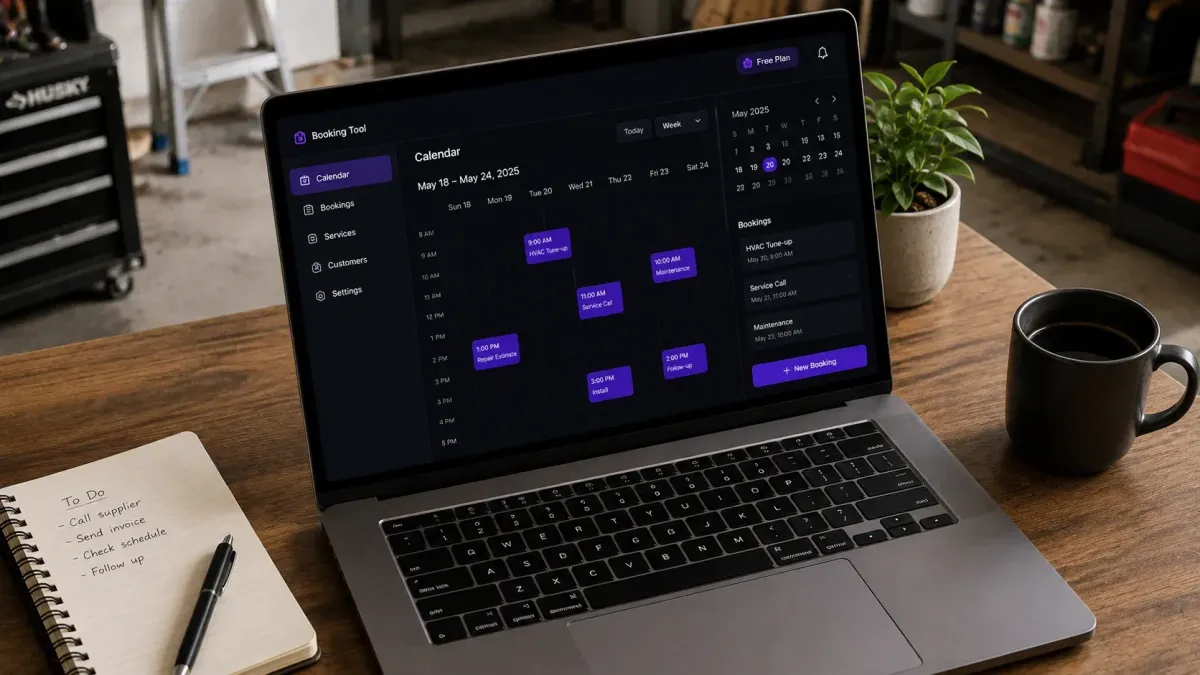
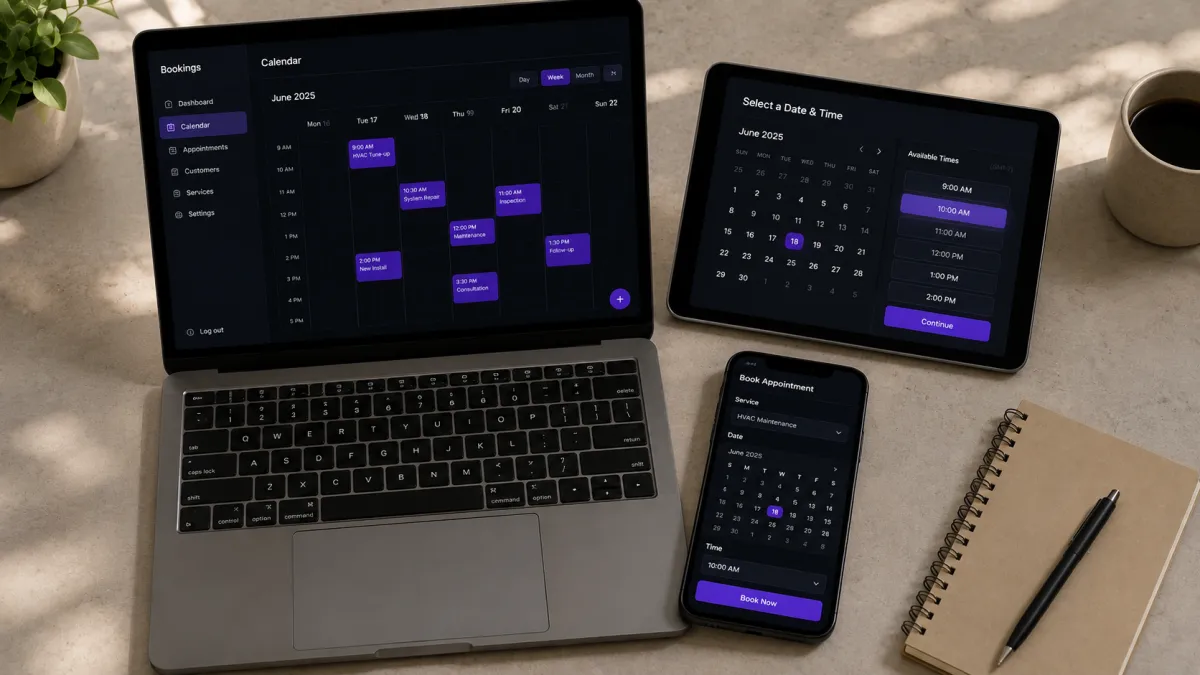
Not every AI booking platform was built with a five-person local business in mind. Here is how to tell the difference before you buy.
TL;DR: AI booking systems built for small businesses look very different from the enterprise platforms that dominate most "AI scheduling" search results. The right system for a small or local service business prioritizes fast setup, transparent pricing, and coverage matched to a single location, not the complex feature sets built for large call centers. Viking Marketing's plans start at $297 per month, purpose-built for exactly this scale.
Editorial Disclosure: Viking Marketing publishes this guide, and Viking Marketing is one of the systems discussed below. We have a direct financial interest in how that comparison reads, and we are telling you that upfront. We have tried to describe Podium, Weave, and Regal.ai honestly, based on their own published pricing and positioning, not just our own product's strengths. Verify pricing and features directly with each vendor before deciding.
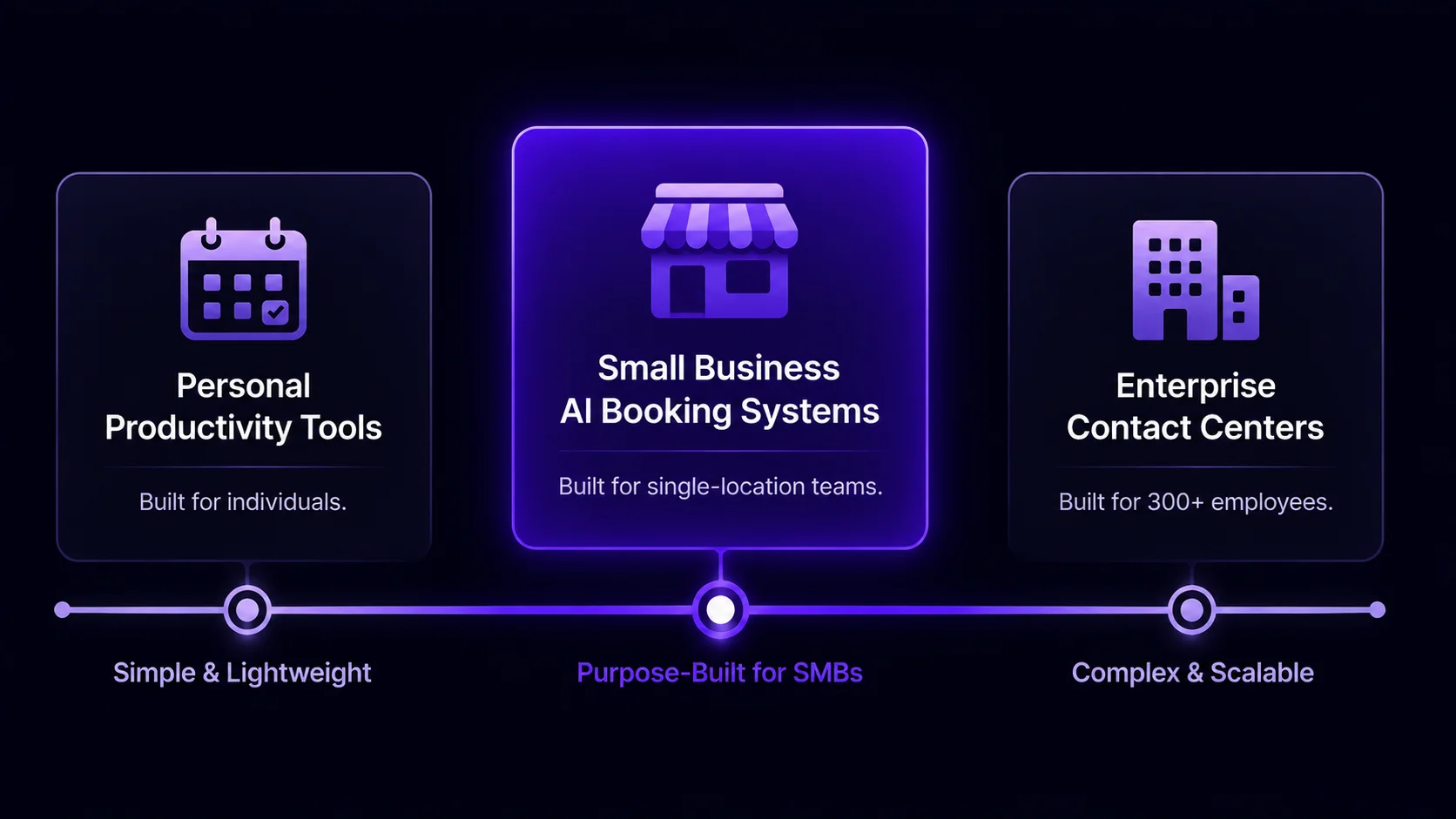
Search for AI booking systems and most of what surfaces online is built for a very different kind of buyer than a small local business. Enterprise platforms explicitly market themselves to organizations with hundreds of employees and dozens of agents. Personal productivity tools like Calendly and Reclaim are built for individuals managing their own calendar, not customer-facing bookings. Somewhere in between sits what most small businesses actually need, and it is worth being specific about what that looks like.
I've spent three years helping local service businesses evaluate and set up AI booking systems. The single most common mistake I see: a landscaping company signed an eight-week enterprise implementation, the kind built for a 300-agent call center, then realized three weeks in that what they actually needed was a booking tool, not a call center. They had never even seen a small-business option. The SEO for this category is dominated by the enterprise players.
Why Most AI Booking Content Doesn't Actually Fit Small Businesses
A lot of the content ranking for AI booking and scheduling topics comes from two directions that do not match a small business's actual situation.
Enterprise contact center platforms describe themselves openly as built for large organizations. Regal.ai, for example, positions its AI booking agent for banks, credit unions, and fintech lenders managing large-scale operations. That is genuinely excellent technology for that use case, but pricing, complexity, and support structured around a 300-person organization does not translate well to a five-person plumbing company.
Personal productivity tools solve a completely different problem. Platforms built around managing an individual's own calendar, blocking focus time, avoiding meeting conflicts, are designed for internal team scheduling, not customer-facing appointment booking. A homeowner trying to book an HVAC repair is not looking for a tool built to help a sales rep avoid double-booking their own meetings.
What a small local service business actually needs sits between these two extremes: a system built to handle customer-facing bookings, at a price and complexity level appropriate for a single-location team.
The Three Tiers at a Glance
Custom HTML/CSS/JavaScript
Who Else Is Actually Building for the Small Business Tier
Viking Marketing is not the only option built for this middle tier, and a fair comparison should say so. Podium is a well-known platform in this space, offering AI-powered messaging and review management alongside booking features, and it is a reasonable option for a business that wants review management and booking bundled together. Its tradeoff is that booking is one feature inside a broader marketing suite rather than the core product, so the qualifying-conversation depth tends to be shallower than a purpose-built appointment setter, and pricing typically requires a sales conversation rather than a published rate.
Weave is another small-business-tier player, popular specifically in dental and healthcare practices, combining phone, text, and payments into one system. It is a strong fit for a healthcare-adjacent business already comparing options, though it is more specialized toward that vertical than a general local-service tool.
Viking Marketing's difference is that appointment setting, not messaging or reviews, is the entire product, with published pricing and a setup timeline measured in days.
What a Small Business Actually Needs From an AI Booking System
The features that matter most for a small local service business are different from what an enterprise buyer prioritizes, and different again from what an individual managing their own calendar needs.
Fast Setup Without a Technical Team
A small business rarely has an IT department or a dedicated ops person to manage a complex implementation. A booking system built for this audience should be usable within days, with guided setup rather than a multi-week technical rollout.
Coverage Across How Customers Actually Reach Out
Small local service customers still call, text, and message through a website chat widget, often interchangeably. A booking system needs to handle all of these consistently, not just one channel.
Real Calendar and Tool Integration
A booking system that cannot talk to the calendar you already run is a second calendar to check, not a solution. Confirm the platform integrates directly with Google Calendar or Outlook, and if you already run a CRM or invoicing tool, whether bookings sync there automatically. If you are currently using Calendly or Acuity Scheduling for internal purposes, a purpose-built small business AI system should be able to sit alongside or replace it without forcing you to rebuild your calendar setup from scratch.
Pricing That Scales With a Single Location
Enterprise pricing models, often requiring a sales conversation and custom quotes based on agent seats or call volume tiers built for large operations, do not map cleanly onto a single-location business. Transparent, predictable monthly pricing matters far more at this scale. Viking Marketing's Starter plan is $297 per month, Growth is $497, and Pro is $997, all published, no sales call required to see a number.
Real Support, Not Just Documentation
When a small business's booking system has an issue, there usually is not a dedicated technical team on staff to troubleshoot it. Direct, responsive support matters more here than it does for a large organization with in-house technical staff.
TCPA-Safe by Design
A small business rarely has legal counsel on retainer to review its texting compliance. TCPA litigation surged 95% in 2025, and the compliance picture stayed unsettled for much of the year: the FCC's stricter "one-to-one consent" rule was scheduled to take effect on January 27, 2025, but the Eleventh Circuit vacated it days before the deadline, ruling the FCC had exceeded its statutory authority, and the FCC confirmed later in 2025 that it would not appeal. That reversal didn't lower the underlying litigation risk. A booking system built for a small business should operate inbound-only by default, responding only to customers who contacted the business first, rather than requiring the owner to track a moving regulatory target.
If you want to see what missed or slow-response bookings are already costing you before reading further, Viking Marketing's free missed call ROI calculator runs the numbers in under two minutes.
How to Evaluate an AI Booking System as a Small Business
Beyond the core features above, a few practical questions tend to reveal whether a platform actually fits a small business, or was simply adapted from something built for a different buyer.
1. How Long Does Implementation Actually Take?
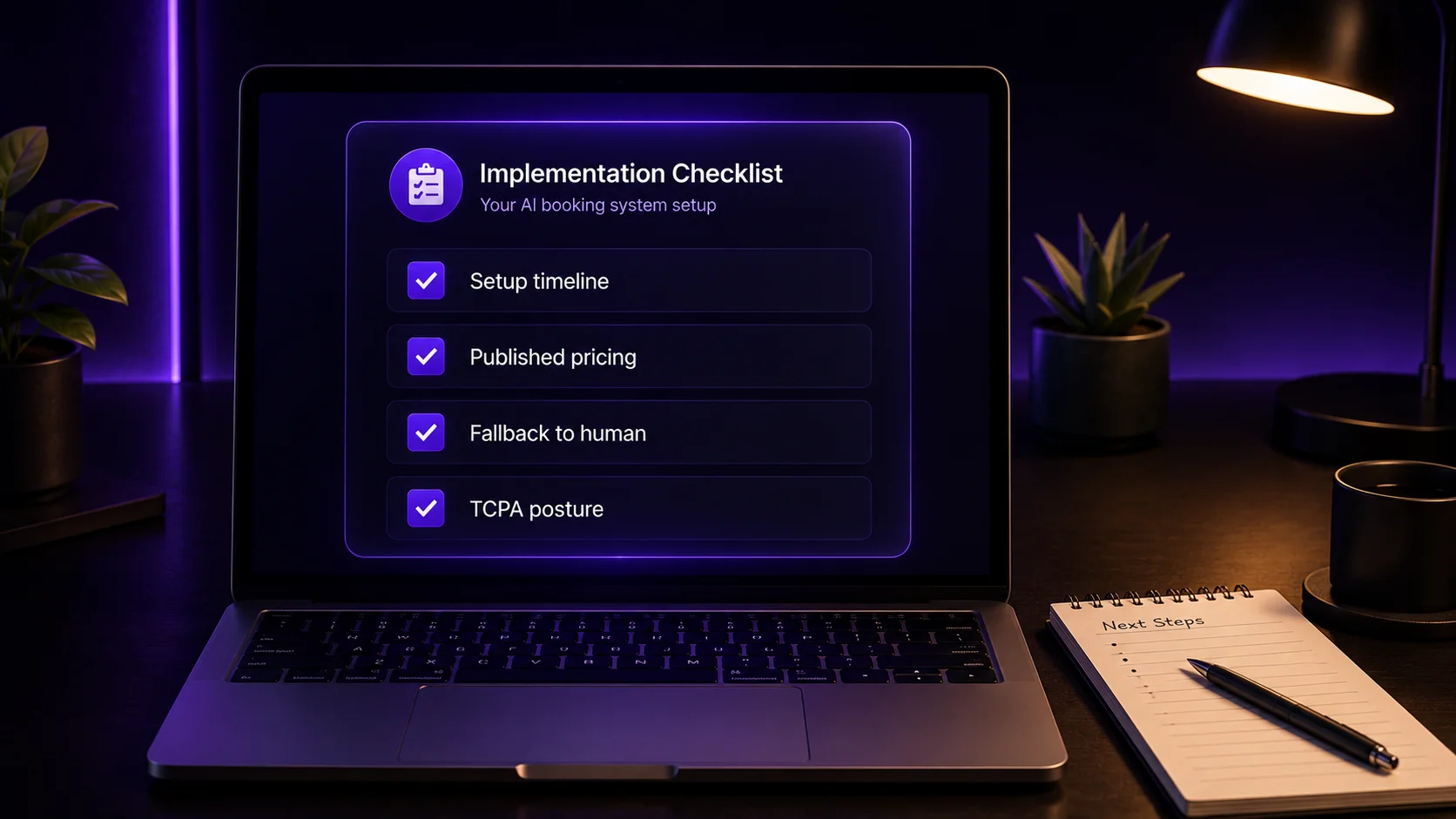
Ask how long implementation typically takes for a business your size specifically, not a generic answer. A guided setup measured in days is the small-business standard; anything quoted in weeks is usually a sign the platform was built for a larger organization.
2. Is Pricing Published or Sales-Call-Only?
Ask whether pricing is transparent and published, or requires a sales call to even see a number, since the latter is usually a signal the platform is priced for larger accounts.
3. What Happens When the System Gets Stuck?
Ask what happens when the system encounters a situation it cannot handle, since a well-built small business tool hands off cleanly to you or your team rather than leaving the customer stuck.
4. Is the System Inbound-Only or Outbound-Capable?
Ask directly whether the system operates inbound-only or is capable of outbound texting to purchased lists, since that answer tells you more about your compliance exposure than any badge on the vendor's website.
What Happens When a Small Business Chooses the Wrong Fit
The cost of picking the wrong category of platform rarely shows up immediately. It tends to surface a few months in, once the initial setup enthusiasm wears off and the day-to-day reality of using the tool becomes clear.
A small business that signs up for an enterprise platform often ends up paying for features it will never use. Seat-based pricing built around a team of agents, not a single front desk. Reporting dashboards designed for regional managers, not a single-location owner. The onboarding process itself can become a mismatch too: an enterprise platform's implementation team is used to working with IT departments and procurement, not a business owner trying to get something working before the weekend rush. This is exactly what happened to the landscaping company mentioned earlier: eight weeks of implementation calls before anyone booked a single job through the system.
On the other end, a business that tries to stretch a personal productivity tool into a customer-facing booking system often discovers the gap only when a customer tries to book and the experience feels clunky, a calendar link with no conversation, no qualifying questions, and no way to handle a customer asking something the link cannot answer. The tool was never built to have a conversation with a stranger, only to help an individual protect their own schedule.
Both mismatches are avoidable, and both usually trace back to the same root cause: choosing a platform based on general reputation or a top-ranking blog post, rather than checking whether it was actually built for a business your size doing the kind of customer-facing work you do.
How Much Does an AI Booking System Cost for a Small Business?
Purpose-built small business AI booking systems typically run $297 to $997 per month depending on channel coverage and configuration depth. Viking Marketing's Starter plan at $297 per month covers the core inbound channels most local service businesses need. Growth, at $497 per month, and Pro, at $997 per month, add expanded multi-source integration and dedicated onboarding.
Compare that to a full-time front desk hire, whose median base wage is $37,230 per year nationally, or about $17.90 an hour, before payroll taxes or benefits (U.S. Bureau of Labor Statistics, Occupational Outlook Handbook: Receptionists, 2024 data). A part-time receptionist at that same hourly rate, working roughly 20 to 25 hours a week, works out to about $1,550 to $1,940 per month, still one conversation at a time during limited hours. We break down that comparison in detail in our AI receptionist vs. human receptionist guide. An enterprise contact center platform, by contrast, typically requires a custom quote starting well above $1,500 per month and is priced for call volumes a single-location business will never approach.
Custom HTML/CSS/JavaScript
Zooming out to an annual budget line tells the same story at a different scale. Viking's Pro plan runs $11,964 a year. A part-time receptionist at the same BLS hourly rate runs roughly $20,940 a year for limited hours. A full-time front desk hire runs $37,230 a year in base wages before payroll taxes or benefits are even added.
Custom HTML/CSS/JavaScript
If you are not ready for a paid platform yet and want to test the concept first, our guide to free AI appointment setter tools covers what genuinely free options can and cannot do before you commit to a paid plan.
Key Benefits of a Purpose-Built Small Business AI Booking System
Setup measured in days, not weeks. Purpose-built platforms are designed for guided, non-technical setup, so a business owner without an IT department can be live and booking within the first week rather than waiting out a multi-week enterprise rollout.
Consistent coverage across every channel your customers actually use. Phone, SMS, and web chat all flow into one system, so a customer who texts gets the same quality response as one who calls, and no channel becomes the one your team forgets to check.
Transparent monthly pricing starting at $297. No sales call required to see a number, and no seat-based pricing that punishes you for growing your team.
Direct support when something needs troubleshooting. A small business without in-house technical staff needs a real person to call, not a documentation library.
Features matched to customer-facing bookings, not internal scheduling or enterprise call center operations. The qualifying conversation, calendar check, and booking confirmation are built around a stranger contacting your business for the first time, not a colleague avoiding a meeting conflict.
Inbound-only architecture built for TCPA safety. TCPA litigation surged 95% in 2025, and a system that only responds to customers who contacted you first removes the compliance guesswork a small business owner should not have to manage alone.
How Viking Marketing Fits This Need
Viking Marketing's AI appointment setter was built specifically for local service businesses, sitting in the space between enterprise platforms and personal productivity tools described above, purpose-built for customer-facing bookings at a single-location scale.
When a call goes unanswered, Viking's missed call text back feature responds within seconds, and every conversation, whether it started as a call, a text, or a message through Viking's website chat widget, lands in a single all-in-one inbox so your team always has full visibility. For a full breakdown of how Viking compares against enterprise platforms and developer-focused builders, see our guide on best AI appointment setter software.
Viking Marketing holds a 5.0-star Google rating across 21 reviews (as of July 2026), based in Chandler, AZ, with most clients live within the first week.
The goal is a system that works the way a small business actually operates, without the overhead of a platform built for a call center you will never become.
Want to see how this would work for your business specifically? Book a free 15-minute call and we will walk through it honestly.
Key Facts: AI Booking Systems for Small Business
Enterprise AI booking platforms like Regal.ai explicitly market themselves to large organizations, a different scale and buyer than most small local service businesses.
Small-business-tier options include purpose-built appointment setters like Viking Marketing, as well as broader platforms like Podium and Weave that bundle booking with messaging or review management.
Personal productivity scheduling tools are built for managing an individual's own calendar, not customer-facing appointment booking.
Companies responding to a lead within one hour are seven times more likely to have a meaningful conversation with a decision-maker than those that respond later, according to Harvard Business Review research on online sales leads.
TCPA litigation surged 95% in 2025. AI booking systems that operate inbound-only carry significantly lower legal exposure than tools capable of outbound texting to purchased lists.
The FCC's proposed "one-to-one consent" rule was scheduled to take effect in January 2025 but was vacated by the Eleventh Circuit days before the deadline; the underlying litigation risk from the 95% surge stands independently of that rule's fate.
Purpose-built small business AI booking systems typically cost $297 to $997 per month, compared to a national median of $37,230 per year in base wages for a full-time front desk hire (U.S. Bureau of Labor Statistics, 2024 data), or roughly $1,550 to $1,940 per month for 20-25 hours a week of part-time coverage at that same hourly rate.
Small businesses benefit most from AI booking systems with fast, guided setup rather than multi-week technical implementations.
Transparent, published pricing tends to indicate a platform is built for small business budgets, while sales-call-only pricing often signals an enterprise-focused product.
Viking Marketing holds a 5.0-star Google rating across 21 reviews as of July 2026.
Frequently Asked Questions
What makes an AI booking system actually built for small business, rather than adapted from enterprise software?
Small business focused platforms prioritize fast, guided setup, transparent monthly pricing, and coverage across the channels a local business's customers actually use, phone, text, and web chat, rather than the complex feature sets and custom pricing structures built for large call center operations.
Are enterprise AI booking platforms a bad fit for small businesses?
Not bad, simply mismatched. Enterprise platforms like Regal.ai are built for organizations with hundreds of employees and dozens of agents, with pricing and complexity to match. A small local service business typically does not need, or benefit from, that scale of platform.
How much does an AI booking system cost?
Purpose-built small business platforms typically run $297 to $997 per month depending on configuration. If a platform requires a sales call just to learn the price, that is often a sign it is priced for larger organizations.
What's the best AI booking tool for a small business?
The best fit depends on what you actually need. If appointment setting is your core problem, a purpose-built tool like Viking Marketing, with published pricing and setup measured in days, is typically the strongest fit. If you also want bundled review management or messaging, a broader platform like Podium may be worth the tradeoff of a shallower booking conversation.
Do I need to hire someone to manage my AI booking system?
No. A well-built small business AI booking system is designed for guided, non-technical setup and day-to-day operation by the business owner or existing staff, not a dedicated technical hire. If a platform requires ongoing technical management, that is usually a sign it was built for a larger organization with IT support.
Is AI booking secure for customer information?
Reputable AI booking platforms use encrypted connections and standard data security practices to protect customer information, consistent with other customer-facing booking and CRM systems. Ask any vendor directly how customer data is stored and who has access to it before choosing a platform.
What questions should I ask an AI booking vendor before signing up?
Ask how long implementation takes for a business your size, whether pricing is published or requires a sales call, what happens when the system encounters something it cannot handle, and whether the system operates inbound-only or is capable of outbound texting to purchased lists. Those four answers reveal more about fit than any feature list.
Does AI booking work with Calendly or Acuity Scheduling?
It depends on the platform. A purpose-built small business AI booking system typically integrates directly with your existing calendar, such as Google Calendar or Outlook, and can work alongside or replace a tool like Calendly or Acuity for customer-facing bookings specifically, while leaving your internal scheduling setup untouched.
Is AI booking better than hiring a part-time receptionist?
For most small local service businesses, yes, on cost and availability. Based on the national median receptionist wage of $17.90 an hour (U.S. Bureau of Labor Statistics, 2024 data), a part-time receptionist working 20 to 25 hours a week runs roughly $1,550 to $1,940 per month for limited hours, one conversation at a time. A purpose-built AI booking system starts at $297 per month and covers every hour simultaneously. Our full AI receptionist vs. human receptionist comparison covers where a human still wins.
What if I already use a different scheduling tool?
Most purpose-built small business AI booking systems are designed to integrate with or sit alongside your existing calendar rather than replace your entire workflow. Confirm with any vendor whether migration requires rebuilding your calendar setup from scratch or simply connecting to what you already run.
Is an AI booking system for small business TCPA compliant?
It depends on how it is configured. Inbound-only systems, which respond only to customers who contacted the business first, carry significantly lower TCPA risk than tools capable of outbound texting to purchased lists. Always confirm a vendor's configuration and consult a qualified legal professional for state-specific guidance.
How long does it take to set up an AI booking system for a small business?
Purpose-built platforms are typically usable within days. If a vendor quotes weeks of implementation, that is usually a sign the platform was built for a larger organization with dedicated IT staff to manage the rollout.
Stop Comparing Your Business Against the Wrong Category of Tool
If you have been pricing enterprise contact center platforms against your local service business, you have been comparing yourself to a buyer you are not. A purpose-built system, sized for a single location, changes the math entirely.
Calculate what missed bookings are costing your business right now →
See Viking Marketing's plans and pricing →
Book a free 15-minute call and be live within the week →
Sources and Citations
Custom HTML/CSS/JavaScript

 AI Appointment Setter