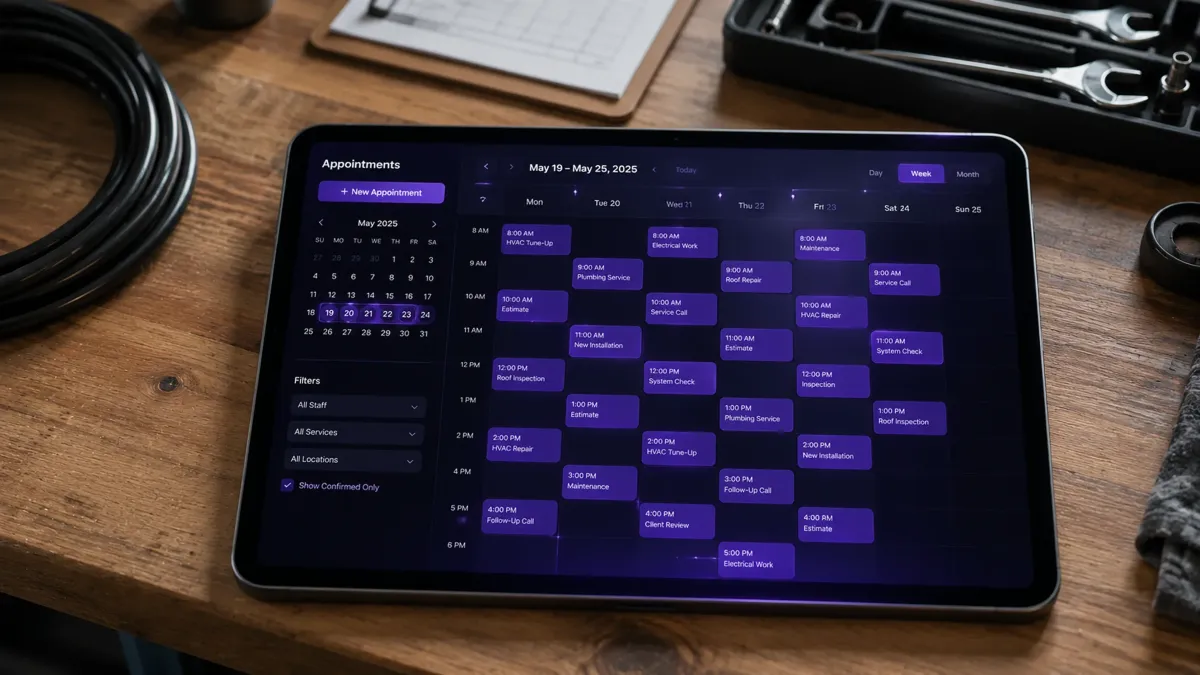
Automated Appointment Setting: How It Works (2026 Guide)
How local service businesses are booking more jobs without anyone sitting by the phone waiting for it to ring.
About the author: Charlie DeFelice is an Arizona entrepreneur who has spent over 10 years building and running businesses in the Chandler area, starting in solar sales before founding Viking Marketing to bring enterprise-grade AI automation to local service businesses. He works hands-on with AI automation, CRM strategy, and online reputation management, including building live database-reactivation campaigns that handle conversations with over 2,000 people daily. More about Viking Marketing.
TL;DR: Automated appointment setting is the process of using software to handle an entire booking conversation, from the first message a customer sends to the confirmed appointment on your calendar, without a staff member managing each step by hand. It combines instant response, lead qualification, and calendar booking into one automatic process. This is the umbrella term for a category of tools, and this guide covers how it works, what it costs, and which specific type of tool actually fits your business.
Every missed call is a small decision a customer makes without you. They decide whether to leave a voicemail, wait for a callback, or just call the next business on the list. Most of the time, they choose the third option.
Automated appointment setting exists to remove that decision entirely, by making sure the response happens before the customer ever has a reason to look elsewhere.
I have spent three years helping local service businesses put automated systems like this in place, and the result is almost always the same. The businesses that adopt it are not trying to replace their team. They are closing the exact gaps where a person could never realistically be available, nights, weekends, and the moments when three people reach out at once.
What Does Automated Appointment Setting Actually Mean?
Automated appointment setting refers to software that takes over the repetitive parts of booking a customer: responding to their initial message, asking the right questions to understand what they need, checking your calendar for real availability, and confirming the appointment, all without a person needing to be available in that exact moment.
This is different from a simple online booking link, where a customer picks a time slot themselves with no conversation involved. Automated appointment setting behaves more like a conversation. It reads what the customer is asking for using natural language processing, qualifies whether they are a good fit for the service, and only then moves to booking the actual time.
How the Process Actually Works, Step by Step
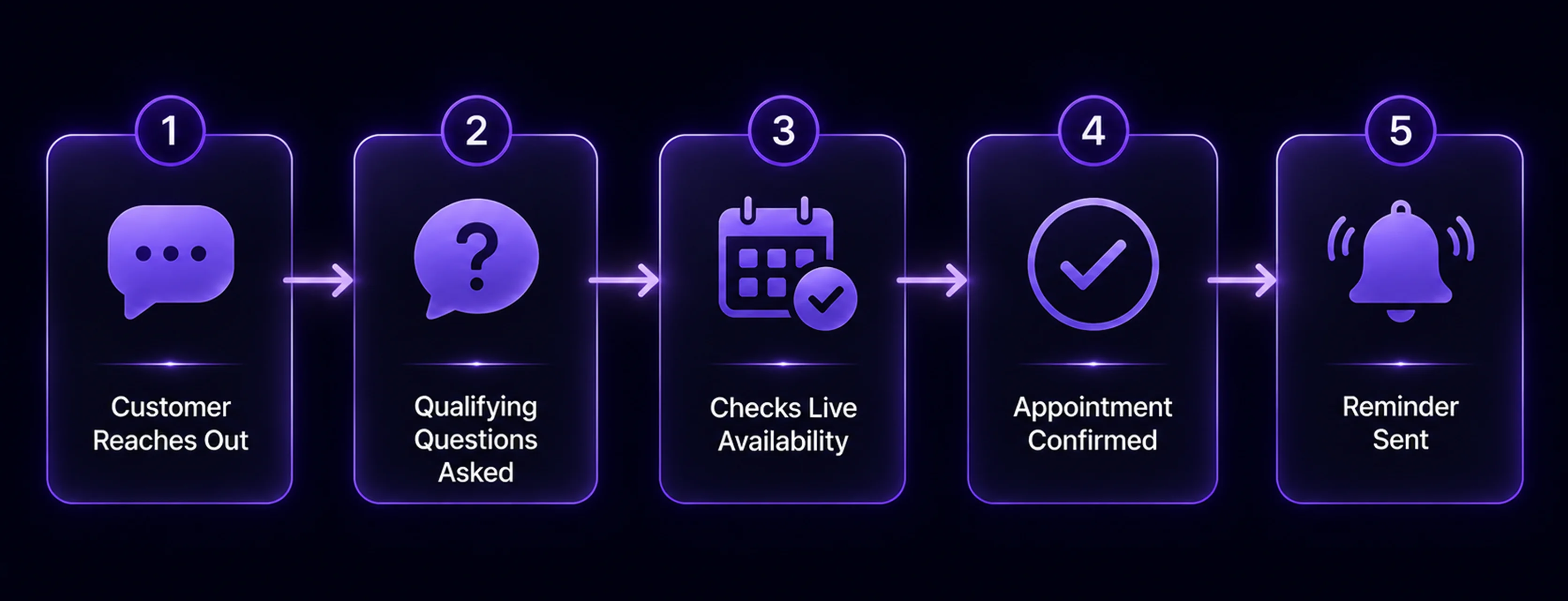
Here is the exact sequence, from first message to confirmed booking.
Step 1: The Customer Reaches Out
A customer contacts your business by phone, text, or web chat. They do not need to know an automated system exists. They just send a message the way they normally would.
Step 2: The System Asks Qualifying Questions
The AI responds within seconds and asks a few clarifying questions, what service they need, their location, or when they are available. This is not a script. It reads the customer's actual response and adapts the next question accordingly.
Step 3: It Checks Calendar Availability in Real Time
The system checks your actual calendar before offering any time slot, factoring in existing bookings and any buffer time your business needs between appointments. No double-booking.
Step 4: It Confirms the Appointment
Once a time is agreed on, the system confirms the appointment on the spot and sends a summary to the customer through the same channel they used to reach out.
Step 5: It Sends a Reminder Before the Appointment
Closer to the appointment date, the system follows up automatically with a reminder, which is the single most effective lever for reducing no-shows.
And if the conversation touches on something the system cannot confidently handle, it hands the conversation to a real person along with full context, so the customer never has to repeat themselves.
Automated Appointment Setting Is an Umbrella Term. Here Is How the Pieces Fit Together.
If you have been researching this topic, you have probably run into several overlapping terms: AI booking agent, AI lead qualifier, AI appointment setting chatbot, AI appointment scheduling software. These are not competing categories. They are different pieces of the same automated appointment setting process, and understanding how they relate makes it much easier to know exactly what your business needs.
AI appointment scheduling software is the broadest category, the general term for any software platform that handles automated booking. This article you are reading now sits at that same broad level, explaining the process itself rather than one specific tool.
An AI booking agent is the tool that actively executes the conversation end to end, engaging a lead the moment they reach out and completing the booking without the customer needing to find a link or fill out a form.
An AI lead qualifier is the specific piece focused on sorting and prioritizing incoming leads using the BANT framework, budget, authority, need, and timeline, before a booking conversation even begins. Not every automated appointment setting system needs deep qualification, but for businesses with high lead volume, this is often the highest-leverage piece.
An AI appointment setting chatbot refers specifically to the conversational interface most customers actually interact with, most commonly through text or web chat.
In practice, a well-built automated appointment setting system combines all of these into one process: a chatbot-style interface, running an AI booking agent's logic, using an AI lead qualifier's criteria, built on top of AI appointment scheduling software. Viking Marketing's system is built this way, as one integrated tool rather than four separate products.
Why Response Speed Is the Real Driver Behind Automated Appointment Setting
Most businesses assume the value of automated appointment setting is convenience. The bigger factor is actually speed.
Customers comparing local service businesses rarely wait around for a reply. They message two or three companies at the same time and go with whoever responds first, often within the first few minutes. The original MIT and InsideSales.com Lead Response Management study found that businesses responding within five minutes of a lead inquiry are 100 times more likely to make contact, and 21 times more likely to qualify that lead, than those who wait 30 minutes. A separate Harvard Business Review study found that companies responding within one hour are seven times more likely to have a meaningful conversation with a decision-maker than those that wait longer.
Automated appointment setting removes the delay entirely. Whether a message comes in at 10 AM on a Tuesday or 11 PM on a Saturday, the response time stays exactly the same. That consistency, not just the fact that a calendar gets updated automatically, is what actually drives the booking increase businesses see.
Automated Appointment Setting vs Manual Booking
The comparison is less about which approach is "better" in the abstract and more about which gaps each one leaves open.
A manual booking process depends entirely on a person being available, checking messages, and following up promptly. That works fine during business hours when staffing is solid. It breaks down during busy periods, after hours, and whenever more than one customer reaches out at the same time.
Automated appointment setting does not have those gaps. It responds instantly regardless of volume or time of day, follows up consistently with leads who go quiet, and applies the same qualifying questions to every conversation without variation. What it cannot do is handle a genuinely unusual situation with the same judgment a person would bring, which is why the best systems are built to recognize those moments and hand the conversation to a human.
Most local service businesses that adopt automated appointment setting are not trying to remove people from the process. They are filling the specific gaps, nights, weekends, and high-volume moments, where manual booking naturally falls short.
Which Businesses Benefit Most From Automated Appointment Setting?
The businesses that see the strongest results share one trait: their customers are comparing multiple providers and deciding quickly.
Home service businesses like HVAC, plumbing, electrical, and pest control fit this pattern closely, since urgent requests often go to whoever answers first. See how this works for HVAC and home services specifically.
Healthcare and dental practices use automated appointment setting to manage high call volumes and reduce no-shows without adding staff. Viking Marketing's dental setup handles new patient intake automatically.
Salons and spas rely on it to keep the calendar full and handle last-minute cancellations without staff monitoring every channel.
Real estate agents use it to respond to property inquiries the moment they come in, regardless of the hour, when a prospect's interest is at its peak.
Insurance agencies use it to respond to quote requests before competing agents call back. See Viking Marketing's insurance-specific configuration.
Businesses with very low appointment volume or highly complex, one-off scheduling needs tend to see less benefit, since the value of automation grows with the number of repeatable booking conversations happening each week.
How Much Does Automated Appointment Setting Cost?
Viking Marketing's own plans run $297 to $997 per month, depending on channel coverage and configuration depth, with an entry-level voice-only tier starting as low as $65 per month.
Compare that to a full-time front desk employee, whose median pay nationally is $33,960 per year according to the Bureau of Labor Statistics, commonly landing in the $30,000 to $45,000 range once local market rates and benefits are factored in, and covering business hours only, one conversation at a time. The automated system covers every hour of every day simultaneously, for a fraction of the annual staffing cost.
Want to see what your business is actually losing to slow response and missed after-hours leads right now? Viking Marketing's free missed call ROI calculator runs the numbers on your specific volume in under two minutes.
Is Automated Appointment Setting TCPA Compliant?
Because automated appointment setting includes automated text confirmations and reminders, this question deserves a direct answer.
The Telephone Consumer Protection Act governs how businesses can send automated text messages. TCPA litigation surged 95% in 2025, and the FCC's expanded one-to-one consent rules that took effect in January 2025 raised the legal exposure for outbound automated texting meaningfully.
The safest configuration is inbound-only: the system responds and follows up exclusively within conversations the customer initiated. A confirmation or reminder sent to a customer who already messaged your business is fundamentally different, legally, from an automated text sent to a purchased lead list that never contacted you first.
Before choosing any automated appointment setting platform, ask the vendor directly whether the system is inbound-only or capable of outbound texting to lists. Always consult a qualified legal professional for guidance specific to your state. Viking Marketing's system operates inbound-only across every channel.
Key Benefits of Automated Appointment Setting
Instant response at any hour. Businesses responding within five minutes are 100 times more likely to make contact than those waiting 30 minutes. Automated appointment setting removes the delay that costs businesses their fastest-moving leads, whether that lead arrives at noon or at midnight.
Consistent lead qualification. Every conversation follows the same qualifying process regardless of volume or who is handling it, which means the fiftieth lead of the day gets the same accurate treatment as the first.
Fewer no-shows. NIH research on appointment reminder systems found that automated confirmations and reminders reduce no-show rates from 23.1% to 13.6% in a general health setting. Automated appointment setting sends those reminders every time, without relying on staff memory.
Lower overhead. A full-time front desk hire commonly costs $30,000 to $45,000 per year (national BLS median for receptionists is $33,960) and covers business hours only. Automated appointment setting covers every hour, for a fraction of that annual cost.
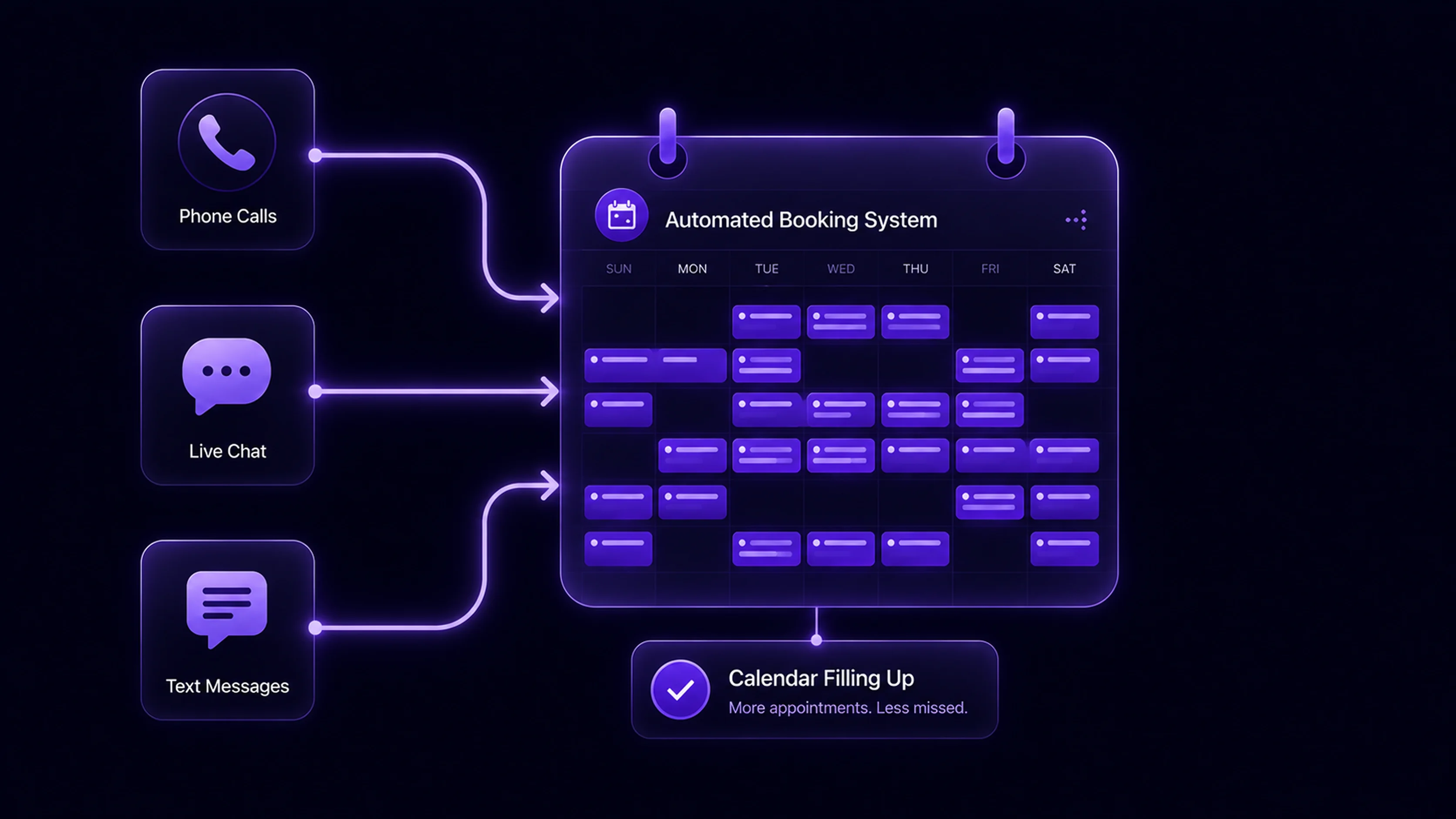
Multichannel coverage. Phone, text, and web chat conversations all flow into a single booking process, so no channel becomes the one your team forgets to check.
Scalable capacity. The system manages a sudden spike in inquiries, a slow Tuesday turning into a busy Friday, without becoming overwhelmed the way a single staff member would.
How Viking Marketing's Automated Appointment Setting Works
Viking Marketing's AI appointment setter was built specifically for local service businesses that cannot afford to lose a booking because nobody was available to respond in time.
When a call goes unanswered, Viking's missed call text back feature sends a text within seconds, keeping the conversation alive instead of letting the customer move on to the next business on their list. From there, the system asks the right qualifying questions using AI lead qualifier logic, checks your calendar, and confirms the appointment directly through a fully automated AI booking agent.
Every conversation, whether it started as a call, a text, or a web chat message, lands in Viking's all-in-one inbox, so your team has full visibility without checking multiple apps.
Viking Marketing holds a 5.0-star Google rating across 21 reviews, based in Chandler, AZ, with most clients live and booking within the first week of setup.
The result behaves like a full front desk team, minus the payroll, running the same way at midnight as it does at noon.
Want to see how this would work for your business specifically? Book a free 15-minute call and we will walk through it together (see the link below).
Key Facts: Automated Appointment Setting Statistics
Businesses responding within five minutes of a lead inquiry are 100 times more likely to make contact and 21 times more likely to qualify that lead than those waiting 30 minutes, based on the MIT and InsideSales.com Lead Response Management study.
Companies responding within one hour are seven times more likely to have a meaningful conversation with a decision-maker than those that respond later, according to Harvard Business Review.
NIH research found that automated appointment reminder systems reduce no-show rates from 23.1% to 13.6% in a general health setting.
TCPA litigation surged 95% in 2025. Automated appointment setting systems that operate inbound-only carry significantly lower legal exposure than outbound automated texting tools.
Automated appointment setting combines instant response, lead qualification, and calendar booking into a single automatic process, and is built to hand off conversations to a human team member when a request needs judgment the system cannot confidently apply.
Home service, healthcare, salon, insurance, and real estate businesses tend to see the strongest results, since response speed has a direct impact on booking rates in each of these industries.
Viking Marketing holds a 5.0-star Google rating across 21 reviews as of July 2026.
Frequently Asked Questions: Automated Appointment Setting
What does automated appointment setting actually mean?
Automated appointment setting refers to software that manages the entire booking conversation, from the first customer message to the confirmed appointment, including qualifying questions, calendar checks, and confirmations, without a staff member handling each step manually.
How is automated appointment setting different from a simple online booking link?
A booking link lets a customer pick a time slot themselves with no conversation involved. Automated appointment setting behaves more like a real conversation, understanding what the customer is asking for, qualifying their request, and only then confirming a time, which allows it to handle a wider range of situations than a static booking page.
Does automated appointment setting work outside of business hours?
Yes. One of the main advantages of automated appointment setting is that response time stays the same regardless of the hour, so a message sent at midnight receives the same fast reply as one sent during the middle of the business day.
Can automated appointment setting handle unusual or complex requests?
Well-designed systems are built to recognize when a conversation needs human judgment and hand it off to a real team member along with full context, rather than attempting to force every situation through an automated process.
Which businesses benefit most from automated appointment setting?
Businesses where customers are comparing multiple providers and deciding quickly tend to benefit most, including home service companies, healthcare and dental practices, salons and spas, insurance agencies, and real estate agents, since response speed has a direct impact on whether a customer books.
How much does automated appointment setting cost?
Viking Marketing's own plans run $297 to $997 per month depending on configuration, with an entry-level tier starting around $65 per month. That compares to $30,000 to $45,000 per year for a full-time front desk employee covering business hours only (the national median for receptionists is $33,960/year per the Bureau of Labor Statistics).
Is automated appointment setting TCPA compliant?
It depends on how it is configured. Inbound-only systems, which respond and follow up exclusively within conversations the customer initiated, carry significantly lower TCPA risk than tools capable of outbound texting to purchased lists. Always confirm a vendor's configuration and consult a qualified legal professional for state-specific guidance.
What is the difference between automated appointment setting and an AI booking agent?
Automated appointment setting is the broad process. An AI booking agent is the specific tool that actively executes that process end to end, engaging a lead the moment they reach out and completing the booking without requiring the customer to find a link or fill out a form.
How long does it take to set up automated appointment setting?
With Viking Marketing, most local service businesses are live and booking appointments within the first week. If a vendor quotes six to eight weeks, you are buying a software implementation project, not a ready-to-use tool.
Stop Missing Bookings While Nobody Is Watching the Phone
Every message that goes unanswered tonight is a booking on a competitor's calendar by tomorrow morning.
Automated appointment setting closes that gap without adding payroll. Viking Marketing's system responds in seconds across every channel, qualifies the lead, checks your calendar, and confirms the appointment, whether it is Tuesday at noon or Saturday at midnight.
Calculate what missed bookings are costing your business right now →
See Viking Marketing's plans and pricing →
Book a free 15-minute call and be live within the week →
Sources and Citations
Dr. James Oldroyd, MIT Sloan School of Management and InsideSales.com, Lead Response Management Study (2007): https://www.leadresponsemanagement.org/lrm_study/
Harvard Business Review, "The Short Life of Online Sales Leads": https://hbr.org/2011/03/the-short-life-of-online-sales-leads
National Institutes of Health, "Reducing Appointment No-Shows: Going from Theory to Practice": https://pmc.ncbi.nlm.nih.gov/articles/PMC3962267
U.S. Bureau of Labor Statistics, Occupational Outlook Handbook, "Receptionists" (May 2025 data): https://www.bls.gov/ooh/office-and-administrative-support/receptionists.htm
ActiveProspect, "TCPA Text Messages: Rules and Regulations Guide for 2026": https://activeprospect.com/blog/tcpa-text-messages/
Viking Marketing: https://vikingmarketing.ai
Viking Marketing, Google Business Profile (5.0 stars, 21 reviews): https://www.google.com/maps/place/Viking+Marketing/data=!4m2!3m1!1s0x0:0x55e9f746330e73f4