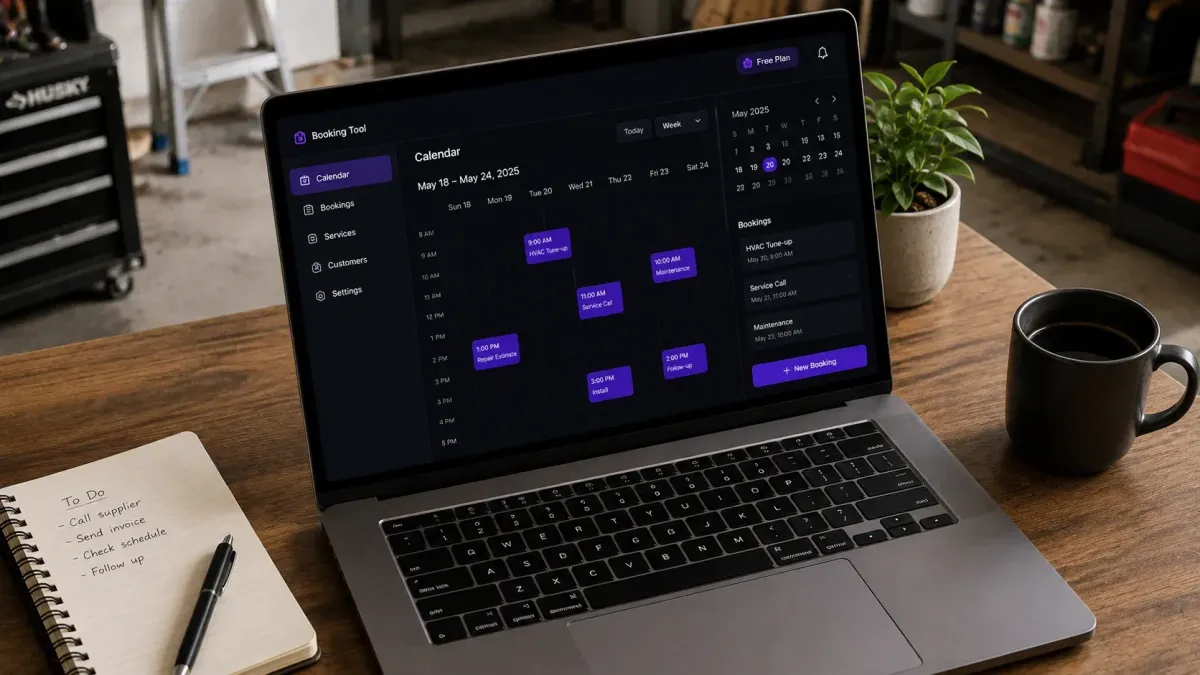
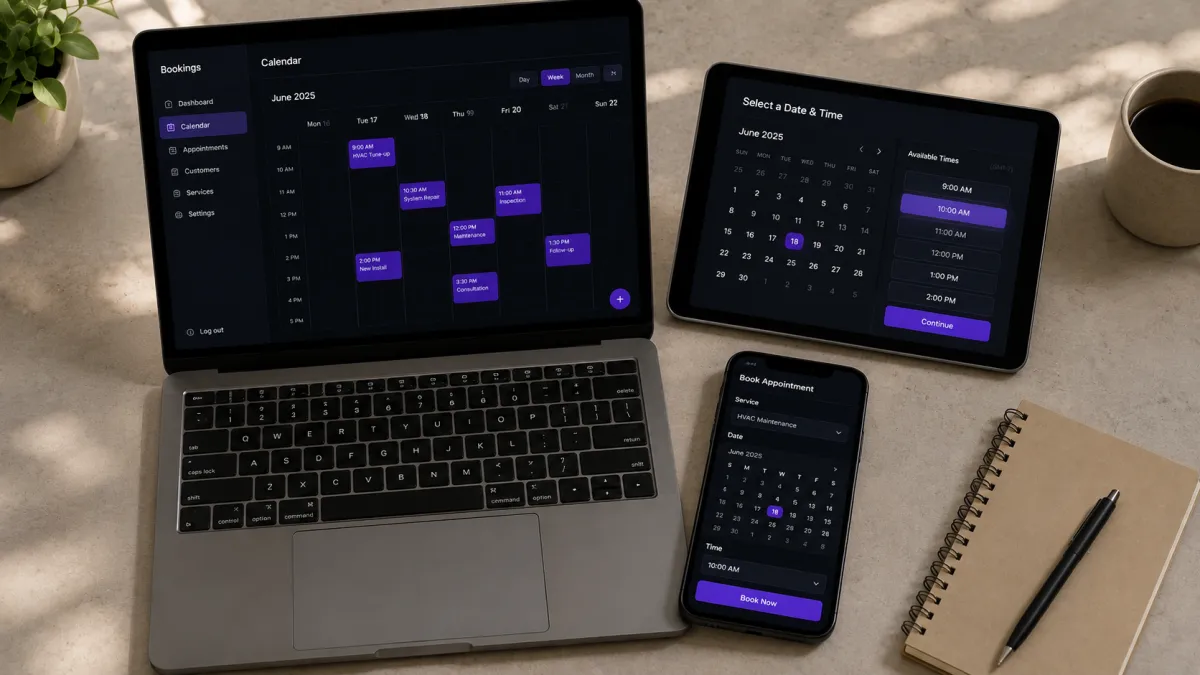
The digital front desk that never closes, never gets overwhelmed, and never lets a lead slip through after hours.
Author: Charlie DeFelice, Founder of Viking Marketing
TL;DR: An AI booking agent, in the context of local service businesses, is software that automatically responds to customer inquiries, checks calendar availability, and confirms appointments without any staff involvement. It works across phone, text, web chat, and social messaging, at any hour, and handles as many conversations simultaneously as needed. This guide covers how it works, what it costs, how it differs from other booking tools, and how to choose the right one for your business.
It is Saturday afternoon. A homeowner scrolls through local businesses trying to book a service before the weekend is over. They message three companies at once. Two of them do not reply until Monday morning. One replies in under a minute, confirms a time slot, and locks in the job before the other two even see the notification.
That business was not staffed by someone glued to their phone all weekend. It was running an AI booking agent.
I have spent three years helping HVAC contractors, dental practices, insurance agencies, and home service businesses set up AI booking systems. The pattern I see every time is identical. The business that responds first captures the booking. The ones that check messages Monday morning are following up on leads that booked elsewhere Friday night.
This guide covers what an AI booking agent actually is, how it differs from other booking tools, what it costs, and what to look for when choosing one.
What Is an AI Booking Agent and How Does It Work?
An AI booking agent is software built to handle the entire scheduling conversation automatically, the way a front desk person would, except it works at 2 AM on a Sunday just as reliably as it does at 2 PM on a Tuesday.
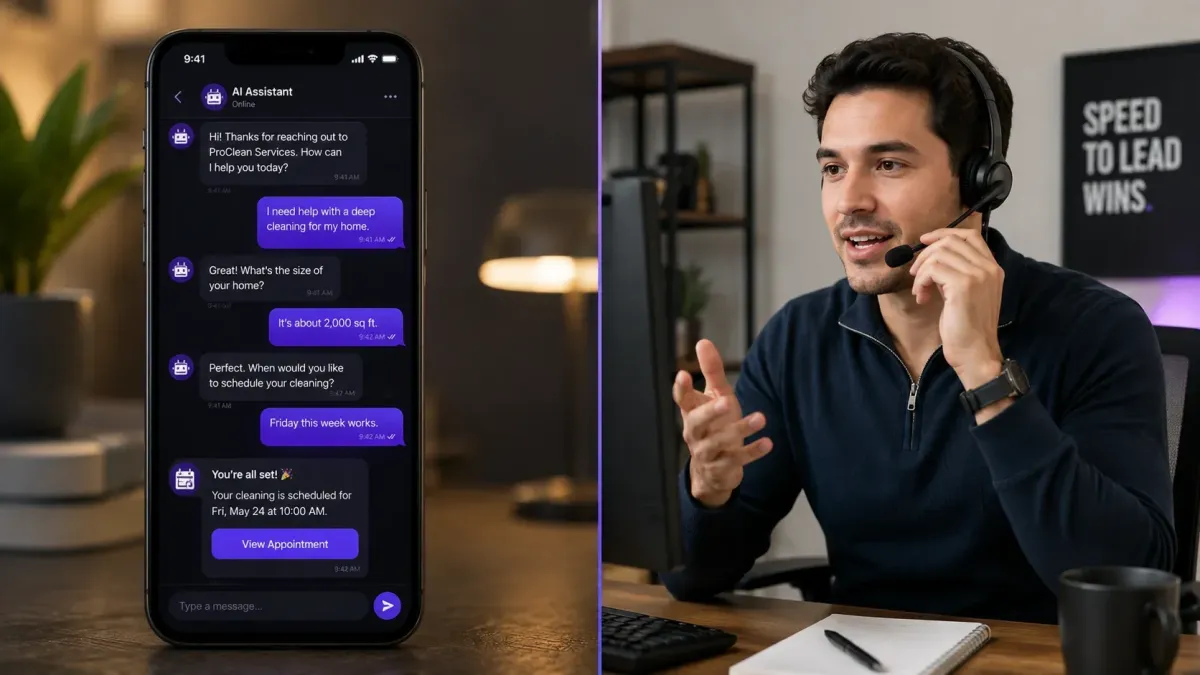
When a customer reaches out by phone, text, Instagram DM, Facebook Messenger, or web chat, the AI booking agent responds immediately. It uses natural language processing to understand what the customer is actually asking not matching rigid keywords, but reading intent — and guides the conversation toward a confirmed appointment.
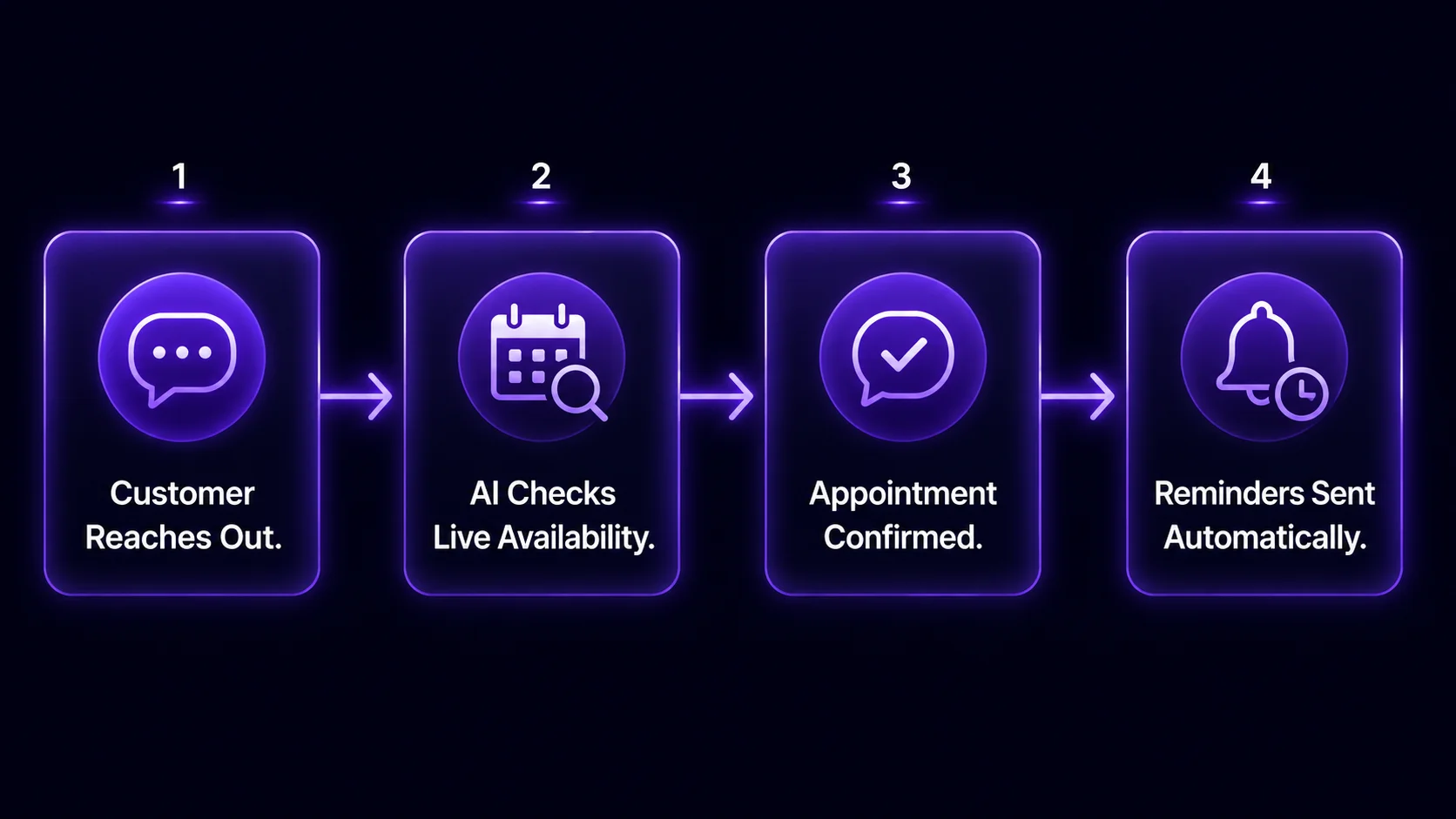
Here is the exact sequence of what happens:
Step 1: The Customer Reaches Out
The prospect contacts your business through any connected channel. They do not need to find a scheduling link, fill out a form, or know that an AI system exists. They just send a message the way they normally would.
Step 2: The AI Reads the Request and Checks Real Availability
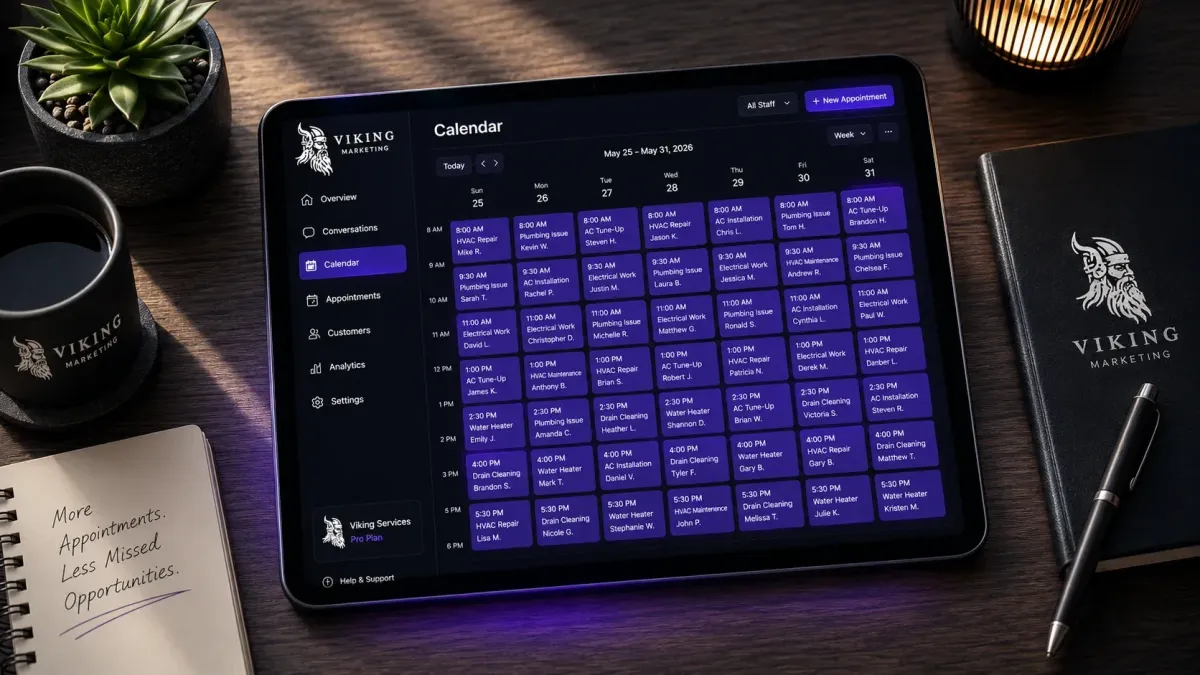
The AI reads what the customer wrote, identifies the service they need, and checks your live calendar in real time. It factors in existing bookings, buffer time between appointments, and any rules you have configured for specific service types or locations. It does not offer a time slot that is already taken.
Step 3: The Appointment Is Confirmed in Real Time
Once it finds a slot that works, it confirms the appointment directly with the customer. The booking is logged into your system immediately. No back-and-forth delays, no waiting for someone to manually check a calendar, no booking confirmation email that sits unread in an inbox for three hours.
Step 4: The System Sends Confirmation and Reminders Automatically
After confirming, the AI sends an immediate booking summary to the customer through the same channel they used to contact you. It then follows up with automated reminders before the appointment date. And if the conversation touches something the AI cannot confidently handle, it hands the full conversation context to a real person so the customer never has to repeat themselves.
What Makes an AI Booking Agent Different from Regular Scheduling Software?
This distinction matters, and most articles about this category skip it entirely.
Traditional scheduling software, think Calendly or Acuity Scheduling, is passive. It waits for the customer to do all the work. They have to find the booking link, open it, pick a service type from a menu, choose a time slot, fill in their details, and submit the form. If they cannot find the link, give up midway, or reach out through a different channel, the booking does not happen and no one on your team knows it almost did.
An AI booking agent is active. The customer just sends a message, anywhere they find you, and the agent handles everything from there. The customer does not need to know the system exists. They do not need a link. They do not need to navigate a form. They just say "can someone come fix my furnace this week?" and the AI takes it from there.
That is the reason "agent" is the right word. An agent acts on your behalf. It takes initiative. It completes the job. A scheduling tool gives the customer a form. An AI booking agent closes the booking.
This also connects to a broader shift in how AI systems are built in 2026. Businesses are moving from passive AI tools that respond when triggered to active AI agents that monitor inbound channels, engage leads, make decisions, and execute outcomes without waiting for instructions at every step. An AI booking agent is one of the clearest practical examples of that shift in action.
For more on how this category developed, see our full breakdown of AI appointment scheduling software and how it compares to traditional booking tools.
AI Booking Agent vs Hiring a Human Receptionist
This comparison comes up in almost every conversation I have with business owners considering the switch. The honest answer is that the two are not competing for the same job.
A human receptionist brings warmth, judgment, and the ability to navigate unusual situations with nuance that no AI system fully replicates. They can read an emotional caller's tone, handle a sensitive situation, and make a decision the AI would not know how to make.
But a human receptionist also works set hours, handles one conversation at a time, and costs between $30,000 and $45,000 per year in salary and benefits and that covers business hours only. If three customers reach out at once, or someone messages at midnight, a single person cannot cover it.
An AI booking agent does not carry those constraints. It manages hundreds of simultaneous conversations, replies in seconds at any hour, and never forgets to follow up with someone who went quiet mid-conversation. What it trades in nuanced judgment, it compensates for entirely in speed, consistency, and availability.
Most businesses that bring in an AI booking agent are not replacing their front desk team. They are covering the gaps: the after-hours messages, the moments when the phone rings three times at once, the leads that would otherwise never receive a reply. The AI handles the repetitive scheduling conversations so the human team can stay focused on the ones that genuinely need a person.
What Industries Benefit Most From AI Booking Agents?
AI booking agents deliver the strongest results in industries where response speed directly decides whether a customer books with you or calls the next business on their list.
Home service businesses like HVAC, plumbing, electrical, and pest control see especially strong results. These customers often compare several providers within minutes of submitting a request and book with whoever responds first. A missed call or an unanswered text at 7 PM on a Friday is a job that goes to a competitor by Saturday morning.
Healthcare and dental practices deploy AI booking agents to manage high call volumes and reduce no-show rates without adding front desk staff. Viking Marketing's dental practice setup handles new patient intake and appointment booking across phone, text, and web chat from one system.
Salons, spas, and med spas use AI booking agents to fill last-minute cancellations and keep the calendar full during slow hours. A customer who messages Saturday afternoon asking about a Sunday appointment slot gets an immediate reply and a confirmed booking before the salon team even clocks in.
Real estate agents rely on AI booking agents to respond instantly to property inquiry leads that arrive after hours. A prospective buyer who just drove past a listing and texts from the curb is at peak motivation at that exact moment. A 48-hour response time kills the lead. An immediate reply books the showing.
Insurance agencies use AI booking agents to respond to quote requests before competing agencies call back. Viking Marketing's insurance agency configuration includes line-of-business qualifying questions specific to auto, home, and commercial lines.
Across every one of these industries, the pattern repeats. Whoever replies first typically wins the booking.
How Much Does an AI Booking Agent Cost?
This is the question most business owners ask right after "does it actually work?"
AI booking agents designed for local service businesses typically run from $65 per month for entry-level voice coverage tools to $297 to $997 per month for full multi-channel systems with calendar integration, service-specific qualifying logic, and automated reminders.
Compare that to a part-time front desk employee covering 20 hours per week at $800 to $1,500 per month — limited hours, one conversation at a time. A full-time hire runs $2,500 to $3,750 per month before benefits, still covering only the hours they are scheduled.
The AI booking agent covers every hour of every day simultaneously, for a fraction of the staffing cost.
The real cost question is not what the software costs. It is what it costs to keep missing bookings without it. Use Viking Marketing's free missed call ROI calculator to run those numbers for your specific lead volume and average job value. Most business owners find the result immediately clarifying.
Compare Viking Marketing's plan options and pricing here.
Can Small Businesses Afford an AI Booking Agent?
Yes, and this is one of the most persistent misconceptions about the technology.
Many business owners assume AI booking agents are built only for large enterprises with call centers and dedicated operations teams. Some platforms are indeed priced and built that way. But they are not the only option.
Platforms built specifically for small and local service businesses price their AI booking agents to fit a single-location team, not a corporate infrastructure. For most small businesses, the monthly cost runs less than hiring even a part-time front desk employee, while providing coverage around the clock instead of during scheduled shifts.
The better question is not whether a small business can afford an AI booking agent. It is whether they can afford to keep missing bookings, after-hours leads, and Friday evening quote requests without one.
Key Benefits of an AI Booking Agent
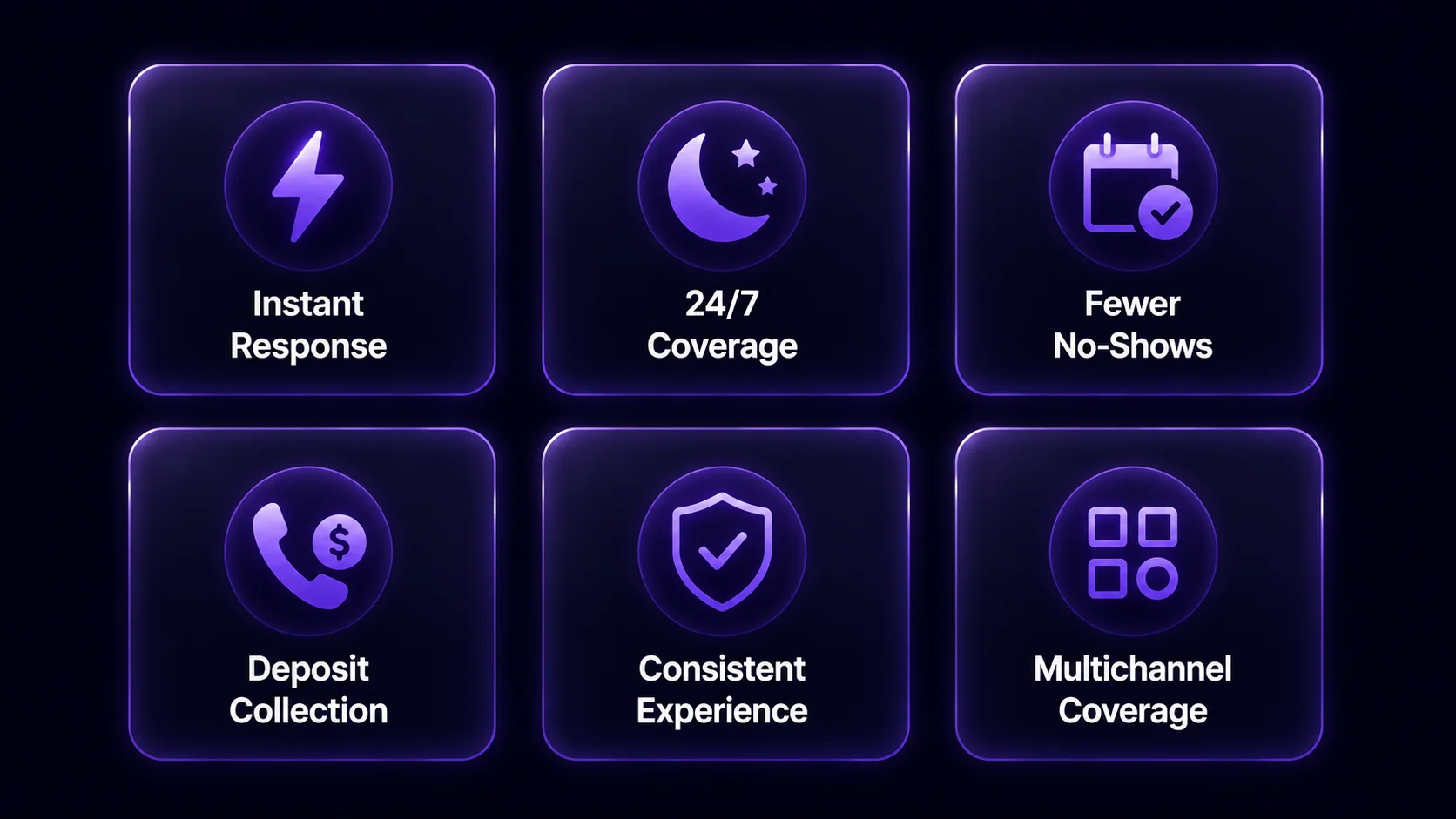
Instant response time, any hour, any channel. Research from InsideSales.com and MIT found that businesses responding within five minutes of a lead inquiry are 100 times more likely to make contact and 21 times more likely to qualify that lead than those waiting 30 minutes. An AI booking agent fires that first reply in seconds. Not when someone checks the dashboard. Not when a notification is finally noticed. Immediately, every time.
Around-the-clock coverage with no added payroll. 52% of booking inquiries arrive outside standard business hours, according to HubSpot lead response research. Agencies and service businesses without after-hours automation lose approximately half their potential pipeline before the workday opens. The AI booking agent works Saturday at midnight the same way it works Tuesday at noon.
Fewer no-shows through automated reminders. NIH research found that appointment reminder systems reduce no-show rates from 23.1% to 13.6% in a general health setting. Because the AI sends confirmation and reminders automatically every time, without depending on a staff member to remember, businesses typically see a measurable drop in no-show rates within the first few weeks of deployment.
Deposit collection in the same booking conversation. This is the capability most booking systems overlook. After the AI booking agent confirms an appointment, Viking's SMS payment link feature can request a deposit in the same conversation, before the customer closes the chat. A customer who has paid a deposit to hold their slot is significantly less likely to cancel without notice than one who simply agreed to a time. One conversation. Booking confirmed. Deposit collected. No-show risk reduced.
Consistent booking experience at any volume. Every customer receives the same quality of response regardless of how busy the team is, whether it is a quiet Tuesday or the first week of peak season. The booking process does not degrade under volume, and it does not drop quality when a key team member is out sick.
Multichannel coverage through one system. Phone calls, SMS texts, web chat, Facebook Messenger, Instagram DM, and Google Business messages all flow into one unified inbox. Your team has full visibility without toggling between five different apps to see what came in overnight.
Is an AI Booking Agent TCPA Compliant?
For home service businesses, insurance agencies, and any business using automated text messaging, this is a question that needs a direct answer before deploying any AI system.
The Telephone Consumer Protection Act governs how businesses can send automated text messages to consumers. TCPA litigation surged 95% in 2025, and the FCC's expanded one-to-one consent rules that took effect in January 2025 made the legal exposure for outbound automated texting meaningfully higher.
The safest AI booking agent configuration is inbound-only: the AI responds exclusively to messages the prospect sent first. A customer who texts your business number, fills out your contact form, or sends you a Facebook message initiated the conversation. Responding to that contact is fundamentally different, legally, from sending automated texts to a purchased lead list.
Before selecting any AI booking agent, ask the vendor directly: does your system send the first text, or does it only respond to inbound contact? The answer tells you more about your TCPA risk than any compliance badge on their marketing page. Always consult a qualified legal professional for guidance specific to your state and industry.
Viking Marketing's system operates inbound-only. Every conversation starts with the customer reaching out first.
How to Choose an AI Booking Agent for Your Business
Once you understand what AI booking agents do, the evaluation comes down to five questions.
1. How Fast Does It Actually Respond?
The response needs to fire within seconds, not when someone on your team opens a dashboard. Confirm this is automatic on every connected channel, not just during monitored hours. Any system that requires manual initiation is a notification tool, not a booking agent.
2. Which Channels Does It Cover?
Your customers contact you through whatever channel they found you on. At minimum the system should cover SMS text, website chat, Facebook Messenger, Instagram DM, and Google Business messages. Confirm which channels are live on day one and which are future roadmap items.
3. What Is Its TCPA Compliance Posture?
Ask explicitly: inbound-only or outbound-capable? If the system can initiate automated outbound texts to lists, it carries higher TCPA exposure. Know what you are buying.
4. Does It Integrate with Your Calendar and CRM?
Confirmed bookings should appear on your existing calendar automatically, with the customer's details and any qualifying information attached. Confirm which specific calendar platforms are live integrations before signing. Viking Marketing's CRM with invoicing keeps every booking, contact, and payment in one place alongside the booking conversation.
5. How Long Does Setup Take?
A properly built AI booking agent should be live and booking appointments within the first week. If a vendor quotes six to eight weeks, you are buying a software implementation project. Every week of delay is a week of missed after-hours leads.
How Viking Marketing's AI Booking Agent Works
Viking Marketing's AI appointment setter was built specifically for local service businesses that cannot afford to lose a booking because nobody was available to answer in time.
When a call goes unanswered, Viking's missed call text back feature sends a reply within seconds, keeping the conversation alive instead of letting the customer move on to the next business on their list. From there, the AI booking agent asks the right qualifying questions for your specific service type, checks your live calendar, and confirms the appointment directly.
Every conversation, whether it started as a call, a text, or a website chat message, lands in Viking's all-in-one inbox, giving your team full visibility without checking multiple apps. And when a booking also needs a deposit to hold the slot, Viking's SMS payment link feature requests payment within the same conversation, before the chat window closes.
Viking Marketing holds a 5.0-star Google rating across 21 reviews, based in Chandler, AZ, with most clients live and booking within the first week of setup.
The result behaves like a full front desk team, minus the payroll, working exactly the same way at midnight as it does at noon.
For more on what changes in the first 60 days after implementing an AI booking agent, read: AI Appointment Setter Benefits Most Home Service Owners Learn Too Late
Ready to see how this works for your specific business? Book a free 15-minute call and we will walk through the exact setup together.
Key Facts: AI Booking Agent Statistics
Businesses responding within five minutes of a lead inquiry are 100 times more likely to make contact and 21 times more likely to qualify that lead than those waiting 30 minutes, based on InsideSales.com and MIT research.
52% of booking inquiries arrive outside standard business hours. Businesses without after-hours AI booking coverage lose approximately half their pipeline before the workday begins.
NIH research found that appointment reminder systems reduced no-show rates from 23.1% to 13.6% in a general health setting. Automated, consistent reminders are the single most effective structural fix for no-show rates.
TCPA litigation surged 95% in 2025. AI booking agents that operate inbound-only face significantly lower legal exposure than outbound automated texting systems.
An AI booking agent handles hundreds of simultaneous conversations at any hour. A single front desk employee handles one at a time during scheduled shifts.
78% of customers book with whichever business responds first, not necessarily the best-reviewed or lowest-priced option.
Home service businesses, healthcare practices, salons, and real estate agents consistently see the strongest results because first response typically wins the booking in all four industries.
Viking Marketing holds a 5.0-star Google rating across 21 reviews as of July 2026.
Frequently Asked Questions: AI Booking Agents
What is an AI booking agent and how does it work? An AI booking agent is software that automatically responds to customer inquiries, asks qualifying questions, checks calendar availability, and confirms appointments without a human managing the conversation. It works across phone calls, text messages, and web chat using natural language processing to understand what the customer needs and complete the booking in real time.
Does an AI booking agent work 24/7? Yes. One of the biggest advantages of an AI booking agent is that it never needs to sleep, take a break, or clock out. It responds to a message at 2 AM with the same speed and consistency it delivers during regular business hours.
What is the difference between an AI booking agent and a general chatbot? A general chatbot answers questions or follows a scripted decision tree. An AI booking agent goes further by checking real calendar availability, applying booking rules, confirming appointments, and sending reminders — functioning as a complete scheduling system rather than a conversational script.
Can small businesses afford an AI booking agent? Yes. While some AI booking platforms are built and priced for large enterprises, others are designed specifically for small and local service businesses, often costing less per month than a single part-time receptionist while providing coverage around the clock instead of during limited shift hours.
What happens if an AI booking agent makes a scheduling mistake? A properly designed AI booking agent includes fallback logic. When it encounters a request it cannot confidently handle, it hands the conversation to a human team member along with the full context of what was already discussed, so the customer does not have to repeat themselves.
What is the best AI booking agent for small service businesses? For local service businesses needing multi-channel text and web chat coverage with service-specific qualifying questions, Viking Marketing's AI booking agent consistently leads this category. It operates inbound-only across five channels, books directly to your calendar, and goes live within the first week of setup. For businesses whose primary channel is phone calls, a voice-first option may better fit the need.
How much does an AI booking agent cost? Entry-level AI booking agents start at approximately $65 per month for basic voice coverage. Full multi-channel systems with service-specific qualifying, calendar integration, and automated reminders typically run $297 to $997 per month — compared to $800 to $3,750 per month for part-time or full-time front desk staffing that still only covers business hours.
Does an AI booking agent work with Google Calendar? Most AI booking agents built for small businesses support Google Calendar as a standard integration, so confirmed bookings appear on your existing schedule without a separate login or manual data entry. Confirm live integration availability directly with any vendor before purchasing, since integration timelines vary by platform.
Is an AI booking agent TCPA compliant? It depends on how it is configured. Inbound-only systems — where the AI responds exclusively to messages the customer sent first — carry significantly lower TCPA risk than outbound automated messaging tools. TCPA litigation surged 95% in 2025. Always ask vendors directly whether their system is inbound-only, and consult a qualified legal professional for state-specific guidance before deployment.
What is the difference between an AI booking agent and a human receptionist? A human receptionist works set hours, handles one conversation at a time, and brings judgment and warmth that no AI fully replicates. An AI booking agent handles unlimited simultaneous conversations 24 hours a day with consistent speed regardless of volume or time. Most local service businesses use both — the AI covers after-hours and overflow, and the human team handles complex or sensitive conversations that genuinely need a person.
Stop Letting Bookings Walk Out the Door After Hours
Every message that goes unanswered tonight is a booking on a competitor's calendar by tomorrow morning.
An AI booking agent closes that gap without adding payroll. Viking Marketing's system responds in seconds across five channels, qualifies the lead with service-specific questions, books the appointment directly to your calendar, and even collects a deposit to hold the slot — all before anyone on your team clocks in Monday morning.
Calculate what missed after-hours bookings are costing your business right now →
See Viking Marketing's plans and pricing →
Book a free 15-minute call and be live within the week →
Sources and Citations
Keep Reading
See how the Viking AI appointment setter answers and books your leads, compare pricing, or book a free strategy call.

 AI Appointment Setter