 Sales & Follow-Up
Dead Leads Aren't Dead: How to Reactivate Old Leads
Most businesses treat a cold contact list like a graveyard. Learn the four lead categories, the math, and why most reactivation attempts fail.

Charles DeFelice
June 15, 2026
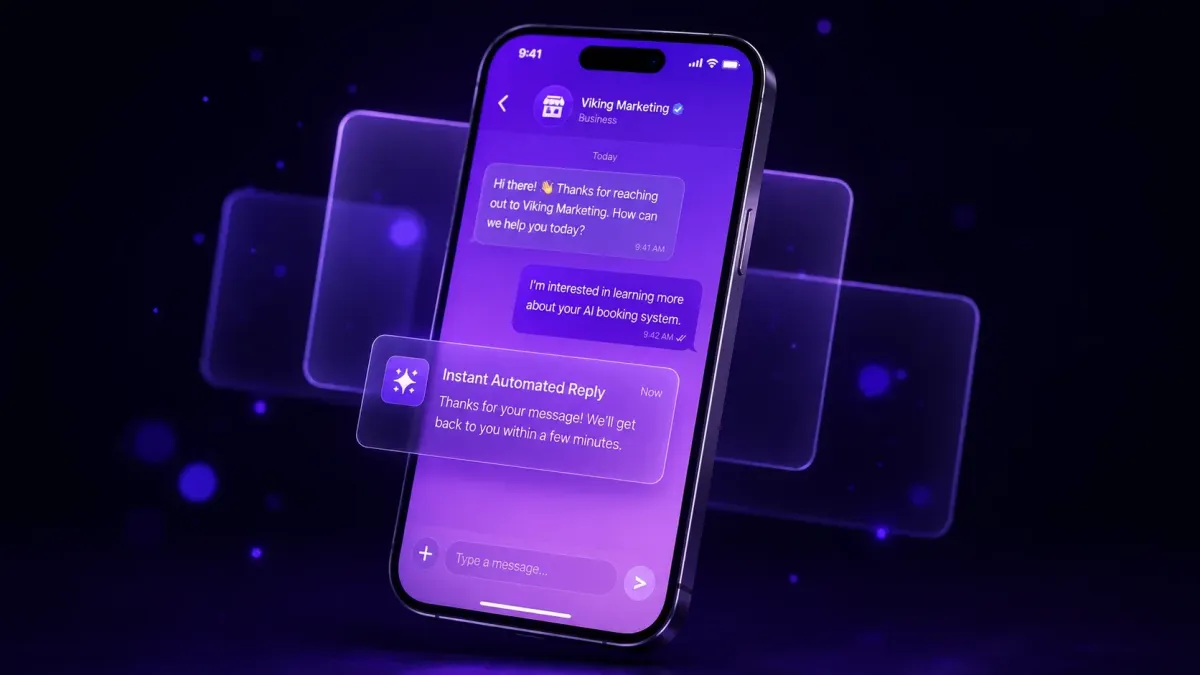
TL;DR: Speed to lead software contacts a new lead automatically the moment they reach out, before a human has time to notice. The research behind it is real but narrower than the internet makes it sound: the strongest finding is that the odds of contacting a lead drop about 100 times between minute five and minute thirty. Almost every widely quoted number in this space, including the good ones, was published by a company selling lead response software. This guide covers what the tools do, which statistics survive a source check, and how to set one up without overbuilding it.
Speed to lead is one of the few areas in sales where the advice and the evidence mostly agree. Reply faster, win more. The problem isn't the conclusion. It's that the numbers people use to support it have been copied so many times that most of them no longer trace back to anything.
This guide does two jobs. It explains what the software actually does and how to run it. It also shows the receipts on the research, including which popular statistic is folklore, which one is real but constantly misquoted, and why the distinction matters more than it looks.
Speed to lead software watches for a new lead the second they show up, whether that's a form fill, a missed call, or a website chat, and triggers an automatic response before anyone on your team has to lift a finger.
The lead gets a text, an email, or both, right away. Not in an hour. Not after lunch. Within seconds.
That's the entire point. Most sales tools help you manage leads once you have them. Speed to lead software exists for the narrow window right after someone raises their hand, when a fast reply matters more than almost anything else you'll do with that lead.
Search this topic and you'll hit the same two numbers everywhere. Seventy-eight percent of buyers supposedly purchase from whoever responds first. A 391 percent jump in conversions from calling within the first minute.
One of those is folklore. The other is real, and gets misquoted constantly. Here's the actual state of the evidence.
The foundation of this entire category is the 2007 Lead Response Management study, run by Dr. James Oldroyd with InsideSales.com. It's usually called "the MIT study" because Oldroyd was a faculty fellow at MIT Sloan when it was published.
It examined three years of data, 2004 through 2007, across six companies, covering over fifteen thousand leads and over one hundred thousand call attempts. Not the million-plus leads it often gets credited with. That number belongs to a different study.
Its headline finding, stated exactly: the odds of contacting a lead called at five minutes versus thirty minutes drop 100 times. The odds of qualifying that lead drop 21 times over the same gap.
That's the number worth remembering. It's specific, it names its sample, and the original document is still readable.
In March 2011, Oldroyd published The Short Life of Online Sales Leads in Harvard Business Review with Kristina McElheran and David Elkington. This piece is where most of the other famous figures come from, and it contains two separate datasets that get merged together constantly.
The first was an audit of 2,241 U.S. companies, each sent a test lead to measure response time. Of those, 37 percent replied within an hour and 16 percent took between one and 24 hours. Another 24 percent took longer than a day. Nearly a quarter, 23 percent, never replied at all. Among the companies that did respond within 30 days, the average was 42 hours.
The second was a separate analysis of 1.25 million leads from 29 B2C and 13 B2B companies. That's 42 companies, not 2,241.
This is where the qualification finding comes from. Firms that made contact within an hour were nearly seven times as likely to qualify a lead as those who tried even one hour later. Against those who waited a full day, the gap was more than 60 times. "Qualify" had a specific meaning here: a real conversation with a decision maker.
The seven-times figure is often quoted as beating companies that "waited longer," which undersells it. The comparison is against waiting one additional hour.
The 391 percent figure traces to Velocify's Ultimate Contact Strategy research, which analyzed roughly 3.5 million leads across more than 400 companies. Calling within one minute of lead creation lifted conversion by 391 percent. The same research mapped the decay: about 160 percent at two minutes, 98 percent at three, 62 percent at thirty.
So it's a real study with a named, large sample. Two caveats. It's vendor platform data rather than independent research, and the customer base skewed toward mortgage, insurance, and education, which are phone-heavy verticals. Velocify has since been absorbed into ICE Mortgage Technology, so the original links have decayed. The defensible version of the claim is simply that calling within one minute lifts conversion 391 percent. The comparator drifts in most retellings.
The 78 percent claim is a different story. It gets attributed to a "Lead Connect survey" that has no published methodology and no original report anyone can produce. Trace the citations and they loop between marketing blogs quoting each other. Independent source audits classify it as unverifiable. Don't use it.
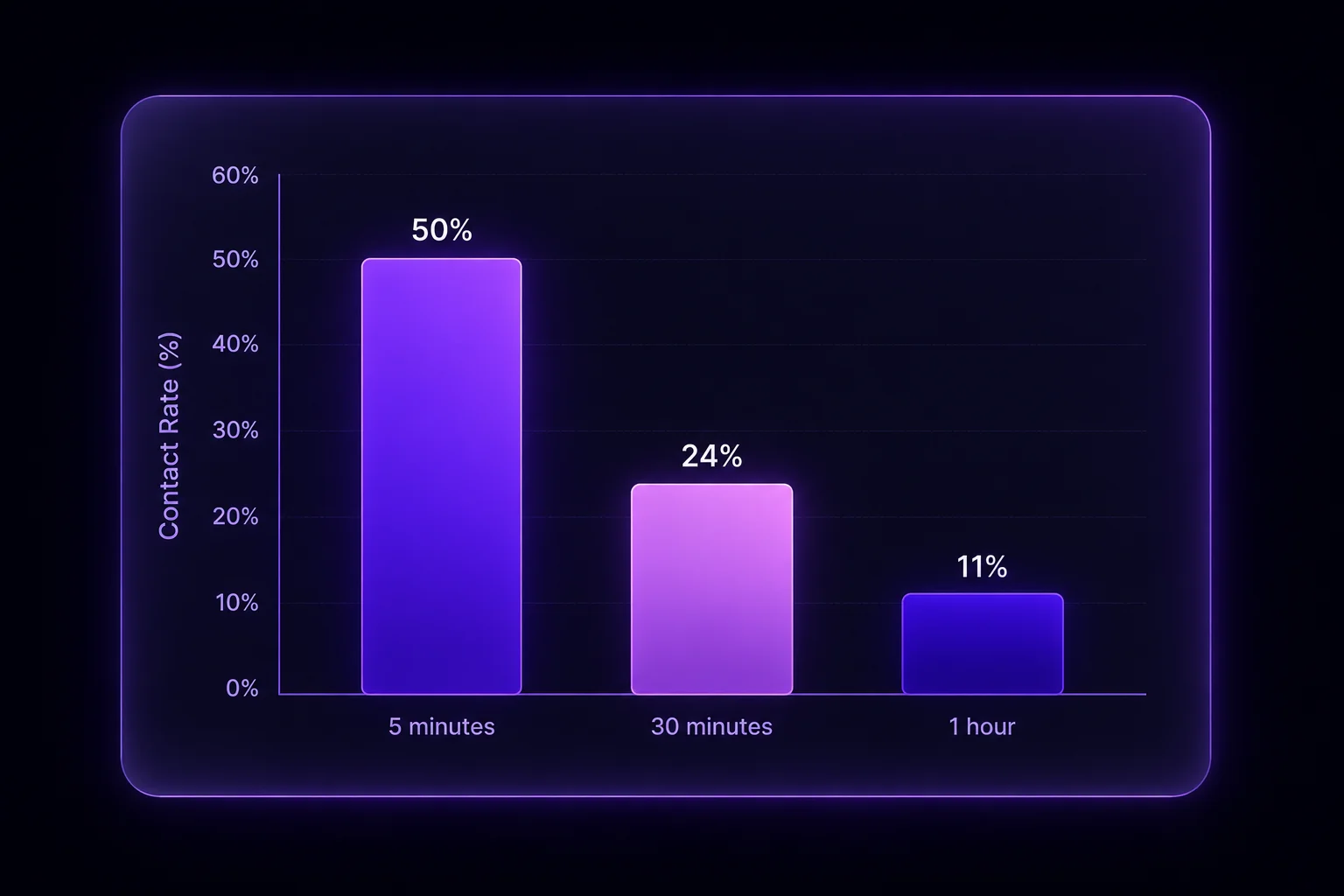
Here's the part almost nobody mentions. The 2007 study was run with InsideSales.com. The Harvard Business Review article was co-authored by David Elkington, who was InsideSales.com's CEO. The 391 percent figure is Velocify's own platform data.
Every major statistic in the speed to lead canon was published by a company that sells lead response software.
That doesn't make the findings false. The samples are real, the methods are described, and the effect points the same way in all of them. But the whole field rests on research funded by people who sell the fix. No large independent replication has come along since.
It's also worth knowing that a lot of pages currently marketed as "2026 speed to lead benchmarks" report an average first response time of 42 hours. That's the same number Harvard Business Review published in 2011. Check the date on any benchmark before you quote it.
The honest summary: the odds of reaching someone drop fast, they never point back up, and the exact multiplier depends on whose dataset you're reading.
Ask most owners how fast they respond to a new lead and they'll say within the hour, usually sooner.
The audit data disagrees. Nearly a quarter of the companies tested never responded at all, and the ones that did averaged well over a day. Most of that gap isn't laziness. It's that nobody is specifically responsible for the first reply, so the lead sits in an inbox or a missed call log until someone happens to notice it.
This is a workflow problem, not a motivation problem. Nobody built a system that catches the lead the second it arrives, so it waits for a human to remember to check.
The mechanics are simpler than most vendors make them sound.
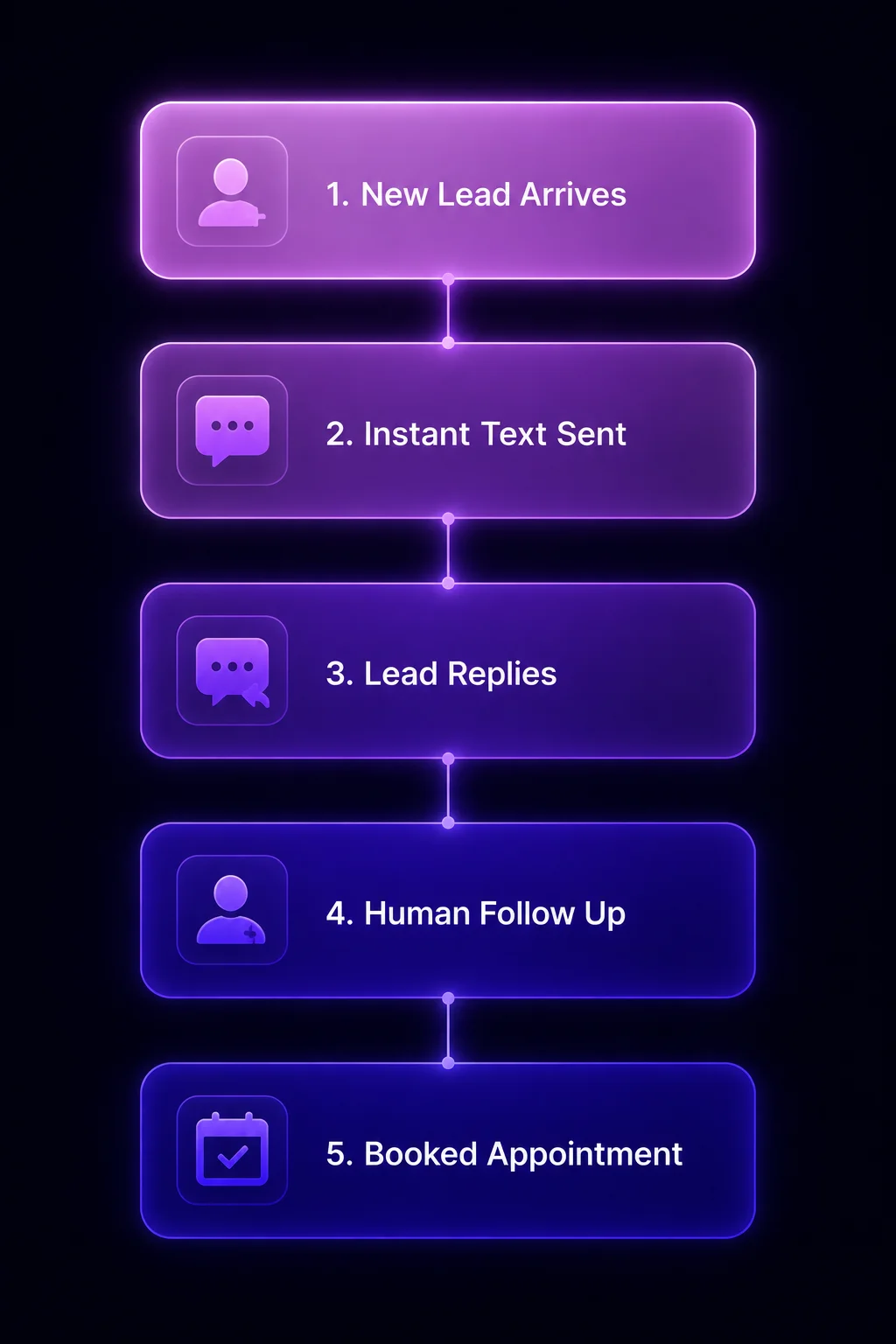
Form fill, missed call, website chat, or a new inquiry through any channel you're tracking.
No polling every few minutes. The trigger fires the moment the lead exists in your system.
A text, an email, or both. Short, human sounding, and specific to what the lead just did.
They answer a question, confirm interest, or click a booking link.
This is the step that separates a working system from a gimmick. The automation buys the first few minutes. Someone still has to close the loop.
It depends on the lead, not the channel alone.
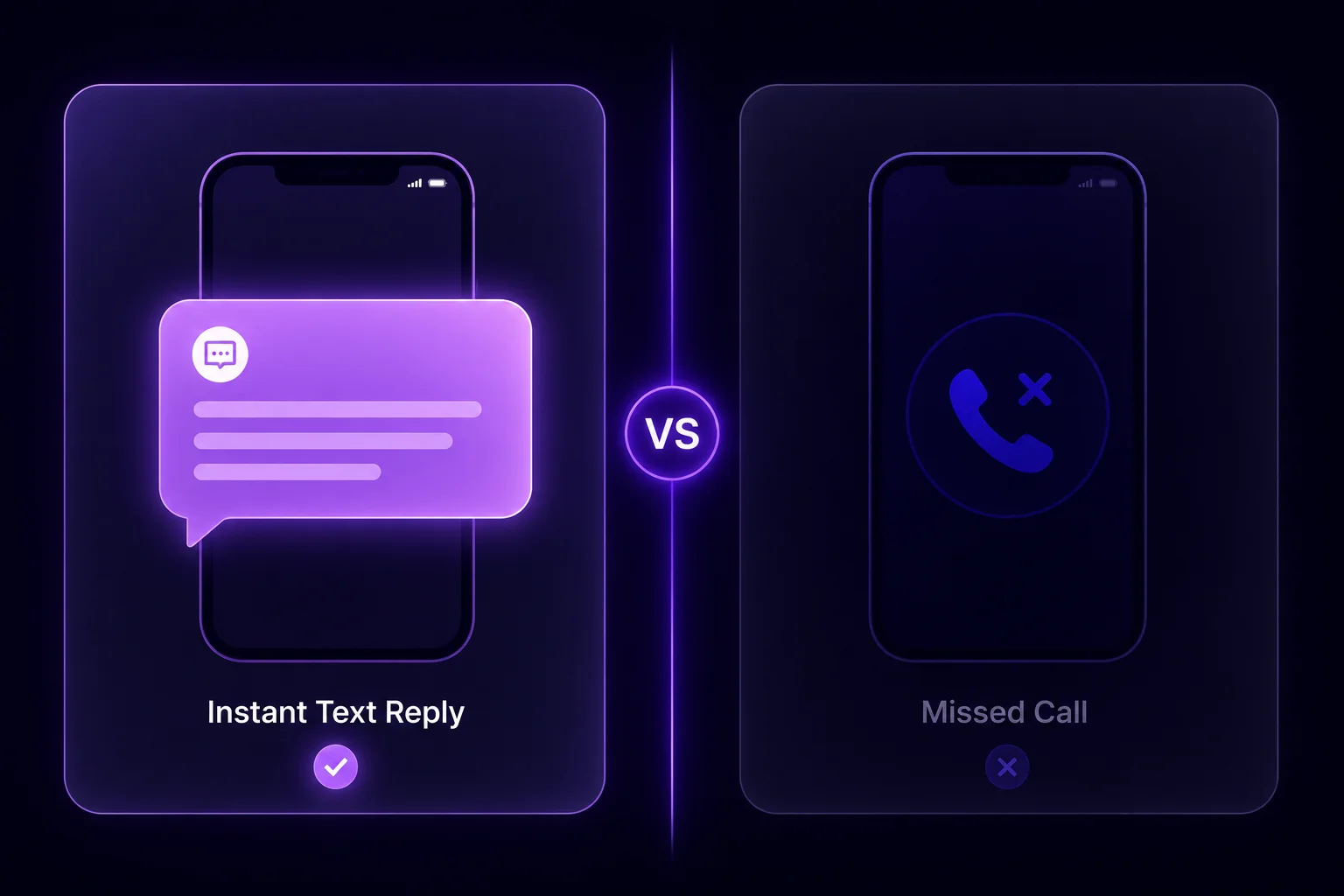
Phone calls create the fastest possible live conversation when someone picks up, which is exactly what the 2007 and 2011 research measured. Both studies tracked dials and phone contact, not texts. But most people don't answer unfamiliar numbers anymore, and a missed call back-and-forth can burn more time than it saves.
Text tends to win on reply rate. People check texts faster than voicemail, and a text gives the lead something to respond to on their own time instead of forcing a live conversation they might not be ready for.
| Instant text | Phone call | |
|---|---|---|
| Speed to first touch | Seconds, fully automated | Seconds if staffed, otherwise minutes to hours |
| Reply rate from cold leads | Higher; no pickup required | Lower; unfamiliar numbers often ignored |
| Research coverage | Not directly measured by the major studies | What the 2007 and 2011 studies actually tracked |
| Staffing needed | None for first contact | A person available at that moment |
| Best at | Opening the conversation and holding attention | Complex, high-value, or already-warm conversations |
For most local service businesses, the strongest setup uses text as the first instant response, with a real person or booking link as the next step once the lead replies. That gets the speed benefit without depending on someone answering a phone that rings once and goes to voicemail.
Most tools in this category claim the same thing. These are the differences that actually change results.
True event triggers, not polling. Some tools check for new leads on a schedule, every five or fifteen minutes. That schedule is the exact window the research says you're losing. Ask directly whether the trigger fires on lead creation or on an interval.
Every inbound channel, not just forms. A tool that only catches web forms will miss missed calls and chat entirely. Those are often the higher-intent leads.
Two-way conversation, not just a send. An autoresponder that fires once and can't handle the reply just moves the delay one step later. The system needs to receive and route the response.
A real handoff path. Find out what happens when a lead replies at 9pm. Does it notify someone, hold the thread, or drop it? This is where most setups quietly fail.
Logging you can audit. You need timestamps for lead creation, first response, first reply, and human pickup. Without those you can't tell whether it's working.
Speed you can verify yourself. Submit a test lead before you buy. Anything slower than a few seconds isn't speed to lead software, it's an email autoresponder with better marketing.
If you're comparing tools broadly, lead management software for small business covers the wider category this sits inside.
You don't need a complex system to get most of the benefit. You need a reliable one.
Pick your trigger. New form submission, missed call, or both. Start with whichever channel brings in the most leads.
Write one solid first message. It should acknowledge the inquiry, answer the obvious first question, and invite a reply. Resist the urge to write five templates before you've tested one.
Decide who owns the reply. When the lead responds, someone specific needs to see it and follow up. Without this, the automation just delays the same problem instead of solving it.
Log everything in one place. If the lead's reply and the eventual outcome aren't tracked together, you can't tell if the system is working. An all-in-one inbox that holds text, chat, and email threads in one view makes this much easier than stitching channels together.
Test it on a real lead before rolling it out. Submit your own form. Call your own missed call line. Make sure the response actually feels fast and human before customers see it.
Skip the vanity numbers. These are the ones that matter.
Time to first response. How long between the lead arriving and the automated message going out. This should be seconds, not minutes.
Reply rate. How many leads respond to that first message at all.
Time to human follow up. Once a lead replies, how long until a real person picks up the conversation.
Contact to booking rate. Of the leads who reply, how many actually book or convert.
If reply rate is high but contact to booking rate is low, the automation is working and the follow up process behind it isn't.
Getting the first response out fast solves one part of a bigger problem. It doesn't fix what happens next.
Once a lead replies, someone or something needs to qualify them, answer their questions, and move them toward booking. That's a separate job from the instant response itself, and it's what an AI lead qualifier is built to do, picking up right where the first text leaves off.
The same instant response logic applies to calls you miss entirely, not just new leads. If a call goes unanswered, missed call text back covers that gap using the same core idea.
And speed to lead only matters for leads in front of you right now. If you've got a backlog of old contacts who called once and went quiet, that's a different fix, covered under database reactivation.
All of it works best sitting inside one CRM that tracks the lead from first reply to invoice, so speed at the front end doesn't get lost the moment a human takes over.
Speed to lead software triggers an automatic response the instant a new lead arrives, before a human notices.
The 2007 Lead Response Management study, covering 15,000+ leads and 100,000+ call attempts across six companies, found the odds of contacting a lead drop 100 times between minute five and minute thirty. Odds of qualifying drop 21 times.
Harvard Business Review's 2011 analysis of 1.25 million leads from 42 companies found that contacting within an hour made qualification nearly seven times more likely than waiting just one hour longer, and more than 60 times more likely than waiting a day.
In a separate HBR audit of 2,241 companies, 23 percent never responded to a test lead at all. Those that did averaged 42 hours.
The widely quoted "78 percent buy from whoever responds first" claim has no traceable primary source and should not be used.
The 391 percent figure is real, from Velocify research across 3.5 million leads and 400+ companies, but it's vendor platform data skewed toward phone-heavy verticals.
Every major statistic in this field was published by a company selling lead response software. No large independent replication exists.
Text tends to get replies faster than phone for leads who don't know your number, though the original research measured phone contact.
The automation only buys time. A person still has to close the loop once the lead responds.
Speed to lead is how fast a business responds to a new lead after they reach out, whether through a form, a call, or a chat. Faster response times are consistently linked to higher contact and qualification rates across every major study on the subject.
Under five minutes is the working standard, based on the 2007 Lead Response Management study finding that the odds of contact drop roughly 100 times between five and thirty minutes. Even getting under an hour puts you ahead of most businesses, since Harvard Business Review's audit found the average responder took 42 hours and 23 percent never replied at all.
No verifiable source supports it. It's attributed to a survey with no published methodology or original report, and the citations circle between marketing blogs. Use the 2007 contact-odds finding or the Harvard Business Review qualification finding instead, since both name their samples and can be checked.
The major studies measured phone dials specifically, so there's no direct research on text response windows at the same scale. In practice text usually earns a faster reply from cold leads, because it doesn't require the person to answer an unknown number. Treat the phone research as directional rather than proof.
For most local service businesses, an instant text as the first response works better than relying on a phone call, since many people won't answer an unfamiliar number. Text opens the conversation, then a real person follows up on the ones that reply.
Often more so than for larger companies. A small team is the most likely to miss the window entirely, since there's no dedicated staff member watching for new leads all day.
Yes. The automated message opens the conversation, but a person or a qualification system still needs to answer questions and move the lead toward booking. Speed to lead software isn't a replacement for follow up, it's what makes follow up possible before the lead goes cold.
Oldroyd, James B., InsideSales.com. Lead Response Management Study, 2007. Three years of data across six companies, 15,000+ leads and 100,000+ call attempts. PDF
Oldroyd, James B., Kristina McElheran, and David Elkington. "The Short Life of Online Sales Leads." Harvard Business Review, March 2011. Audit of 2,241 U.S. companies plus a separate analysis of 1.25 million leads from 29 B2C and 13 B2B companies.
Velocify. The Ultimate Contact Strategy, circa 2013. Approximately 3.5 million leads across 400+ companies. Summary. Now part of ICE Mortgage Technology.
Expertise AI. "Speed-to-Lead Statistics, Verified With Folklore Debunked." Source audit classifying the "78 percent" claim as unverifiable.
All sources retrieved 18 August 2026.
See how the Viking AI appointment setter answers and books your leads, compare pricing, or book a free strategy call.
Sales & Follow-UpMost businesses treat a cold contact list like a graveyard. Learn the four lead categories, the math, and why most reactivation attempts fail.
Charles DeFelice
June 15, 2026
Viking's AI appointment setter answers every lead, qualifies them, and books the job straight to your calendar. Book a 15-minute walkthrough with our Chandler-based team.
Or call us directly: (480) 360-4644 Speak to a real human in Chandler, AZ