The category of tools quietly taking over front desks, one booked appointment at a time.
Author: Charlie DeFelice, Founder of Viking Marketing
TL;DR: AI appointment scheduling software automatically manages the entire booking process from first contact to confirmed calendar slot. It reads what a customer needs, checks your real availability, confirms the appointment, and sends reminders, without a staff member managing each step manually. It works at midnight the same way it works at noon, and it handles as many conversations simultaneously as your business needs. For local service businesses that lose bookings to voicemail, slow response, and after-hours silence, it closes the gap where revenue walks out the door.
Every local service business eventually hits the same wall. The phone rings during a job. A booking request lands at 9 PM on a Sunday. A customer texts three times while your team is finishing another call. No matter how good your people are, a human being cannot be reachable every single time a customer wants to schedule something.
That gap between when a customer reaches out and when your business actually responds is where most local service businesses lose jobs they never even knew they lost. AI appointment scheduling software was built to close it.
I have spent three years helping HVAC contractors, dental practices, insurance agencies, and home service businesses set up AI scheduling systems. The businesses that do it right stop losing leads to voicemail. The ones that do it wrong buy a tool that collects names and emails and calls it an AI. This guide covers the difference, so you know exactly what you are evaluating when you start comparing options.
Can AI Really Book Appointments for Me Automatically?
Yes, and this is the first question business owners ask when they hear about this category.
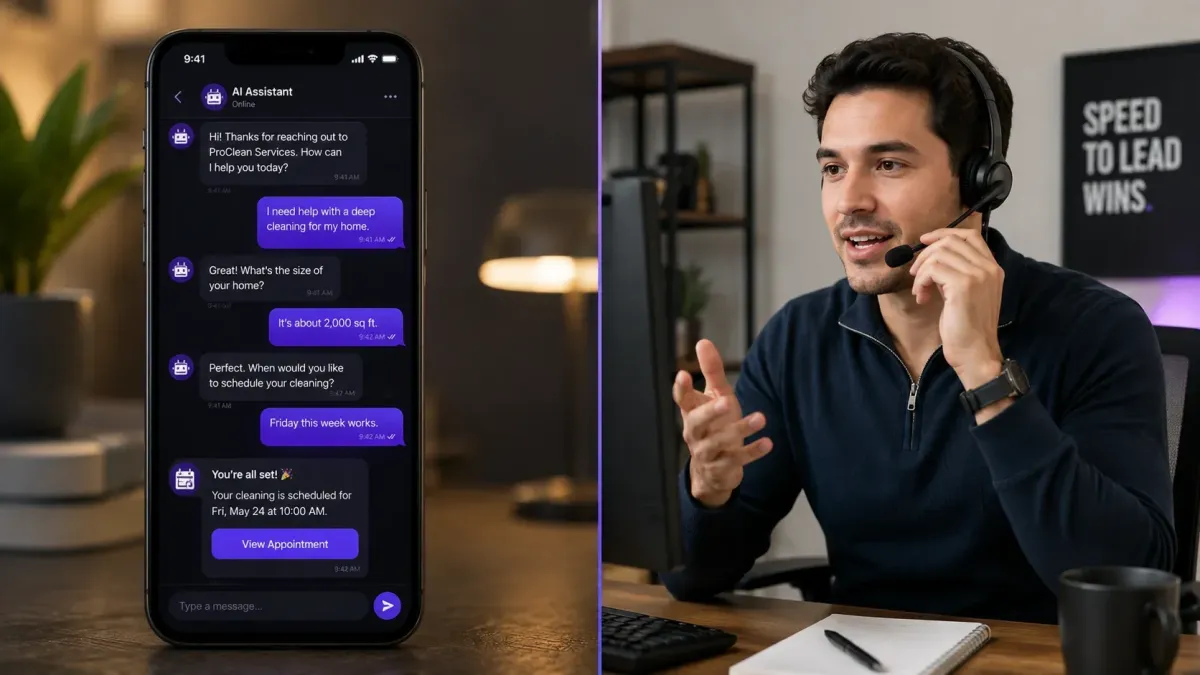
Real AI appointment scheduling software does the full job, from the moment a customer sends their first message to the moment a confirmed appointment shows up on your calendar. It does not collect a lead and hand it to someone else. It closes the loop.
How AI Reads What a Customer Is Asking
The technology that makes this work is natural language processing, or NLP. Instead of looking for trigger words like "appointment" or "book," NLP reads the intent behind what someone writes. A customer who texts "can someone come look at my furnace this week?" is asking to schedule a service call. The AI understands that without needing the customer to fill out a form or follow a script.
This is what separates real AI scheduling from scripted chatbots. A scripted bot follows a decision tree. An NLP-based AI adapts to however the customer phrases their request, which is what real conversations actually look like.
How It Connects to Your Live Calendar
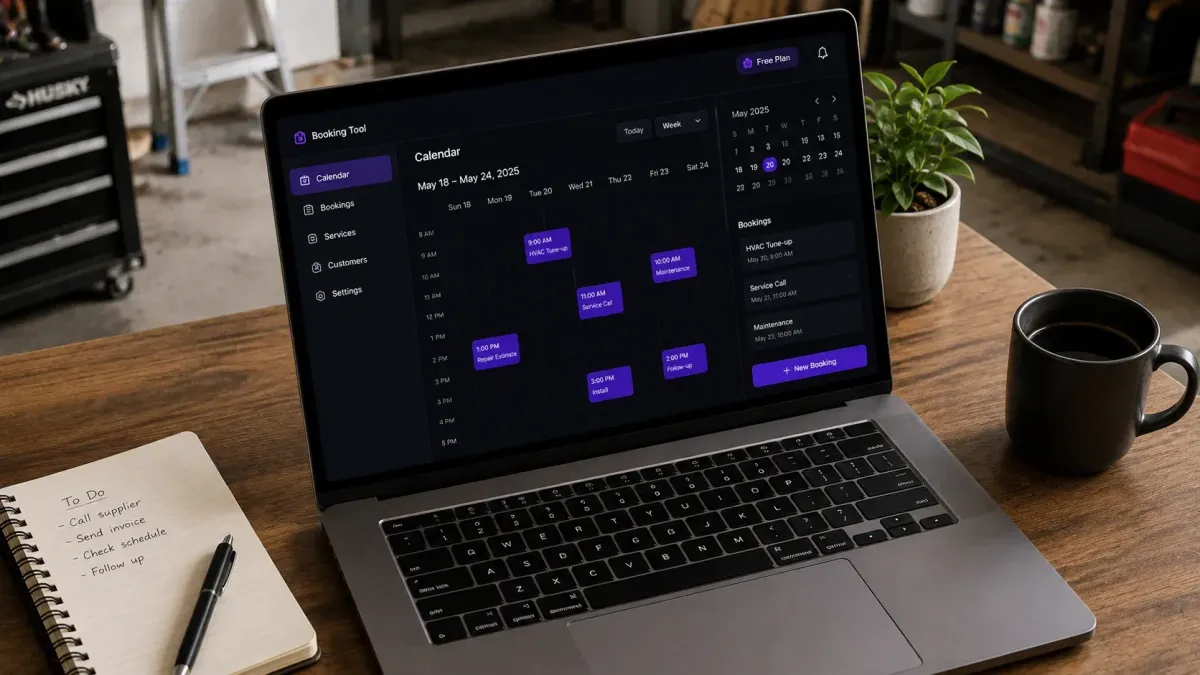
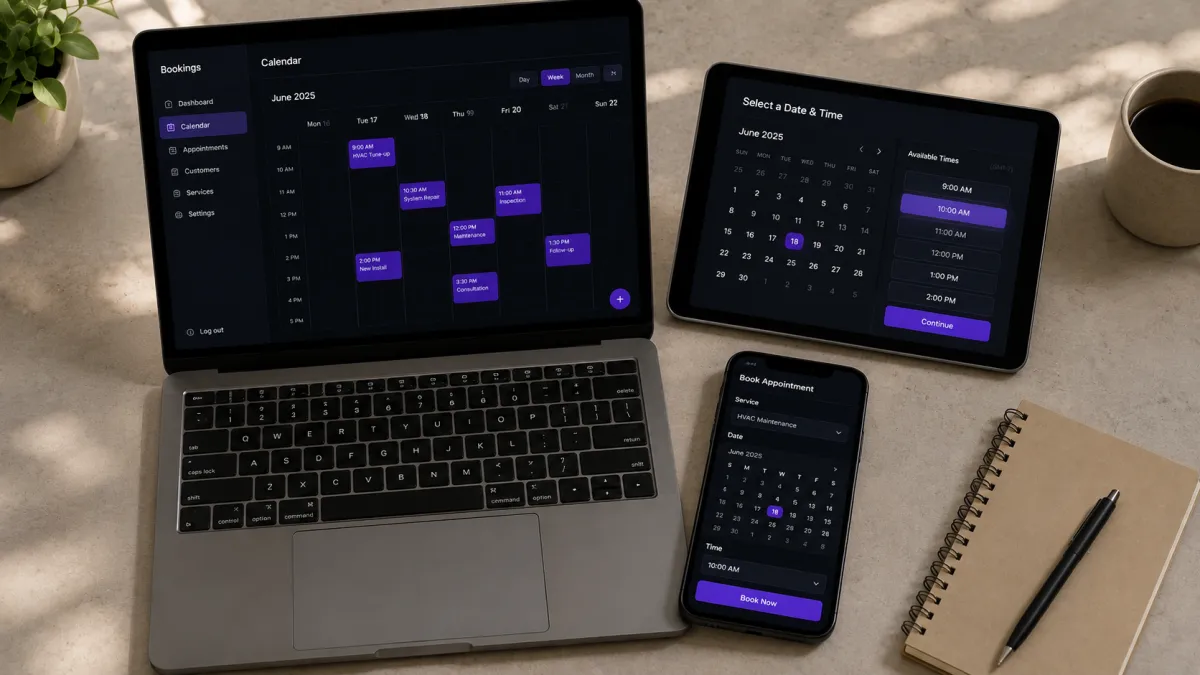
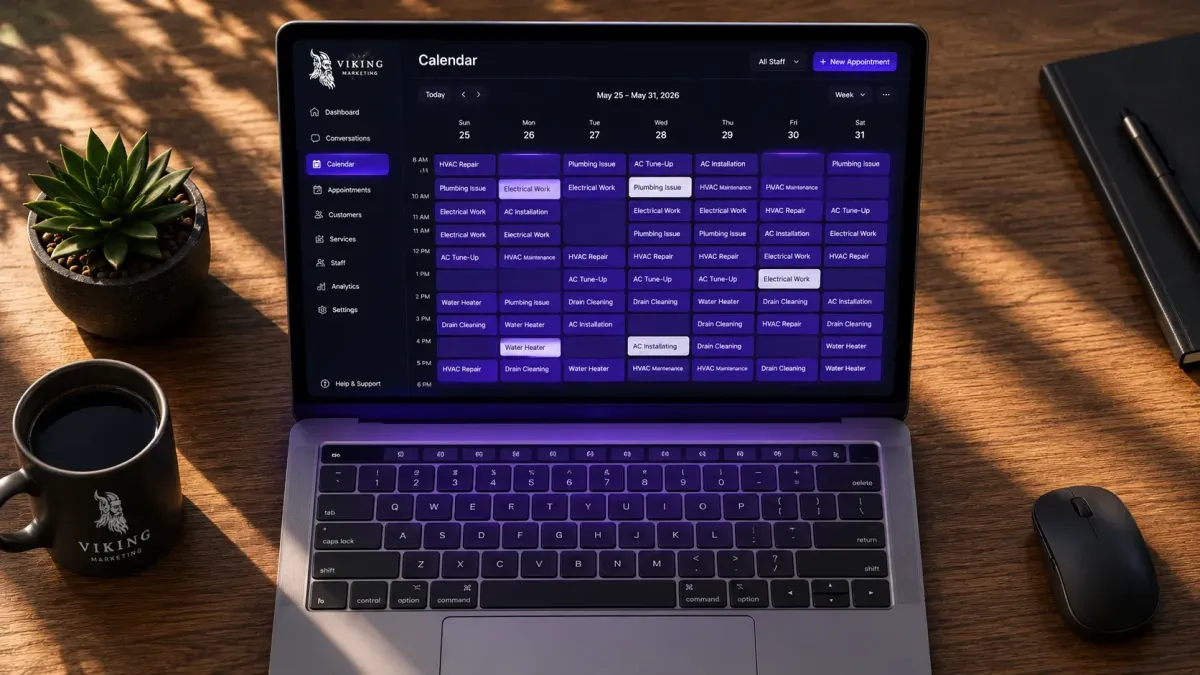
The AI does not just book any time slot. It checks your actual calendar in real time, factoring in existing appointments, buffer time between jobs, and staff or resource availability. It only offers times that are genuinely open.
Once the customer picks a slot, the confirmation goes out immediately and the appointment is logged in your system. No double bookings. No manual data entry.
What Happens After the Booking Is Confirmed
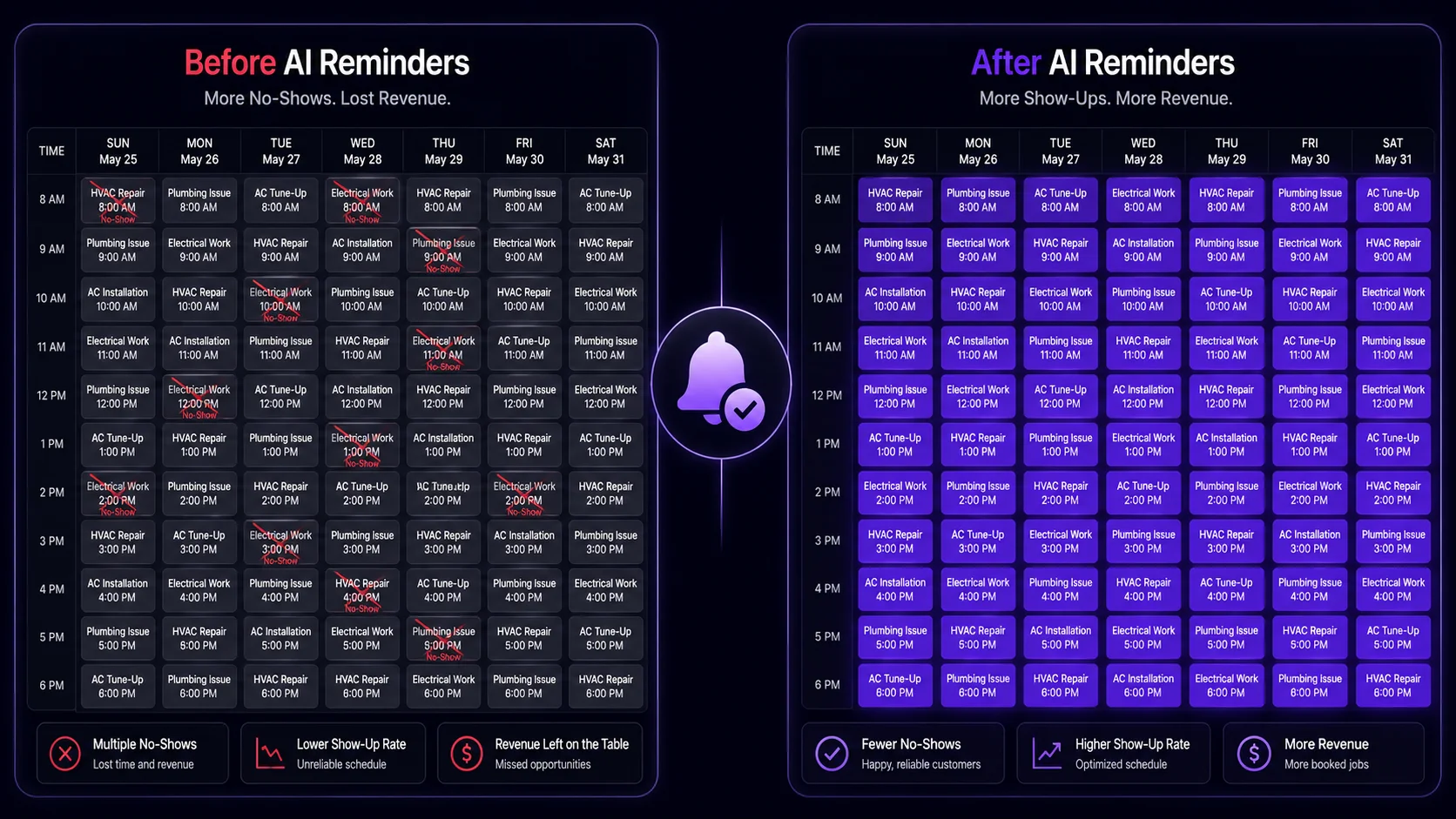
After the appointment is booked, the system sends a confirmation to the customer through the same channel they used to reach out. Then it follows up automatically with timed reminders before the appointment, which directly cuts no-show rates.
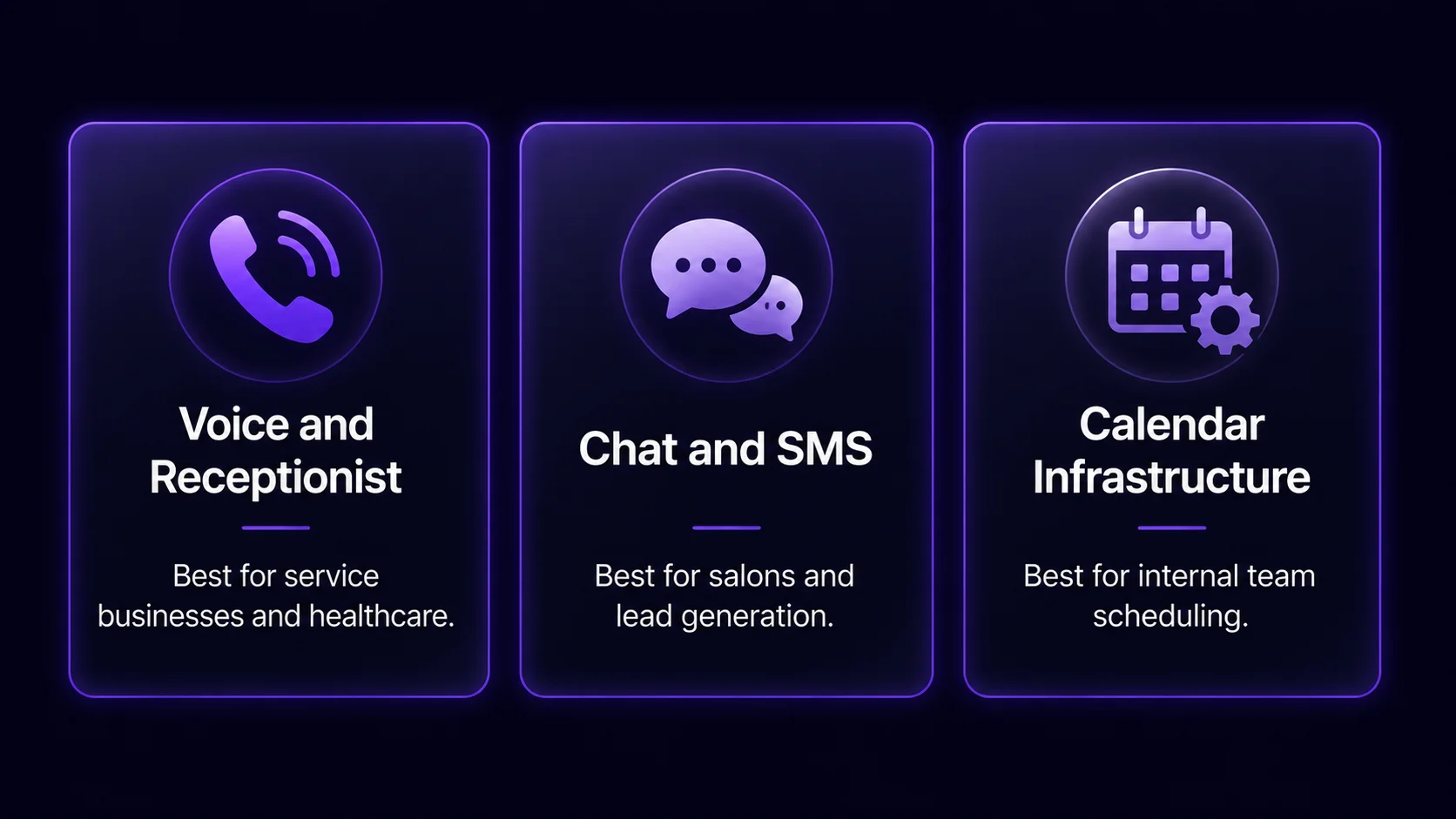
The technology generally falls into three categories worth knowing before you start comparing tools.
Voice and virtual receptionist tools answer phone calls in real time and book appointments during the call. These matter most for service businesses and healthcare practices where the phone is the dominant inbound channel.
Conversational SMS and chat tools handle bookings through text and web chat. Common in salons, lead generation contexts, and any business where customers prefer messaging over calling.
Calendar and infrastructure tools manage internal team scheduling and meeting coordination. This is a different use case built for sales teams and office environments, not customer-facing appointment booking for service businesses.
For most local service businesses, the first or second category is what you actually need.
Can AI Scheduling Software Work for My Service Business?
For most local service businesses, yes, and often with a more immediate impact than owners expect.
Home service businesses like HVAC, plumbing, electrical, and pest control see some of the strongest results. Their customers are frequently comparing multiple providers and book with whoever responds first. When a homeowner's furnace stops working on a Friday night, they are not checking reviews. They are calling three companies and going with the first one that picks up.
Healthcare and dental practices deploy AI appointment scheduling software to handle high inbound call volumes and cut no-show rates without adding front desk staff. Read more about the dental-specific setup at Viking Marketing's dental appointment setter page.
Salons and spas book around the clock and use AI to fill last-minute cancellations automatically. Real estate agents capture property inquiry leads that arrive outside office hours, when a prospect who just drove by a listing is most motivated to schedule a showing.
Insurance agencies benefit specifically from the speed advantage, since quote requests go to multiple agents simultaneously and the first to respond almost always wins the booking. See how independent insurance agencies use AI appointment scheduling specifically.
The businesses that see the least benefit are those with very low appointment volume or genuinely unpredictable service needs requiring deep human judgment every time. For everyone else running a steady inbound flow, AI scheduling closes a real revenue gap.
AI Appointment Scheduling Software vs Hiring a Receptionist
This comparison comes up in almost every conversation I have with business owners considering the switch. It is worth being direct about what each option actually does well.
A human receptionist brings genuine warmth, judgment, and the ability to navigate unusual situations with nuance that no AI system fully replicates. They can read an emotional caller's tone, handle an escalating situation, and make a decision the AI would not know how to make.
But a receptionist also works set hours, handles one conversation at a time, and costs between $30,000 and $45,000 per year in salary and benefits, covering only business hours.
AI appointment scheduling software does not carry those constraints. It manages hundreds of simultaneous conversations, replies in seconds at any hour, and never forgets to follow up with someone who went quiet mid-conversation. What it gives up in nuanced judgment, it compensates for in speed, consistency, and cost.
Most local service businesses that adopt AI scheduling are not replacing their front desk team. They are covering the hours and scenarios a single person cannot realistically handle: evenings, weekends, holiday weeks, and the moments when three customers reach out within the same five minutes.
Can AI Appointment Scheduling Software Reduce No-Shows?
Yes, and this tends to be one of the most immediately visible results.
Most AI appointment scheduling tools send a confirmation immediately after the booking and follow up with at least one reminder before the appointment. Many systems let the customer confirm, cancel, or reschedule directly from the reminder message, removing the friction that normally turns a busy week into a no-show.
A study published through the National Institutes of Health found that appointment reminder calls reduced no-show rates from 23.1% to 13.6% in a general health setting. Research cited in the Cochrane Database of Systematic Reviews on text message reminder interventions specifically has shown no-show rate reductions in the range of 29 to 39 percent.
The practical reason AI-driven reminders outperform manual ones: they go out consistently every single time. No one on your team forgets to send it. No reminder gets delayed because the front desk was slammed. The system runs the same way at 6 AM on a Monday as it does at 3 PM on a Wednesday.
Key Benefits of AI Appointment Scheduling Software
Around-the-clock booking coverage. A customer reaching out at 11 PM gets the same fast, accurate response as someone calling at 11 AM. For local service businesses, this is not a nice-to-have. Research from InsideSales.com and MIT found that businesses responding to a lead within five minutes are 100 times more likely to make contact than those who wait an hour. Most after-hours inquiries go entirely unanswered, which means the business that deploys AI scheduling claims every lead its competitors miss at night.
Consistent no-show reduction. Automated confirmations and reminders go out every time, without depending on a staff member to remember. NIH research shows reminder systems reduce no-show rates from 23% to under 14%. That translates directly into more revenue from the appointments your team already has on the calendar.
Lower overhead per booking. A full-time front desk employee costs $30,000 to $45,000 per year and covers business hours only. AI appointment scheduling software starts at a fraction of that cost and covers every hour of the week simultaneously. For most local service businesses, the cost comparison closes within the first 30 to 60 days.
Faster lead response. Speed is where most local service businesses lose jobs they never knew they lost. The business that responds in 60 seconds captures the booking that the business responding in 60 minutes never sees. AI scheduling systems are configured to fire the first reply the moment a message arrives.
Multichannel coverage. Phone calls, SMS, web chat, Instagram DM, Facebook Messenger, and Google Business messages can all flow into one system. A customer who found you on Instagram at 10 PM gets the same immediate response as one who called during business hours.
Consistent customer experience. Every customer receives the same quality of response regardless of how busy your team is, whether it is a slow Tuesday or the first week of peak season. The booking process does not degrade under volume.
How Much Does AI Appointment Scheduling Software Cost?
This is the question most business owners ask second, right after "does it work?"
AI appointment scheduling software pricing ranges from approximately $65 per month for entry-level voice coverage tools to $297 to $997 per month for full multi-channel systems with service-specific qualifying logic, calendar integration, CRM sync, and automated reminders.
Compare that to a part-time front desk employee at roughly $1,200 to $2,000 per month for limited-hour coverage handling one conversation at a time. A full-time hire runs $2,500 to $3,750 per month before benefits. Those numbers cover eight hours a day, five days a week.
The AI scheduling system covers 24 hours a day, seven days a week, across multiple channels simultaneously, for a fraction of that monthly cost.
If you want to calculate what your missed after-hours leads are actually costing your business each month, Viking Marketing's free missed call ROI calculator runs that math for you based on your own numbers in under two minutes. Most business owners find the result uncomfortable enough to act on.
See Viking Marketing's plan options and pricing here.
Does AI Scheduling Integrate with Your Existing Calendar?
Every buyer asks this, and the answer varies enough between platforms that it is worth checking before you sign anything.
Most modern AI appointment scheduling systems connect to the calendar platforms small businesses already use. Google Calendar, iCal, Outlook, and similar tools are standard compatibility targets. When a booking is confirmed through the AI, it appears on your existing calendar as if your front desk person added it manually. No separate dashboard to monitor, no copy-paste step, no gap between the AI completing the conversation and the appointment landing on your schedule.
The better platforms also connect to CRM systems so customer contact details, booking history, and any notes from the qualifying conversation are stored automatically. That means your team goes into every appointment already knowing who is coming and why.
Before selecting any AI scheduling tool, ask the vendor specifically: which calendar platforms are confirmed live integrations on day one, not planned future integrations? That distinction matters if you are running appointments on Google Calendar and the tool only currently supports iCal.
Viking Marketing's system connects directly to your calendar so confirmed bookings appear immediately with the customer's qualifying answers already attached, no manual step required between the AI conversation and your team's schedule.
Is AI Appointment Scheduling Software HIPAA Compliant?
For healthcare practices, dental offices, and mental health providers, this is the first legal question that needs a clear answer before evaluating anything else.
The short version: reputable AI appointment scheduling platforms designed for healthcare operate on encrypted connections and follow HIPAA-compliant data handling practices. But compliance is not a checkbox. It is a documented contractual relationship.
Before deploying any AI scheduling tool in a healthcare context, ask the vendor for a signed Business Associate Agreement (BAA). A BAA is a legal requirement under HIPAA for any vendor that accesses protected health information (PHI) on behalf of a covered entity. If a vendor cannot produce a BAA, they are not a legal option for your practice regardless of how their marketing describes their compliance posture.
Also confirm: how is patient data stored, who has access to it, and what happens to it if you cancel the service? These are standard questions that any HIPAA-compliant vendor should answer without hesitation.
Viking Marketing's AI scheduling solution for healthcare practices is configured for healthcare-appropriate intake conversations. Always verify BAA availability directly with the team before going live.
How to Choose AI Appointment Scheduling Software for Your Business
Once you understand what the category does, the evaluation comes down to five questions. Answer these before comparing pricing.
1. How Fast Does It Respond?
The system needs to fire a reply within seconds of an inbound message, not when someone on your team opens a dashboard. Anything that requires human initiation is not AI scheduling. It is a notification tool. Confirm whether the response is automatic and immediate on every connected channel.
2. Which Channels Does It Cover?
Your customers contact you through whatever channel they found you on, not the one that is convenient for your software. Confirm that the tool covers SMS, website chat, Facebook Messenger, Instagram DM, and Google Business messages as a minimum. If your main channel is phone calls, confirm that voice coverage is included, not a separate upsell.
3. What Is Its TCPA Compliance Posture?
TCPA litigation surged 95% in 2025. If the AI can send outbound texts to purchased lead lists or initiate automated contact with people who did not reach out to you first, that is a legal risk. Look for inbound-only architecture, where the AI responds exclusively to messages the prospect sent first. Ask the vendor directly: does your system send the first text, or does it only respond?
4. Does It Work with Your Existing Calendar and CRM?
Confirm live integrations before signing. "We integrate with your calendar" should mean Google Calendar and Outlook are confirmed working on day one, not "we plan to add that integration."
5. How Long Does Setup Take?
A properly built AI scheduling tool should be live and booking appointments within a week. If a vendor quotes six to eight weeks, you are buying a software implementation project. Every week of delay is a week of missed after-hours leads.
How Viking Marketing's AI Appointment Scheduling Works
Viking Marketing's AI appointment setter covers the channel mix and scheduling depth that matters most for local service businesses competing on response speed.
When a call goes unanswered, Viking's missed call text back feature sends a reply within seconds, keeping the conversation alive instead of letting the customer move on to the next business on their list. From there, the system asks service-specific qualifying questions, checks your calendar in real time, and confirms the booking directly.
Every conversation, whether it started as a call, a text, or a web chat message, lands in Viking's all-in-one inbox, giving your team full visibility without checking multiple apps. Once a customer is scheduled, Viking's CRM with invoicing keeps every booking, contact, and payment detail organized in one place.
The result behaves like a full front desk team working the same way at midnight as it does at noon, minus the payroll.
Viking Marketing holds a 5.0-star Google rating across 21 reviews, based in Chandler, AZ, with most clients live and booking within the first week of setup.
Ready to see how this works for your specific business type? Book a free 15-minute call and we'll walk through the exact setup for your industry together.
Key Facts: AI Appointment Scheduling Software Statistics
Businesses responding to a lead within five minutes are 100 times more likely to make contact and 21 times more likely to qualify that lead than those waiting 30 minutes or more, according to InsideSales.com and MIT research.
NIH research found that appointment reminder systems reduced no-show rates from 23.1% to 13.6% in a general health setting. Text message reminder interventions specifically have shown no-show reductions of 29 to 39 percent according to systematic review research published in the Cochrane Database.
A full-time front desk employee costs $30,000 to $45,000 per year in salary and benefits and covers business hours only, one conversation at a time. AI appointment scheduling software handles unlimited simultaneous conversations, 24 hours a day, for a fraction of that cost.
52% of booking inquiries arrive outside standard business hours, according to HubSpot lead response data. Agencies and service businesses without after-hours automation lose approximately half their potential pipeline before the workday begins.
AI appointment scheduling software falls into three categories: voice and virtual receptionist tools for service and healthcare businesses, conversational SMS and chat tools for salons and lead generation, and calendar infrastructure tools for internal team scheduling.
Home service businesses, healthcare practices, salons, and real estate agents see the strongest results because response speed directly determines booking rates in all four industries.
Viking Marketing holds a 5.0-star Google rating across 21 reviews as of July 2026.
Frequently Asked Questions: AI Appointment Scheduling Software
Can AI really book appointments for me automatically? Yes. AI appointment scheduling software combines natural language processing with live calendar access to read what a customer is requesting, check real availability, and confirm the booking directly, without a staff member needing to manage each step manually.
Does AI scheduling work 24/7 for bookings? Yes. One of the core advantages of AI appointment scheduling software is that it never needs to sleep, take a break, or clock out. It responds to a booking request at any hour with the same speed and consistency it delivers during regular business hours.
How secure is AI appointment scheduling software? Reputable AI appointment scheduling platforms employ encrypted connections and secure data handling practices to protect customer information, consistent with standards used by other customer-facing booking and CRM systems. Confirm with any provider exactly how customer data is stored and who holds access to it before choosing a platform.
Can small businesses actually afford AI scheduling? Yes. While some platforms are built and priced for large enterprises, many AI appointment scheduling tools are designed specifically for small and local service businesses, often costing less per month than hiring a single part-time front desk employee who covers limited hours only.
What happens if AI makes a scheduling mistake? Well-designed AI appointment scheduling software includes fallback logic. When it encounters a request it cannot confidently handle, it hands the conversation to a human team member along with the full context of what was already discussed, so the customer does not have to repeat themselves.
What is the best AI appointment scheduling software for small service businesses? The best fit depends on your primary inbound channel and industry. For local service businesses needing multi-channel text and web chat coverage with service-specific qualifying, Viking Marketing's AI appointment setter consistently leads this category. For businesses whose main inbound channel is phone calls, a voice-first tool may suit the need better. Evaluate response speed, channel coverage, and whether qualifying logic is configurable for your specific service type before comparing pricing.
How much does AI appointment scheduling software cost? Entry-level AI scheduling tools start at approximately $65 per month for basic voice coverage. Full multi-channel systems with service-specific qualifying, calendar integration, and automated reminders typically run $297 to $997 per month. That compares to $1,200 to $3,750 per month for part-time or full-time front desk staffing that still only covers business hours.
Does AI appointment scheduling software work with Google Calendar? Most modern AI scheduling platforms support Google Calendar as a standard integration. When a booking is confirmed through the AI, it appears on your Google Calendar immediately as a confirmed appointment with the customer's details attached. Confirm live integration availability directly with any vendor before purchasing, since "coming soon" integrations are common in early-stage platforms.
Is AI appointment scheduling software HIPAA compliant? It can be, but compliance is not automatic. Healthcare practices and dental offices must request a signed Business Associate Agreement (BAA) from any AI scheduling vendor before going live. Without a BAA, the vendor is not a legal option under HIPAA regardless of how their marketing describes their security posture. Always verify BAA availability and confirm data storage practices before deployment in a healthcare setting.
What is the difference between AI appointment scheduling and a virtual receptionist? A virtual receptionist is a human being working set hours who handles one call at a time. AI appointment scheduling software handles unlimited simultaneous conversations across multiple channels, 24 hours a day, with consistent response speed regardless of call volume or time of day. A virtual receptionist provides stronger judgment for genuinely unusual situations. AI scheduling provides consistent coverage for the high volume of routine booking requests that dominate most service businesses.
Stop Letting Booking Requests Go Unanswered After Hours
Every inquiry that hits voicemail tonight is a job on a competitor's calendar tomorrow morning.
AI appointment scheduling software closes that gap, not by replacing your team, but by making sure every lead that reaches out at 9 PM on a Sunday gets the same fast, accurate response as a call that comes in at 10 AM on a Tuesday. Viking Marketing's system covers five inbound channels simultaneously, asks your service-specific qualifying questions, and books confirmed appointments directly to your calendar, day or night.
Calculate what missed after-hours leads are costing your business right now →
See Viking Marketing's plans and pricing →
Book a free 15-minute call and be live within the week →
Sources and Citations
Keep Reading
See how the Viking AI appointment setter answers and books your leads, compare pricing, or book a free strategy call.

 AI Appointment Setter