 AI Tools
Escape the AI Tool Trap: Build a Smart AI Strategy
Why small businesses end up with too many AI tools and no results, and how to choose, test and scale AI with clear goals and human oversight.

Charles DeFelice
October 27, 2025

Google review velocity describes the rate and rhythm at which a business collects new Google Reviews, and it matters because search algorithms use that temporal pattern to judge ongoing customer satisfaction and operational reliability. Understanding review velocity stability helps local businesses prioritize a steady cadence of authentic feedback rather than chasing raw totals, which can be noisy or manipulable. This article explains how velocity differs from recency and volume, shows how it maps to local pack ranking signals, and provides tactical playbooks to create a sustainable cadence of reviews. You will find mechanistic explanations, measurable KPIs, ethical outreach scripts, automation patterns, profile optimizations, and recovery steps for unnatural patterns. Read on for actionable lists, EAV comparison tables, and a 60–90 day action plan that turns review velocity theory into repeatable practice for local SEO.
Google review velocity is the measured flow of incoming reviews over time, and it influences local search because it signals to Google whether a business is consistently serving customers and earning fresh feedback. Algorithms analyze time-series patterns—rate, variance, recency, and author diversity—to infer reliability; steady positive inflow indicates ongoing relevance while erratic spikes or long droughts raise suspicion. For local SEO, this means a business with dependable review velocity stability can improve visibility in the Local Pack and maps results because Google favors signals that imply consistent quality and up-to-date user experience. The next sections break down how Google likely measures velocity and why consistency often outranks raw volume in practical ranking outcomes.
Review velocity likely functions as a time-series metric that tracks the count and frequency of new reviews across rolling windows, and Google combines that with recency, reviewer diversity, and content signals to form a composite reliability score. In practice, the system computes short-term rates (daily/weekly), moving averages (7/30 days), and variance metrics that detect sudden fluctuations relative to historical baselines, and it cross-checks author accounts to assess diversity and authenticity. This mechanistic view explains why two businesses with similar totals can rank differently: one shows stable weekly inflows while the other shows isolated bursts. Understanding these signals helps businesses design outreach cadence and monitoring that align with the algorithm’s likely expectations and reduces detection risk.
Consistency matters because a steady flow of reviews demonstrates to Google that customer satisfaction is an ongoing characteristic of a business rather than the result of a one-off campaign or incentivized burst. Whereas total review count is a static aggregate, velocity stability captures operational continuity and recent relevance—attributes search engines prioritize for local intent queries. For small and midsize businesses, this means outperforming competitors with far higher totals is feasible by maintaining a predictable weekly cadence and diverse reviewer base. The implication for operators is clear: design processes that produce repeatable, consistent review acquisition rather than episodic spikes that can trigger algorithmic suspicion.
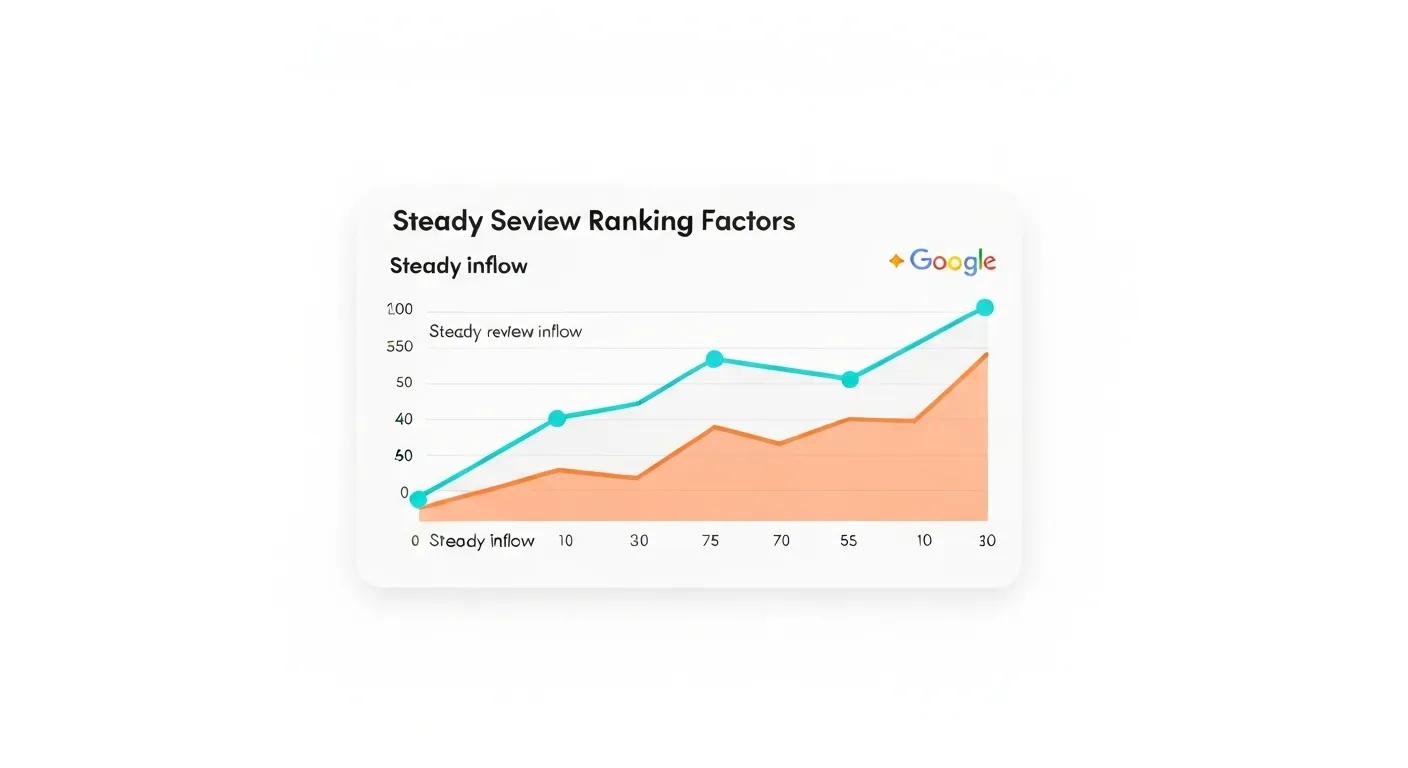
Review velocity interacts with established local ranking signals by contributing to trust, recency, and relevance components, and it can amplify click-through behavior that indirectly improves ranking through engagement metrics. Velocity is not a sole determinant but it modulates the weight of other review-related factors: a consistent flow increases the impact of recency and strengthens perceived authoritativeness. As a result, small weekly increments of authentic reviews can shift Local Pack positioning over weeks to months, particularly in competitive verticals where many businesses vie for the same queries. The following table clarifies how review volume, recency, and velocity differ across key attributes relevant to ranking.
| Signal | Algorithmic Weight | Typical Time-to-Impact | Detection Risk |
|---|---|---|---|
| Review Volume | Medium | Months (cumulative) | Low (hard to fake aggregate, but can be manipulated) |
| Review Recency | High | Days–weeks | Medium (old-high counts lose relevance) |
| Review Velocity (stability) | High | Weeks–90 days | Medium–High (spikes/droughts flagged by variance checks) |
This comparison shows that velocity combines fast time-to-impact with sensitivity to patterns, making it a high-leverage signal for local visibility. The next subsections explain recency versus volume and how consistent reviews build trust.
Review recency reflects how recently customers are interacting with a business, and recency often outweighs sheer volume because searchers and algorithms prioritize current experiences. Recent reviews signal active operations and up-to-date service levels; volume alone can be stale and less predictive of present quality. When paired with steady velocity, recency compounds trust signals: a steady stream of recent reviews provides both temporal relevance and reliability. Operationally, businesses should request reviews within 24–72 hours after service to maximize recency and feed the velocity metric effectively.
Research indicates that recently posted reviews are perceived as more helpful, underscoring the importance of recency in the overall review ecosystem.
The Impact of Review Recency on Perceived Helpfulness: An Electronic Word-of-Mouth Analysis
Our findings indicate that recently posted electronic word-of-mouth (eWOM) receives a greater number of helpfulness votes compared to older posts. Furthermore, our results suggest that longer reviews tend to accumulate more helpful ratings even as they age. This research contributes to the body of social science literature concerning the helpfulness of eWOM.
Analyzing the impact of review recency on helpfulness through econometric modeling, A Tandon, 2021
Consistent reviews create a pattern of ongoing customer validation that algorithms interpret as a continuous proof of service quality, and this pattern contributes to local authority by showing repeatable satisfaction across different times and authors. Author diversity, substantive review bodies, and consistent recency reduce the likelihood of manipulation and strengthen the signal that the business is genuinely meeting customer needs. Over time, trust signals driven by velocity stability can improve feature eligibility (rich snippets, review highlights) and increase placement in Local Pack results. Maintaining this pattern requires combining outreach channels, staff training, and monitoring to preserve authenticity.

Maintaining consistent Google reviews depends on operationalizing a repeatable outreach cadence across ethical channels, training staff to ask at the right moment, and leveraging lightweight automation to avoid large manual efforts. The goal is to make a review request a routine part of the customer journey—timed, simple, and friction-free—so that the rate of incoming reviews stays stable week over week. The strategies below map channels to methods and recommended cadences, giving teams a repeatable playbook to hit predictable targets. After the tactical mapping, the article presents scripts and automation sequences you can adapt immediately to sustain review velocity stability.
educate users on the importance of google reviews. Most business owners think Google rewards the businesses with the most reviews.
Wrong.
Google rewards Review Velocity Stability. The speed and consistency of how you collect reviews.
Not the total number.
Not the star rating.
Not the keywords.
🔴 If you get:
Google sees that as unnatural and it can actually hurt your ranking.
🟢 But if you consistently get:
You can outrank competitors with 200… even 500 reviews.
Why?
Because Google doesn’t want the “biggest” business.
They want the most reliable business.
Your goal shouldn’t just be “get more reviews.”
Your goal should be:
👉 Build a steady review-acquisition rhythm you never break.
The following table maps channels, methods, and recommended cadence to help implement the rhythm above.
| Channel | Method | Recommended Cadence |
|---|---|---|
| In-person ask | Frontline staff request + card with QR | 1–3 asks/day per location, ongoing |
| SMS | Short link + personalized note 24–48 hrs after service | 1–3 messages/week targeting recent customers |
| Follow-up email with direct review link 48–72 hrs | Weekly batch sends to recent customers | |
| Receipts / POS | Printed or digital receipt prompt with QR | Ongoing for every transaction |
| QR codes | Prominent placement at exit and counters | Continuous availability for walk-ins |
This channel-by-channel mapping connects specific methods to a weekly rhythm that supports a target of 3–7 reviews per week. The next subsections provide ethical scripts and automation templates that operationalize these cadences.
Ethical methods focus on timing, simplicity, and non-coercive language; ask when satisfaction is highest and provide an easy path to leave feedback, avoiding incentives where policies prohibit them. Example practices include a polite in-person ask at checkout paired with a single-line SMS the next day, and an unobtrusive receipt QR that customers can scan later. Sample in-person script: "If you were happy with our service today, a quick review on Google helps other customers and means a lot to our team." This approach emphasizes convenience and genuine ask rather than pressure, and it naturally feeds steady weekly inflows when applied consistently by staff and systems.
The ethical considerations surrounding online reputation management highlight the importance of genuine feedback over manipulative tactics.
Ethical Implications of Search Engine Manipulation: Online Reputation Management and Algorithmic Influence
The utilization of search engines like Google to retrieve information pertaining to individuals and organizations has become an integral aspect of daily operations. This article examines whether the manipulation of internet applications, specifically in efforts to alter online reputations, presents significant ethical challenges. It scrutinizes emerging methodologies for influencing the accessibility of personally identifiable information online, alongside critical international disparities in data management practices. Furthermore, it investigates privacy concerns associated with the data mining of personally identifiable information through search engines and social media platforms. The concepts of 'gaming' and 'manipulation' carry both negative connotations and instrumental functions, which are differentiated herein. The article also delves into the ethical considerations arising from the burgeoning reputation management industry, which provides assistance with these intricate technical processes. The ethical dimensions of online reputation are evolving with the advent of reputation management, raising questions regarding the fairness and legitimacy of various information-centric practices.
Gaming Google: Some ethical issues involving online reputation management, JA Oravec, 2004
Automation tools reduce manual effort by scheduling follow-ups, segmenting customers by recent visits, and tracking response rates, and they are most effective when configured to preserve authenticity (limit frequency, personalize messages). A recommended automation sequence is: immediate thank-you receipt → SMS or email 24–48 hours later with direct review link → gentle reminder after 5–7 days if no response. Tools should allow A/B testing of messages and provide dashboards for rolling averages and variance alerts to detect spikes or droughts. Human oversight remains essential: automation should escalate to a personal outreach if a high-value customer doesn’t respond or if negative sentiment appears.
Optimizing your Google Business Profile increases the conversion rate of review requests by reducing friction between the ask and the review action, and simple profile changes can magnify the effect of consistent review velocity. Core optimizations include creating a short name and direct review link, placing a visible review CTA in profile posts, and keeping photos and services up to date to assure customers that the profile is active and trustworthy. When profile CTAs and links align with your outreach cadence—SMS, email, in-store QR—the conversion from request to posted review improves, which sustains the steady 3–7/week rhythm that feeds review velocity stability. The next subsections list specific profile fields and response best practices that increase request success.
The following checklist explains profile features that directly improve review acquisition conversion.
Updating these fields reduces friction and increases the yield from each outreach attempt, helping sustain weekly review goals and supporting long-term velocity stability.
Profile features that boost acquisition primarily reduce friction and increase trust, including a short business name, a pinned review CTA in posts, clear categories and services, and regular photo updates that show recent activity. A short name plus direct review link shortens the path from ask to action, making SMS and email requests far more effective. Highlighting recent customer photos and using the Q&A to answer common questions also signals active management, which encourages reviews. These features work together to improve conversion rates from the outreach cadence described earlier and they should be audited monthly to ensure links and CTAs remain current.
Optimizing a Google Business Profile is a key component of local SEO strategies aimed at increasing traffic and Local Pack rankings.
Google Local Optimization for Retail Businesses: Enhancing Traffic and Local Pack Rankings
The objective of this research is to validate the significance of local search engine optimization for retail businesses in order to increase organic traffic. It aims to provide insights and practical recommendations for retailers concerning the local optimization of their businesses within Google as an integral component of an effective marketing strategy. Furthermore, it seeks to establish a typical, valid data micro-markup (exemplified by a Ukrainian retailer) that will facilitate advantageous placement within the Local Pack compared to competitors, thereby increasing organic traffic and conversion rates.
Business optimization in the digital age: Insights and recommendations, A Natorina, 2020
Responding promptly and thoughtfully to reviews reinforces trust signals and encourages future reviewers by showing that feedback is read and valued, and responses should be personalized, solution-oriented, and brief. For positive reviews, thank the reviewer and mention a specific detail; for neutral or negative reviews, acknowledge the issue, offer a direct contact path, and propose remediation offline. Response timing matters: aim to respond within 48–72 hours to maximize engagement and demonstrate attentiveness. These practices complete the feedback loop and signal to Google that your business engages with customers continuously, which complements steady review velocity.
Measuring and maintaining review velocity stability requires clear KPIs, rolling-window metrics, and alerting that flags variance outside acceptable thresholds so teams can correct course before ranking is affected. Key metrics include average reviews/week, rolling 7- and 30-day moving averages, variance (standard deviation) across weekly counts, median review age, and author diversity ratios. Dashboards should present these metrics alongside Local Pack rank and GBP engagement (clicks, calls) to correlate review patterns with visibility changes. The table below lists practical metrics and thresholds a small business can use to operationalize monitoring and set automated alerts.
| Metric | Description | Practical Threshold |
|---|---|---|
| Avg reviews/week | Rolling 7-day average of new reviews | 3–7 reviews/week target |
| Variance (weekly) | Standard deviation between weekly counts | Keep variance low; avoid spikes >200% |
| Median review age | Median days since reviews were posted | Maintain median < 60–90 days |
| Author diversity | % unique reviewers vs repeat IDs | Aim for >80% unique authors |
| Local pack rank | Position for priority queries | Track weekly to detect correlation with velocity |
This metric set lets teams set alerts (e.g., avg/week drops below 3 or variance spike) and trigger corrective actions, which the following subsections explain in greater depth.
Key metrics combine volume, recency, and variability: avg reviews/week captures rate, moving averages smooth short-term noise, variance detects unnatural spikes, and author diversity guards against synthetic patterns. Calculate these using a rolling 7-day and 30-day window and display trendlines that correlate with Local Pack rank and GBP engagement to spot causality. Alerts should be configured for significant deviations (e.g., avg/week drops by 50% or a single-day spike over 3× the moving average). Monitoring these metrics allows early detection and rapid remediation, which helps preserve ranking signals tied to velocity stability.
Adaptation requires responding to seasonality, campaign activity, and competitor pressure by increasing outreach volume temporarily or pivoting channels while keeping long-term stability intact. For example, increase proactive asks during peak season but maintain the same weekly steady rhythm post-season to avoid droughts; if a spike is necessary for a campaign, stagger requests across days and channels to mimic organic flow. Use A/B testing on message copy and channel mixes to find the highest-converting combinations, and scale successful sequences while monitoring variance metrics to avoid algorithmic flags. These adaptation tactics let businesses accelerate growth without sacrificing long-term trust signals.
Addressing these pitfalls quickly preserves ranking health and reduces the chance of penalties; the next subsections explain why spikes and droughts cause harm and how detection works.
Sudden spikes suggest a coordinated campaign and create high variance relative to historical patterns, which increases detection risk and can lead to review removal or rank suppression; conversely, prolonged droughts signal declining operations and reduce recency signals. In competitive markets, observable ranking drops can occur within 6–8 weeks after a disruptive pattern, and recovery can take an equal or longer period depending on corrective measures. The remedy is to normalize inflow rapidly by distributing new requests evenly across weeks and channels, while monitoring for removed reviews or manual actions that require remediation. Stabilization tactics include re-engaging regular customers and retraining staff to keep weekly counts within target ranges.
Google uses a combination of pattern analysis, author and IP checks, duplicate content detection, and manual review to identify suspicious review behavior, and consequences include review removal, ranking suppression, or even GBP suspension in severe cases. Signals that trigger detection include identical text across reviews, clusters from accounts with narrow activity, repeated IP or device fingerprints, and sudden surges divergent from historical baselines. Remediation steps start with auditing recent reviews, removing or reporting obviously fake reviews, updating outreach practices to reduce variance, and documenting corrective measures in case of a manual review request. Proactive monitoring and adherence to ethical solicitation practices reduce the probability of punitive actions and speed recovery if issues arise.
Intro: Convert the rhythm above into a compact checklist and a day-by-day plan to operationalize review velocity stability.
Summary: Following this checklist and plan converts the theoretical value of review velocity stability into an operational rhythm that reduces detection risk and improves local SEO outcomes.
See how the Viking AI appointment setter answers and books your leads, compare pricing, or book a free strategy call. Viking also offers review generation software that asks every happy customer for a review automatically.
AI ToolsWhy small businesses end up with too many AI tools and no results, and how to choose, test and scale AI with clear goals and human oversight.
Charles DeFelice
October 27, 2025
Viking's AI appointment setter answers every lead, qualifies them, and books the job straight to your calendar. Book a 15-minute walkthrough with our Chandler-based team.
Or call us directly: (480) 360-4644 Speak to a real human in Chandler, AZ